Choosing midi skirts: waistband, lining, movement and footwear
Midi describes a broad length range, not a guaranteed proportion. Fit the waist and hip, then test the hem through walking, stairs and real shoes.
In this guide
Choose the hem position only after the top block works
Measure the intended waistband position and garment length, then test hip release, lining, opacity and stride with the footwear and outer layer already owned. A midi earns its place when the hem stays clear, the waist remains stable and the fabric returns to shape after sitting.
A midi skirt can finish below the knee, at mid-calf or near the ankle depending on wearer and product. Model height does not locate the hem on another body. The decision needs waist-to-hem measurement, silhouette, cloth, lining and the movement demanded by the day.
Map measurements to silhouette
| Area | What to record | Why it matters |
|---|---|---|
| Waist | Body position and garment circumference | Controls stability and final hem height. |
| Hip | Body and garment at the same level | Determines release, pocket strain and ride-up. |
| Waist-to-hem | Front, side or product method | Locates the midi endpoint on the wearer. |
| Sweep | Hem circumference or panel width | Limits stride and fabric volume. |
| Slit | Height and overlap | Affects movement and coverage. |
| Lining | Length, width and fibre | Can support opacity or restrict the outer skirt. |
Set the waistband position
Decide whether the skirt should sit at the natural waist or lower on the torso, then measure there over the intended base layer. A high elastic waist may feel comfortable standing but roll while sitting; a low waist can drop and change the hem position.
Compare a trusted skirt laid flat and identify whether the band is straight, curved, elasticated or faced. Check that zip, hook and button close without pulling. Our clothing chart guide explains why the label alone cannot solve the fit.
Fit hip and seat before judging drape
A straight or bias skirt needs enough hip ease to remain vertical rather than climbing. An A-line skirt should release from a stable top block without diagonal pulling. Pleats should hang closed at rest unless designed to open, and pockets should lie flat.
Sit for several minutes, then stand without pulling the skirt down. Persistent ride-up, twisting or horizontal strain shows a cut or size problem. Stretch can support movement, but it should recover rather than leave a widened seat.
Choose shape by movement
- A-line: offers progressive ease and can work across walking and sitting.
- Pencil: needs sufficient sweep or a secure slit for stride.
- Pleated: adds moving volume and demands stable pleat setting and care.
- Bias cut: drapes closely and may grow or twist when hung.
- Tiered: adds seam weight and volume that can overwhelm small spaces.
- Wrap: needs dependable overlap through wind, sitting and stairs.
Walk at normal pace, take a long step and climb stairs. Check whether the skirt catches knees, exposes more than intended or tangles around boots. A decorative slit should be reinforced at its top and remain within the wearer’s coverage brief.
Place the hem with real footwear
Stand in the lowest and highest shoes that will be worn. Mark the product length on the body from the intended waistband point. A hem ending at the widest calf may create a different visual line than one slightly above or below; this is preference, not a universal rule.
Practical clearance matters more than the label. Long midi hems should stay away from the ground, bicycle parts and escalator edges. Boots can grip lining or create static; trainers change the break and formality. Test rather than buying a new shoe to rescue the skirt.
Inspect lining as a separate garment
The lining should provide opacity and smooth movement without being narrower than the stride. Sit and raise a knee to check whether it pulls the outer cloth upward. It should be secured at suitable points without twisting and finish high enough not to show during walking.
Partial lining can solve hip opacity while leaving a sheer lower section by design. Check the effect in daylight and backlight. Fibre and care can differ from the outer cloth, so read both. Use the fabric guide.
Check opacity, static and surface behaviour
Hold the skirt against light and wear the intended underwear. Printed cloth can appear opaque while stretching makes areas more transparent. Static depends on layers, humidity and fibres; one anti-static treatment is not a permanent quality guarantee.
Rub a concealed area as permitted to observe snagging and lint. Satin-like shine can reveal pulls; brushed surfaces can collect fibres. A surface that needs constant correction may be unsuitable for crowded commuting or pets.
Inspect construction and pattern balance
Check waistband attachment, darts, zip base, pocket corners, slit reinforcement and hem. Side seams should hang without rotating. On checks or directional prints, decide whether matching at front and major seams supports the price claim.
Bias garments may have intentionally different seam behaviour but should still hang consistently after settling. Use the clothing-quality checklist rather than treating a premium fibre as sufficient evidence.
Price alterations before removing tags
Shortening a plain A-line hem may be straightforward; altering pleats, bias, tiers, curved hems, lace or deep facings can be costly. Shortening changes the skirt’s sweep and print placement. Waist adjustment can disturb pockets, zip and side seams.
Pin the proposed length, walk and quote it before the return deadline. Include alteration and cleaning in the cost-per-wear framework. A sale price does not compensate for a silhouette lost in alteration.
Build three outfits across weather
Try one tucked top, one untucked knit and the coat or jacket already owned. Check waistband bulk, static and whether the outer layer catches the skirt. Add tights if they are part of winter use; their surface can change drape and cling.
Photograph the outfits privately at normal stance and connect the result to the capsule-wardrobe guide. A skirt that requires several new tops has not filled one simple gap.
Care can change pleats and drape
Follow the sewn label for washing, drying, ironing and professional care. Heat can flatten synthetic pleats or mark shine; hanging can lengthen some bias cloths. Heavy knit skirts may stretch from a hanger and need folding.
Store zips closed where instructed, remove heavy pocket contents and let moisture dry. Use our care-label explainer before assuming every polyester or wool blend behaves alike.
Evaluate an online listing without relying on model styling
Record the model height only as context and prioritise garment measurements, waistband construction, lining length and fabric composition. Look for front, back and side views that show seam placement, slit overlap and how pleats or bias panels hang. If the retailer omits garment length or the point from which it is measured, ask before ordering rather than converting a body-size chart into an assumed hem position.
Compare the returns route with the planned home fit check. Keep labels attached while testing sitting, stairs, a long stride and the intended shoes on a clean floor. Photograph any defect or mismatch promptly without altering the garment. A styling image can suggest an outfit, but it cannot demonstrate opacity, recovery or the fit of the lining on another wearer.
Check seated comfort and all-day recovery
Sit in the skirt for ten minutes with the normal top layer, then stand and observe whether the waistband folds, the zip buckles or the seat remains stretched. Put ordinary items in usable pockets and check whether their weight distorts the side seam. For a wrap, repeat the movement in front of a mirror from the side to assess overlap without relying on a still front view.
Allow fluid or bias-cut fabric to settle on a suitable hanger if the care instructions permit, then recheck the hem before alteration. Pleated and tiered shapes should return to an orderly line after movement rather than needing constant hand adjustment. The aim is not a perfectly static silhouette, but predictable movement that fits the wearer’s day.
Which midi silhouette is appropriate?
Stable shape and easy movement matter
The waist and hip release cleanly, the hem clears footwear and the cloth holds its line.
Soft drape is the intended benefit
The fabric remains opaque, recovers after sitting and the wearer accepts its care and surface sensitivity.
Balanced verdict
The right midi skirt stays secure at the intended waist, releases over the hip and moves through a full stride without riding or dragging. Choose the hem with real shoes, assess lining separately and quote any alteration before keeping it.
Review UK returns, test offers with the discount guide, and browse Fashion guidance or the shop directory.
Check current official sources:
GOV.UK textile labelling ↗GOV.UK product labelling ↗GOV.UK returns and refunds ↗
Frequently asked questions
Where should a midi skirt finish?
There is no universal point. Measure the intended waistband-to-hem length and test it with real footwear and movement.
Why does a midi skirt ride up?
Insufficient hip ease, fabric friction, lining, cut and stretch recovery can all contribute.
Can a pleated midi be shortened?
Sometimes, but hem treatment and pleat geometry can make the alteration complex. Obtain a quote first.
Should a midi skirt be lined?
Not always. Judge opacity, comfort and movement; a poor narrow lining can make fit worse.
Can I wear ankle boots with a midi?
Yes when the hem, boot shaft and stride work together without catching or unwanted bunching.
Methodology and limitations
We assessed midi skirts through waist, hip, length, shape, lining, movement, footwear, construction, alteration and care. Official UK textile and returns guidance was checked on 29 August 2026. No named skirt was wear-tested.
Limitations
Fit and styling are individual, and fabrics vary. Recheck the exact chart, garment, care and return route.
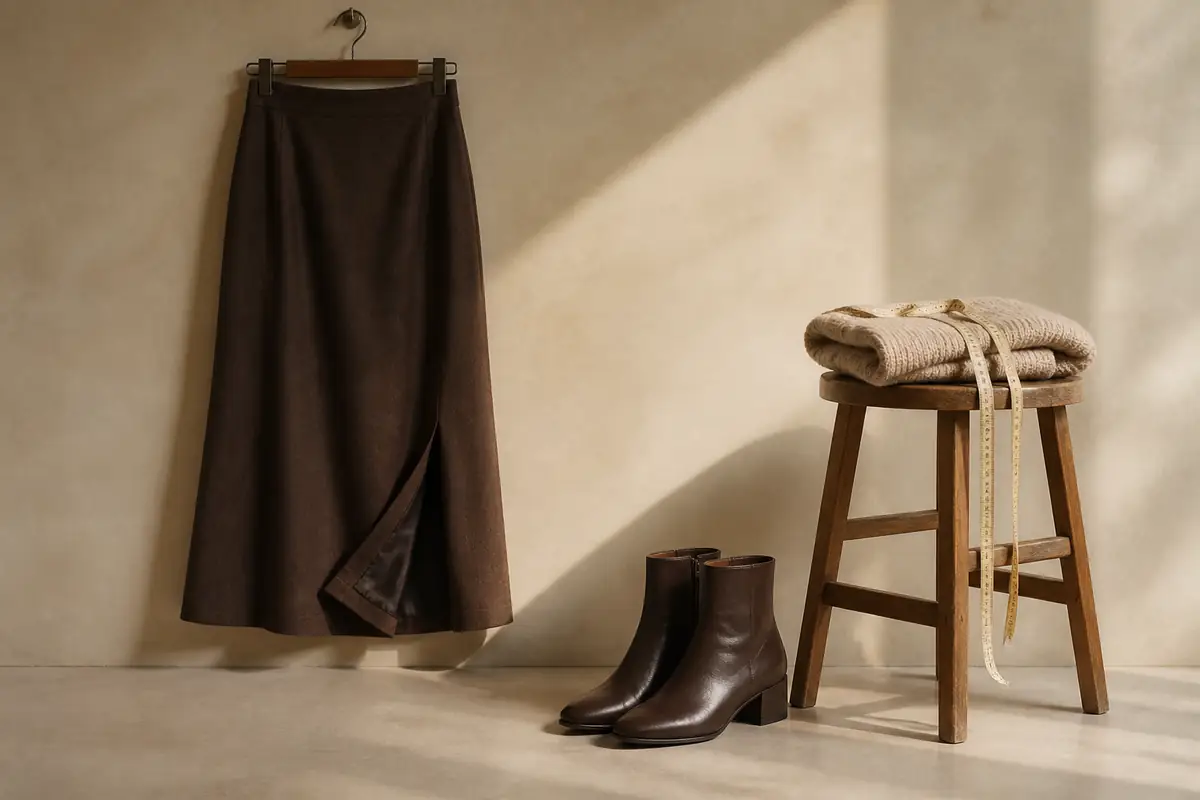
The image is an editorial illustration, not a photograph from a product test. Links are editorial and non-affiliate.