Meaco Arete Two 12L vs 20L UK: compare the same conditions
The headline litres do not describe every room: compare the same air conditions, tank-emptying routine and complete purchase before choosing capacity.
In this guide
The capacity label is not a room-output promise
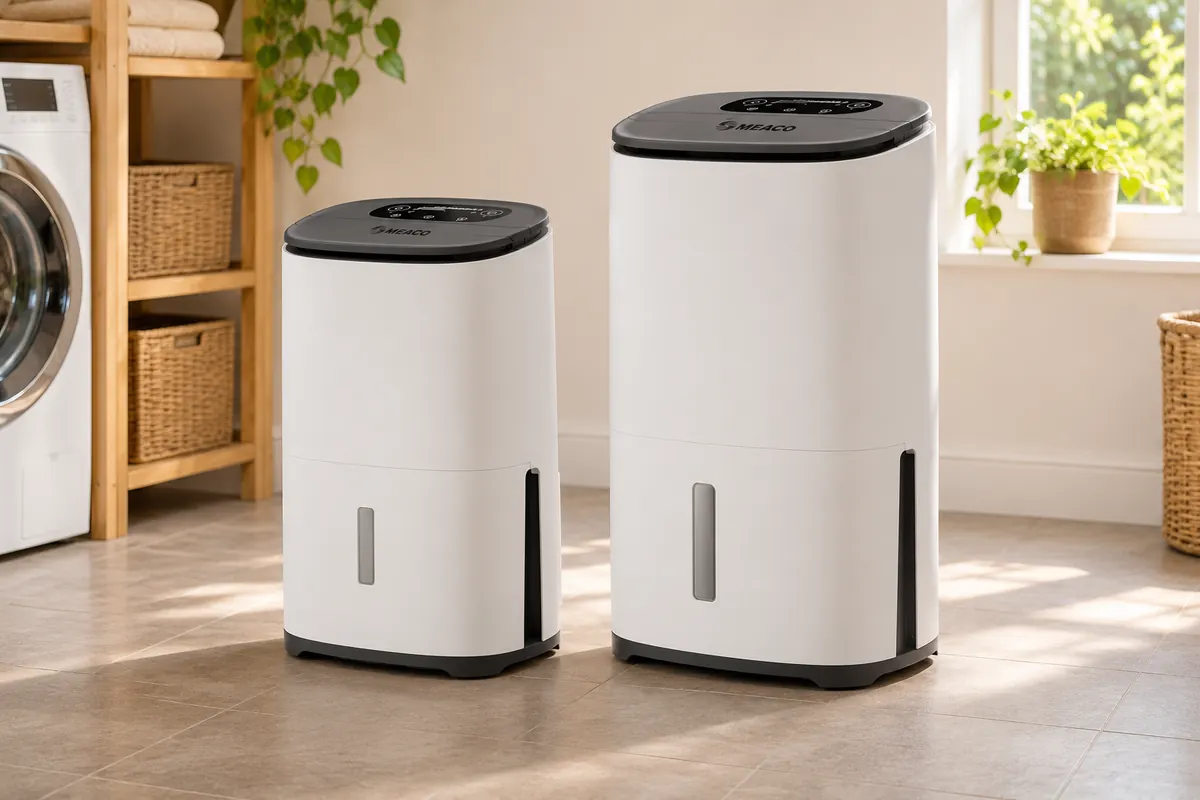
The Arete Two 20L offers higher published extraction than the 12L at the same temperature and humidity, together with a larger water tank. The 12L costs less and occupies a smaller space. Choose around the moisture load, operating conditions, emptying routine and actual available location, rather than assuming that the headline litres describe an ordinary winter day.
We compare MeacoDry Arete Two 12L and 20L using Meaco’s current UK product tables and the manuals linked from those pages. Arete One, the 10L and 25L versions, and the separate Low Energy range are outside this comparison. If you have not yet defined the household requirement, begin with our UK dehumidifier sizing guide before narrowing it to this pair.
Matched extraction figures for the two models
| Test condition | Arete Two 12L | Arete Two 20L | What the comparison establishes |
|---|---|---|---|
| 10°C, 60% relative humidity | 1.97 litres/day; 111 W | 3.35 litres/day; 176 W | Published performance at the same cooler condition |
| 20°C, 60% relative humidity | 5.40 litres/day; 136 W | 8.50 litres/day; 207 W | A matched warmer condition, not guaranteed household output |
| 30°C, 80% relative humidity | 11.99 litres/day; 182 W | 20.45 litres/day; 271 W | The much warmer, more humid condition behind the nominal capacity class |
Do not compare the smaller machine at one condition with the larger machine at another. The difference between 1.97 and 11.99 litres for the 12L demonstrates why the room conditions matter. It does not mean the appliance is defective if a domestic tank collects less than twelve litres in a day.
The figures are manufacturer-published laboratory data. We have not placed the two machines in an identical house or independently measured extraction. A real room changes as moisture is removed, doors open, heating cycles and new moisture enters. The humidistat can also stop the compressor once its control conditions are met.
A larger tank solves another problem
The linked manuals give a 2.5-litre tank for the 12L and a 4.8-litre tank for the 20L. Tank volume and daily extraction are different specifications. The tank determines how much water can be held between emptying stops; it does not tell you how rapidly the appliance removes it.
A larger tank may be useful when the location is inconvenient to revisit, but a filled container also has to be handled and carried. Consider the route to a suitable drain and whether you can remove and refit the tank comfortably. This is a practical ownership decision rather than a reason to buy the biggest machine automatically.
If continuous drainage is required, follow the precise instructions for the selected version, hose and outlet arrangement. A hose option is not permission to improvise a pump or let a drain line run wherever it is convenient. Our dehumidifier filter, tank and drainage guide separates the maintenance and drainage tasks that need checking.
Published dimensions need a version check
There is a source inconsistency worth flagging before a tight-clearance purchase. The current 12L product specification lists 495 × 315 × 235 mm and 11.3 kg; its linked 10L/12L manual lists the 12L at 492 × 319 × 237 mm and 10.9 kg. The 20L page lists 620 × 365 × 270 mm and 15.4 kg, while its linked 20L/25L manual gives the 20L as 618 × 366 × 272 mm and 15.1 kg.
We cannot determine from those documents whether every difference reflects a revision, a measurement convention or an outdated file. If a few millimetres or the lifting weight determine suitability, ask Meaco to confirm the exact supplied version and current instructions. Do not average the figures or select whichever makes a cupboard appear to fit.
The appliance also needs its instructed operating clearance and access for the tank and filter. An external dimension is not a recommended enclosure size. The broader dehumidifier buying guide explains the specification questions to resolve before treating a room-size recommendation as a complete installation plan.
Calculate energy from a stated assumption
Meaco’s product pages display hourly cost examples tied to an electricity price of 26.32p per kWh. Your own unit rate may differ, so copy the calculation method rather than a cost headline. Use the same condition when comparing the published wattage of these two models.
Illustrative running-cost calculation
At an assumed 25p per kWh, 136 W corresponds to 0.136 kWh for one continuous hour, costing 3.4p. At the same assumed tariff, 207 W costs about 5.18p for one continuous hour. These use the manufacturer’s 20°C/60% figures; they are arithmetic examples, not metered bills or a prediction of compressor duty cycle.
The cheaper hour is not automatically the cheaper completed moisture-removal task. The 20L also has higher published extraction at that condition. Equally, dividing nominal litres by input watts does not tell you what either appliance will cost in a room that changes throughout the day. Record both the conditions and the task before making an efficiency claim.
Our UK appliance running-cost explanation helps distinguish watts, energy and the electricity unit rate. For this pair, useful ownership evidence would include actual energy use alongside room conditions and the moisture-control result, rather than one isolated power reading.
Laundry and noise require a real-use brief
Both pages promote laundry drying, but there is no drying-time experiment in this article. The amount and type of washing, how it is spaced, room temperature, airflow and other moisture sources all affect the task. A larger extraction class cannot establish a fixed number of minutes saved on your own load.
Check the laundry-mode instructions, suitable placement and the route around the airer. Clothes must not obstruct the appliance or put dripping water near electrical parts. The guide to laundry modes and running-cost comparisons develops that use case without turning a mode name into an independently verified saving.
The manufacturer advertises noise starting from 35 dB for the 12L and 38 dB for the 20L. Those minimum figures are not a complete ranking of every fan setting in your room. The manuals list different values by speed, and a location near a sleeping person needs more thought than comparing only the smallest number.
Stock status and the extra purchase cost
At the dated UK check, the 12L page displayed £199.99 and an out-of-stock notice with a November 2026 expected-return message. The 20L displayed £299.99 and an add-to-basket option. That is a £100 displayed purchase difference before your final order checks, not a guarantee that the smaller model will return by a particular day.
Do not buy the larger machine solely because it is the available button if its size or operating brief is unsuitable. Conversely, waiting for the 12L should be weighed against a real need and a confirmed supply estimate. We placed no order and reserved no stock.
Include compatible filters, drainage accessories and the maintenance routine in the longer-term comparison. The dehumidifier value guide provides the broader cost framework; the appliance repairability and spare-parts guide helps identify what to ask about service after purchase.
Which Arete Two size is the better candidate?
Investigate the 12L for the smaller brief
Its matched extraction figures address your requirement, the tank-emptying routine is practical and the lower purchase price matters. Resolve current availability and any critical dimension discrepancy before ordering.
Investigate the 20L for greater removal capacity
The higher published extraction and larger tank serve a defined workload, and the bigger unit fits the operating space. Compare the extra purchase and energy cost with that actual requirement.
Our conclusion favours a condition-matched choice, with the source discrepancy kept visible. Neither bedroom counts nor headline litres are enough on their own. An appliance comparison also cannot identify or resolve the underlying cause of persistent moisture in a building; investigate the source when the problem continues.
Meaco UK specifications and linked manuals
Arete Two 12L UK product, stock notice and water-removal tableArete Two 20L UK product and condition-matched performance dataUK 10L/12L manual, including the separate 12L specification columnUK 20L/25L manual and model-specific technical table
Arete Two capacity questions
Will the 12L collect twelve litres every day?
The nominal class relates to warm, humid test conditions. Meaco publishes much lower figures at cooler temperatures and lower relative humidity.
Does a bigger tank mean faster extraction?
Tank capacity controls the water held before emptying. Compare the condition-matched extraction tables for removal performance.
Which dimensions should I trust for a tight space?
The current pages and linked manuals disagree slightly. Ask Meaco to confirm the exact supplied revision and required operating clearances.
Is the 20L always cheaper for drying laundry?
No matched laundry-cost test was performed here. A completed-task comparison needs load, room conditions, operating time and energy measurements.
Was the 12L available when you checked?
The UK page showed an out-of-stock notice on 22 November 2026. Its expected-return wording is not a reserved delivery commitment.
How the Meaco capacity evidence was read
We read the UK product tables and visually checked the technical pages in both linked manuals on 22 November 2026. Values were compared within the correct model columns and identical air conditions. The energy example uses an explicitly assumed tariff.
Limits of this document comparison
We have no independent extraction, acoustics, energy, laundry-time or long-term reliability measurements. Product-page and manual dimensions remain unresolved; postcode fulfilment, supplied revision and household suitability require separate confirmation.