Leather Grades Explained: Full-Grain, Top-Grain, “Genuine” and Bonded
Learn what full-grain, top-grain, split and bonded leather describe. “Genuine leather” alone does not establish quality or predict durability.
In this guide
The useful question is how the whole item is made. “Genuine leather” alone cannot establish quality. Compare the material, finish, stitching, hardware, care requirements and repair options before paying more.
A leather label can describe the part of a hide, the treatment of its surface or a composite containing leather fibres. Those are different pieces of information. They do not form a universal league table in which one word guarantees a durable shoe, bag or sofa.
What the main terms tell you
| Term | What to establish | Question for the seller |
|---|---|---|
| Full-grain | The original grain surface has not been mechanically corrected | What finish, thickness and construction does the item use? |
| Corrected grain | The grain has been partly removed and the surface finished | How should this finish be cleaned and maintained? |
| Split leather | A layer below the grain split | Which component uses it, and how is its surface finished? |
| Coated leather | Leather with a substantial surface coating | What coating is used, and what care does it require? |
| Bonded material | A composite containing leather fibres | What is the complete composition, including backing and binder? |
| “Genuine leather” | The claim alone does not identify a quality grade | Can you provide the more precise material specification? |
The Leather Working Group glossary provides industry definitions. A “top-grain” description still needs detail about surface correction and finish. Suede describes a napped surface; do not assume every suede product has the same construction or care needs.
Check which parts are leather
A bag can use different materials for its outer panels, straps, trim and lining. Footwear can have different uppers, linings and soles. On furniture, the material used on a seat may differ from that on its back or side panels. Ask where the claim applies, particularly at the points you touch or that carry weight.
The ASA’s guidance on leather furniture claims illustrates why the scope of a description matters. Its furniture examples should not be treated as a grading system for every leather product.
Judge construction alongside material
Follow the load through the item. On a bag, inspect strap anchors, handles, zip ends and the base. On shoes, check sole attachment, heel seating and the lining around the heel. Look for secure joins, consistent stitching and hardware that can be operated without forcing it.
Consider how a likely repair would work. A replaceable strap is useful only if a suitable replacement is available. A shoe described as resoleable still needs a sound upper and a repairer who can work with its construction. Ask about parts and service before assuming a premium purchase will be economical to maintain. Our online product-quality checklist helps organise these questions.
What photographs can and cannot show
Request close photographs of seams, edges, backing, fastenings and worn or folded areas. A single styled photograph often hides the parts that matter most. Compare the photographs with the written material description and ask the seller to explain a mismatch.
A grain pattern or cut edge is a clue, not a reliable authentication test on its own. Finishes, embossing, lighting and image processing can change what you see. Do not scratch, burn, wet or dismantle an item to identify its material. Those tests can damage it and make a return harder.
Choose a finish you can maintain
Read the care instructions before buying. Establish whether the maker permits a conditioner, protective spray or particular cleaner, and whether colour transfer or water marking needs special care. A treatment suitable for one smooth leather may be unsuitable for suede or a coated finish.
Tanning and finishing are separate parts of production. A vegetable-tanned or chrome-tanned description does not, by itself, tell you the final softness, water resistance or lifespan. Ask about the finished product’s intended use rather than assuming one tanning method always wins.
Compare alternative materials fairly
For a product marketed as “vegan leather” or “plant-based leather”, ask for the actual composition. Identify the surface, backing, binder and the part covered by any plant-content percentage. Then compare the same practical matters: handling, cleaning, flexing, repair and expected use.
Do not infer an environmental advantage from a material name alone. A useful claim explains what was measured and which parts of the product or lifecycle it covers. Our guide to sustainable fashion claims explains how to read those qualifications.
Calculate value with realistic use
Use a cost estimate to test your assumptions, not to justify the most expensive option. For example, a hypothetical £120 bag used 300 times costs 40p per use before maintenance. A £60 bag used 200 times costs 30p per use. These are arithmetic examples, not predicted lifespans or evidence that either material will last that long.
Add care and repair costs and use a realistic number of outings. If the more expensive bag is uncomfortable or unsuitable for your routine, its material description cannot rescue the calculation. The cost-per-use method provides a broader comparison.
Before you order
- Confirm the material used in each important component.
- Ask what the finish requires in everyday care.
- Inspect seams, fastenings and load-bearing joins.
- Check dimensions, weight and fit for your actual use.
- Find a realistic repair or replacement route.
- Save the listing and current return terms.
Choose the item when its complete specification and practical use justify the price. If a seller relies on a broad leather claim but cannot answer basic construction or care questions, compare another product.
For footwear, combine the leather description with fit, sole construction and repair options using our How to choose leather boots: uppers, soles, fit and care.
Frequently asked questions
Is “genuine leather” good or bad?
The phrase alone does not tell you. Ask for the specific material, finish and construction of the item.
Is full-grain always the best choice?
It cannot guarantee the best finished product. Suitability, construction, comfort, care and repair access still matter.
Can I identify leather quality from a photograph?
Photographs help you inspect visible details, but they cannot establish composition, authenticity or durability by themselves. Combine them with a precise written specification.
Should every leather item be conditioned?
Follow the maker’s instructions for that finish. Do not assume a treatment intended for one material is suitable for another.
Sources and scope
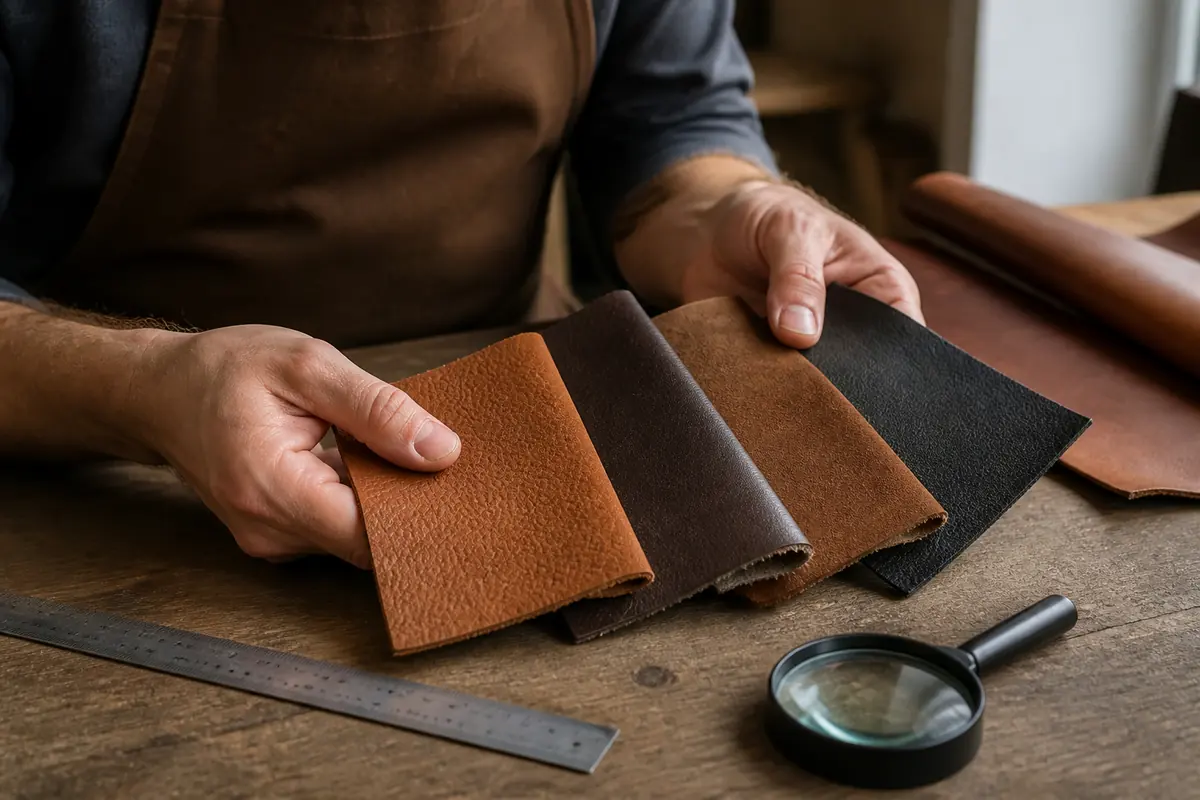
This guide uses the industry definitions and advertising guidance linked above, alongside a practical inspection and cost-comparison method. We have not handled or durability-tested the products you may be considering. No universal lifespan or material ranking is claimed. The featured image is an editorial illustration.