Kitchen bins buying guide: choose capacity, lid and recycling layout
The best kitchen bin fits the room, the council’s collection system and the household’s real waste rhythm. Capacity printed on the box matters less than usable opening, liner fit, cleaning access and whether the lid can operate in its intended position.
In this guide
Measure the operating space and one normal week of waste
Choose the smallest layout that comfortably holds each waste stream between sensible emptying days. Allow clearance for the lid, doorway and walkway, confirm replacement liners, and prefer removable smooth-sided buckets over decorative complexity that is difficult to clean.
A bin is a small storage system with unusually demanding hygiene and access requirements. This guide separates capacity, segregation, mechanism and maintenance so a good-looking model does not create daily friction. For broader room planning, use the small-kitchen buying guide.
Start with the household’s collection pattern
Before measuring products, list what the local authority collects separately, which containers it supplies and how frequently each stream leaves the home. Food waste, dry mixed recycling, glass and residual rubbish may follow different schedules. A multi-compartment bin is only helpful when its compartments correspond to that routine; otherwise it can waste volume and force unnecessary sorting later.
Observe one representative week rather than estimating from bag size. Note which stream fills first, whether bulky packaging can be flattened, and whether food waste is emptied daily. A household that cooks from fresh ingredients may need a small frequently emptied food caddy and modest residual section. One receiving regular parcels may need more temporary recycling space elsewhere.
Capacity labels do not describe usable capacity
| Decision | What to measure | Common mistake |
|---|---|---|
| Total size | Normal waste volume between emptying days | Buying the largest litre figure available |
| Compartments | Capacity of each section, not just total | Assuming an equal split suits every stream |
| Opening | Clear width with lid fully open | Ignoring plates, cartons and dustpan access |
| Footprint | Widest and deepest operating dimensions | Measuring only the cabinet or body |
| Height | Body plus lid, pedal or drawer travel | Placing a lift lid beneath a worktop |
A tall narrow body can advertise generous litres while accepting a liner poorly or leaving a constricted opening. A rectangular footprint often uses wall space efficiently, while a round bin may be easier to walk around but creates dead space against a cabinet. Use the product’s external dimensions and opening diagram, then mark them on the floor with removable tape.
Choose the mechanism around hands, clearance and noise
Pedal lids allow hands-free opening, but the pedal projects and the lid needs vertical clearance. Test whether the foot position feels stable and whether the hinge closes in a controlled way. A light bin that moves backwards at every press needs wall protection or a non-slip base.
Touch lids can work in tight footprints but put frequent contact on the mechanism. Swing lids accept quick deposits yet expose more of the opening and may be awkward with a full bag. Open recycling tubs remove mechanisms altogether, which can suit clean dry materials in a ventilated utility space but not odorous food waste.
Sensor lids add batteries, electronics and a motor to a simple task. They can help accessibility when the sensing area and opening delay suit the user, but they also create another failure mode. Check manual override, battery access and whether the lid can be cleaned without wetting controls. Do not buy automation simply because it looks premium.
Compartment layouts: integrated or separate?
The streams fill at similar rates
You have enough operating space, each internal bucket is removable and the exact split matches local collection.
The streams have different rhythms
Food leaves daily, recycling accumulates elsewhere, or one shared body would sacrifice useful capacity and cleaning access.
Integrated systems create a tidier single footprint, but one full compartment can encourage premature emptying of the others. Separate containers can be positioned near the task that generates the material: a caddy near food preparation, dry recycling near the back door and residual waste at the main work zone. The correct layout reduces carrying and sorting rather than merely hiding containers.
Liners are part of the running cost
Check the internal bucket’s width, depth and rim rather than relying only on litres. Proprietary liners may fit neatly but can lock the household into a specific supply and price. Standard liners can work when their dimensions and strength match, although excess material around the rim may interfere with the lid.
- Confirm availability: identify at least one replacement liner before purchase.
- Allow removal space: a full bag must lift out without catching a hinge or cabinet.
- Avoid overfilling: compression can split bags and soil the bucket.
- Keep food waste small: frequent emptying usually controls odour better than extra capacity.
- Test the retainer: liner rings should hold material without sharp edges.
If local collections require particular compostable food-waste liners, confirm the authority’s current instructions rather than treating similar-looking bags as interchangeable. Our product-specification guide helps separate a documented compatibility requirement from a vague product claim, while local collection rules still decide where material goes.
Materials and finishes change the cleaning workload
Powder-coated steel can feel substantial but may chip when struck. Stainless steel resists many marks yet shows fingerprints unless the finish disguises them. Plastic is lighter and does not rust, though thin bodies and hinges can flex. The internal bucket matters most: smooth rounded corners and a handle are usually easier to wash than ribs, narrow channels and exposed fixings.
Look for a removable lid assembly or clear access beneath the hinge, where splashes and dust collect. Check care instructions before using disinfectants or abrasive pads. A fingerprint-resistant claim describes appearance, not antimicrobial performance. Routine emptying, hand hygiene and physical cleaning remain necessary.
Placement decides whether the bin remains usable
Keep the bin out of the main passage and away from heat sources. Leave room to remove the bucket and full bag. If it sits beside a wall or cabinet, check whether the lid, handle or pedal will strike the surface. For an under-sink system, measure around plumbing, filters and door hinges, not just the empty cabinet shell.
Households with children or pets may need a more secure lid, but a lock that is awkward for adults can discourage sorting. Consider stability and pinch points as well as access. For other dimension-sensitive purchases, the measuring-before-buying guide uses the same operating-clearance principle.
How to compare value without being distracted by features
Calculate the delivered cost of the bin, any required liners and likely replacement parts. A robust simple pedal model with replaceable components can provide better value than a sensor model that cannot be repaired. Warranty length is useful only when exclusions, proof requirements and the practical claim route are clear.
Read lower-rated reviews for repeated mechanical patterns, but separate misuse from design. Several reports of the same hinge fracture or liner snag are more informative than isolated preferences about colour. Our review-evidence guide explains that pattern-based approach.
A ten-minute pre-purchase test
- List the locally collected waste streams and emptying frequency.
- Measure a normal week’s approximate volume by stream.
- Mark body, lid and pedal clearance in the intended position.
- Confirm each compartment’s capacity and removable-bucket access.
- Find compatible liners and note their ongoing cost.
- Check material care, spare parts, warranty and return terms.
- Compare the final delivered total, not the headline discount.
Keep the product dimensions and order record until the bin has been tested in position. Test the lid several times, remove each bucket and simulate lifting a full liner without forcing the hinge. If buying online, review the retailer returns-policy checklist before removing protective materials.
Balanced verdict
A well-chosen kitchen bin disappears into the routine because its compartments, opening and cleaning access match the household. Buy capacity from observed volume, not aspiration; treat liners and clearance as part of the specification; and prefer a mechanism simple enough to maintain. A larger or more automated model is not an upgrade when it blocks a walkway, mixes the wrong streams or becomes unpleasant to clean.
Recheck the layout after one week of use while the return window remains open. If one stream repeatedly overflows, first test a different emptying location or flattening routine before assuming the whole system is too small. The most useful bin is the one the household can sort correctly without creating an obstacle.
Continue with the Home & Kitchen archive or apply the same clearance discipline in our hallway storage measuring guide.
Official guidance:
GOV.UK: local recycling collections ↗Recycle Now: how to recycle ↗Food Standards Agency: food waste ↗
Frequently asked questions
What size kitchen bin is best for a family?
There is no universal litre figure. Measure the household’s waste by stream between realistic emptying days and choose the smallest comfortable capacity.
Is a dual-compartment bin worth it?
Yes when two streams fill at similar rates and the split matches local collection; separate containers are better when their rhythms differ.
Are sensor bins more hygienic?
Hands-free opening can reduce contact with the lid, but the bin still needs routine cleaning and the sensor adds batteries and mechanical complexity.
Can any liner fit a kitchen bin?
Nominal litres are not enough. Match liner width, length, rim and strength to the internal bucket and retainer.
Should a food-waste caddy be large?
Usually not. A smaller caddy emptied frequently can control odour and cleaning burden better than storing food waste for longer.
Methodology and limitations
We evaluated capacity, geometry, mechanisms, liners, cleaning, recycling separation, placement and lifetime cost against official UK waste guidance.
Limitations
Local collections, product dimensions, liner availability and warranties vary. Confirm council instructions and the exact product specification before purchase.
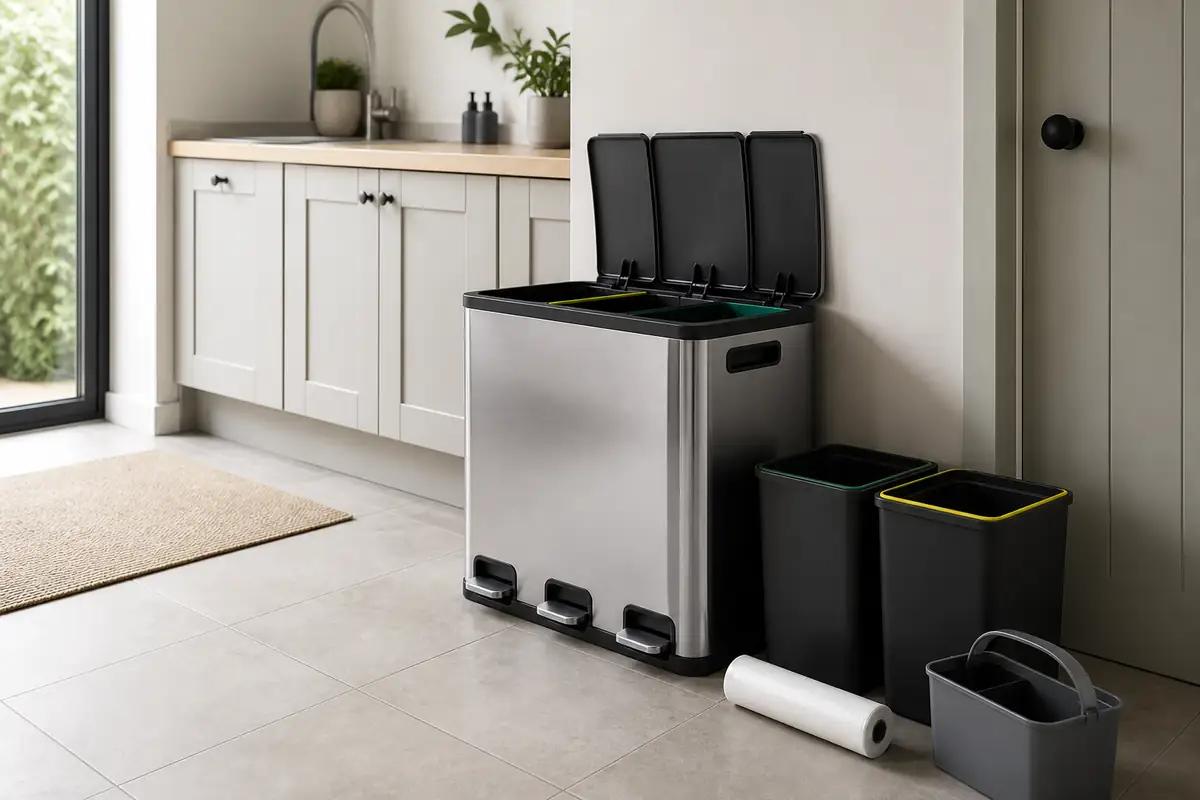
The image is an editorial illustration, not a photograph from a product test. Links are editorial and non-affiliate.