Vacuum cleaner filtration: bags, filters, maintenance and allergy claims
A high-grade filter matters only if air passes through it, seals remain intact and the machine is emptied and maintained correctly. Compare the complete dust path, replacement schedule, availability and evidence behind any allergy wording.
In this guide
Judge containment as a complete system
Look beyond “HEPA” on the filter. Check intake pickup, bag or bin closure, pre-motor and exhaust stages, body seals, emptying exposure and the exact test supporting the claim. Price genuine consumables over several years and confirm that filters, bags and seals remain obtainable.
This guide compares domestic dry vacuum filtration and dust containment. It does not diagnose or treat allergy, asthma or another condition, and no vacuum makes a home allergen-free. People with symptoms or specialist cleaning needs should follow individual clinical and manufacturer advice.
Define the cleaning problem first
List floor types, stairs, pets, fine dust, storage, noise constraints and who will empty the machine. A sealed bag can reduce direct contact during disposal, while a washable bin avoids bags but may expose the user to dust when opened. Weight, head design and pickup performance still matter: filtration cannot capture debris the cleaner never lifts.
Separate routine soil from building dust, ash, liquids or hazardous material. A domestic dry vacuum may be unsuitable for those tasks and can be damaged or create risk. Read the manual before use; our pre-purchase manual guide shows how to find exclusions and maintenance demands before ordering.
| Feature | Potential advantage | Trade-off | Evidence to request |
|---|---|---|---|
| Self-sealing bag | Contained disposal and clean chamber | Recurring cost and compatibility | Closure design, capacity and supply |
| Bagless bin | No bag purchases and visible fill level | Dust exposure during emptying | Emptying mechanism and filter access |
| High-efficiency exhaust filter | Captures defined particles in test conditions | Benefit falls if air bypasses it | Grade, test method and whole-machine result |
| Washable filter | Can reduce replacement frequency | Needs correct washing and complete drying | Interval, method and replacement point |
| Sealed dust path | Limits leakage around filter stages | Seals age and need inspection | Whole-system leakage or emissions test |
Record the whole filtration path
- Floorhead pickup and airflow controls.
- Bag material or bin and cyclone design.
- Bag collar, bin lid and disposal closure.
- Pre-motor filter location and maintenance.
- Exhaust filter grade and test standard claimed.
- Body gaskets, hose joints and bypass routes.
- Replacement intervals, part numbers, prices and stock.
- Exact scope of allergy, dust-emission or certification wording.
Start at pickup, not the exhaust
Dust containment begins with removing material from the surface. Floorhead geometry, brush action, height, edge pickup and airflow must suit carpet, rugs and hard floors. A cleaner that captures a high fraction of particles passing through its filter may still leave soil behind if pickup is weak.
Strong suction language is not enough. Airflow, suction, head seal and agitation interact, and maximum input power does not describe cleaning performance by itself. Compare like-for-like independent tests when available and use the exact head intended for the floor.
Bagged systems can simplify disposal
In a bagged cleaner, dust is collected in a porous bag that also acts as a filtration stage. Multi-layer bags with a closing flap or shutter can reduce release while changing them. Fit is critical: the collar must seal to the inlet, and an incorrect bag can leak into the chamber or impair airflow.
Check capacity, change indicator, part number and long-term availability. A low machine price can be offset by expensive bags, especially if small capacity or performance loss requires frequent changes. Include delivery charges and realistic usage in the total-cost-of-ownership calculation.
Bagless systems move the burden to emptying
Cyclones separate particles into a bin, usually with one or more filters for finer material. A transparent bin makes fill level visible, but exceeding the maximum mark can reduce separation and load filters. Hair and compacted dust may require manual removal, which increases contact.
Inspect the emptying mechanism: can the bin release into a bag without shaking, scraping or placing hands inside? Allergy UK advises care when emptying bagless machines because dust can be re-aerosolised. Someone sensitive to dust may prefer another person to empty it outside according to appropriate advice and the manual.
Understand filter stages
A pre-motor filter protects the motor from fine debris; an exhaust or post-motor filter treats outgoing air. Some bags and cyclones provide additional stages. Marketing may call several components a “filtration system”, so locate each one and understand whether it is washable, replaceable or nominally lifetime.
A clogged filter can reduce airflow, strain performance and increase maintenance. A damaged or badly seated filter can allow bypass. Inspect frames, tabs and gaskets rather than only the filter medium. Never run the machine without required filters.
Ask what “HEPA” describes
HEPA is a performance classification associated with defined test methods, not a general synonym for good filtration. Listings may say HEPA-type, HEPA-style or simply “high efficiency” without identifying a grade or standard. Those phrases are not equivalent to a documented classification.
Even a properly classified filter does not prove the complete vacuum has low emissions. Air can escape through seals, joints, the bag collar or filter housing. Prefer evidence for whole-machine dust re-emission or system sealing, with test scope and model clearly identified. A badge that covers only the filter should be described that way.
Read allergy claims narrowly
“Allergy friendly”, “captures allergens” and similar claims need a defined particle or allergen, test condition, efficiency and part of the system assessed. Laboratory capture does not guarantee a health outcome for every user. The claim should not imply prevention or treatment unless supported and authorised appropriately.
Check the certifier’s current register, model number, protocol and expiry rather than trusting a logo image. The claim-checking principles also apply here: identify the owner, scope, evidence and material limitations of any badge.
System sealing is a maintenance item
Rubber and foam seals can collect debris, deform or age. Housings can be closed incorrectly after cleaning. Inspect the bag collar, bin lid, filter frame, hose connection and exhaust cover at the intervals in the manual. Replace damaged parts with compatible components rather than improvising a fit.
A whistling joint, dust inside a supposedly clean chamber or sudden performance change warrants investigation. Disconnect the appliance safely before opening user-serviceable parts. The seller-verification checklist adds business-identity and traceability checks before buying an electrical product.
Washable does not mean permanent
Follow the specified washing method. Detergent, brushes, hot water or a dishwasher can damage media not designed for them. A filter must dry completely for the stated time before refitting; damp installation can damage the machine or create odour and contamination.
Some washable filters still require eventual replacement when damaged, distorted or no longer cleanable. “Lifetime” may mean the expected life of the appliance under stated care, not an unconditional guarantee. Find the part number and price before purchase.
Price consumables and parts over time
Calculate bags per year, pre-filter and exhaust-filter intervals, postage, brushes and any specialist cleaning consumables. Confirm whether third-party replacements reproduce the fit and performance evidence; a visually similar filter may use different media or sealing dimensions.
Availability is part of filtration performance. A machine that depends on a proprietary filter becomes a poor choice if supply stops. Use the repairability and spare-parts guide and search by exact model and part number, not a family name.
Inspect and test within return conditions
On delivery, check model, hose, heads, bag or bin, every stated filter and seal. Photograph missing or damaged components before assembly. Read the manual and inspect product-safety alerts. Do not collect hazardous material or perform an extreme “test” that contaminates a returnable machine.
Use normal household debris in a small permitted area if the retailer allows a functional trial, then check pickup, exhaust smell, unusual noise, sealing and emptying ergonomics. The returns-policy audit helps distinguish a clean inspection from use that may reduce a change-of-mind refund.
Choose maintenance you will actually perform
A complex multi-filter machine can work well when maintained, but published performance may not persist if filters are never cleaned or seated correctly. Put intervals in a household calendar and store the manual and part numbers. Consider who can lift, carry, empty and wash components.
If dust exposure is the central concern, disposal may matter more than avoiding bag cost. If recurring consumables are impractical, a well-designed bagless system with a controlled emptying routine may be preferable. There is no universally best architecture.
Prefer a bagged system when
- Contained disposal is a high priority.
- Compatible self-closing bags remain affordable.
- Capacity suits the home and cleaning frequency.
- The complete system has credible emissions evidence.
Prefer a bagless system when
- A controlled emptying routine is practical.
- Filters are accessible and maintenance is realistic.
- Bin seals and maximum-fill guidance are clear.
- Avoiding recurring bags outweighs disposal exposure.
Balanced verdict
The best filtration choice is a chain: effective pickup, controlled collection, sealed airflow, a documented final filter and disciplined disposal. Break any link and the headline filter grade tells only part of the story.
For households concerned about dust exposure, compare whole-machine evidence and the emptying event as carefully as the exhaust filter. For everyone else, include consumable supply, maintenance effort and repairability so filtration performance remains achievable after the first month.
Check current official information:
GOV.UK product safety alerts and recallsGOV.UK product-safety guidanceAllergy UK indoor-air-quality factsheet
Frequently asked questions
Is a HEPA filter enough for a vacuum?
No. The filter’s grade matters, but air must pass through it and the housing, bag, bin, hose and body seals must limit bypass.
Are bagged vacuums better for allergies?
A self-sealing bag can reduce exposure during emptying, but complete-system performance and individual needs matter. No machine guarantees symptom control.
Can I wash every vacuum filter?
No. Wash only filters explicitly described as washable and follow the specified method and drying time.
How often should filters be replaced?
Use the exact manual and inspect condition. Intervals vary with filter, model, use and environment; “lifetime” still has conditions.
Do more watts mean better filtration?
No. Input power does not describe pickup, airflow path, emissions or seal quality on its own.
Are third-party filters equivalent?
Not automatically. Check media specification, dimensions, gasket fit and whether performance evidence applies to that replacement.
How we researched this guide
Recommended Today reviewed current UK product-safety guidance and Allergy UK indoor-air-quality advice, then mapped vacuum containment across pickup, bags, bins, filter stages, seals, emissions evidence, maintenance and ownership cost.
Limitations
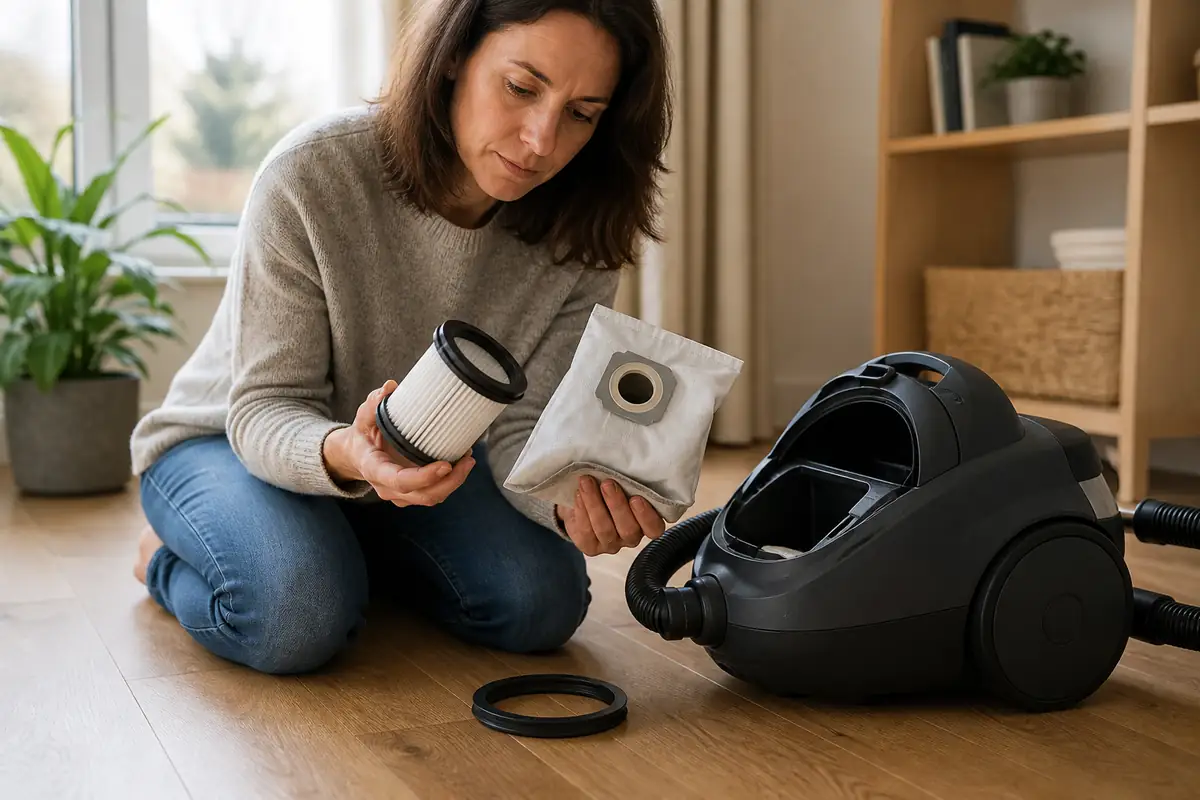
We did not laboratory-test individual vacuums, filters or health outcomes. Specifications, parts and claims change, and specialist cleaning requires appropriate advice. Recheck the exact model, manual and safety notices before purchase. The image is an editorial illustration, not a photograph from a product test.