Steam mop buying guide: floor compatibility, pads and limitations
A steam mop is suitable only where both the floor maker and mop maker permit steam. Check sealing, joints, temperature and moisture limits before comparing heat-up time, steam control, pads, descaling and accessories.
In this guide
Get written floor approval before buying the machine
Confirm the exact floor type and manufacturer care instructions first. Then choose controllable steam, a head that reaches the room, enough washable pads and a realistic limescale routine. Do not use steam on an uncertain, damaged, unsealed or explicitly excluded surface.
This guide concerns domestic steam mops and upright steam cleaners on ordinary hard floors. It is not infection-control advice and does not verify manufacturer hygiene percentages. Hot steam can burn, moisture can damage floors and electrical appliances need careful handling.
Identify every floor before shopping
List tile, stone, vinyl, laminate, engineered wood, sealed timber and any transitions. Record the exact product or installation documentation where possible. “Wood effect” describes appearance, not material; it could be ceramic, vinyl or laminate with very different moisture requirements.
Find the floor maker’s current cleaning guidance. A steam-mop maker may list a broad category such as sealed parquet, but the floor warranty can prohibit steam or set stricter limits. Apply the stricter instruction. The manual-before-buying guide helps locate these exclusions before checkout.
| Feature | Useful evidence | Risk if unclear | Decision |
|---|---|---|---|
| Floor compatibility | Exact floor and mop manuals both permit steam | Swelling, adhesive or finish damage | Do not proceed on generic wording |
| Steam control | Defined levels with operating instructions | Too much heat or moisture for surface | Choose controllable output |
| Pad system | Material, attachment, washing and replacements | Soil smearing or unavailable consumables | Price several pads |
| Water care | Water type and descaling method | Scale, blockage or damage | Follow exact regional manual |
| Safety and storage | Parking, cooling, cable and child controls | Burn, trip or floor damage | Plan the whole routine |
Steam-mop compatibility record
- Floor manufacturer, product and installation date.
- Whether the floor is sealed and in sound condition.
- Explicit floor-maker steam permission or prohibition.
- Mop-maker list for the exact model and attachment.
- Required steam level, dwell and movement guidance.
- Pad change, washing and replacement instructions.
- Water type, cartridge or descaling schedule.
- Safe parking, cooling and storage location.
“Sealed hard floor” still needs definition
Sealing is not permanent or uniform. Scratches, worn finish, gaps, lifted edges and damaged grout can allow moisture into vulnerable layers. A floor that once tolerated damp cleaning may no longer be suitable for concentrated heat and moisture.
Inspect in good light and ask the installer or manufacturer if identity or condition is uncertain. Do not test steam in a hidden area when the official guidance prohibits it; a small damaged patch is still damage.
Tile and stone are not one category
Glazed ceramic and porcelain tile can be robust when grout and installation are sound, but natural stone, sealers, waxes and specialised finishes have their own rules. Steam may affect coatings or drive moisture into cracked grout. Confirm the tile, grout and sealer rather than relying on the visual surface.
Loose tiles, damaged joints and unknown adhesive need repair or assessment before wet or steam cleaning. A machine’s stone icon is not permission for every stone installation.
Laminate and wood require special caution
Laminate edges and wood joints can swell, warp or delaminate when moisture enters. Heat can affect finishes and adhesives. Some mop manufacturers list sealed laminate or parquet, while some flooring manufacturers prohibit steam. This conflict is resolved by not using steam until the floor maker approves the exact method.
Do not assume “low steam” or rapid movement makes a prohibited use acceptable. If steam is permitted, follow pad, output and motion instructions and never leave the hot head parked on the floor.
Vinyl and resilient floors also vary
Sheet vinyl, luxury vinyl tile and other resilient materials use different wear layers, joints and adhesives. Excess heat can affect some products or weaken adhesion. Verify the exact floor documentation, particularly for glued installations, damaged seams and recent work.
Steam does not replace prompt spill removal or the cleaner specified by the floor maker. Choose a conventional damp method when approval is absent.
Steam control matters more than a large claim
Adjustable output can help match permitted surfaces and soil, but only when levels are explained. A trigger offers direct control; continuous output can be convenient but needs a safe pause method. Check warm-up, recovery after refill and whether the tank can be refilled while in use.
Do not rank by temperature or pressure alone. Higher output may add risk without improving the floor’s allowed cleaning method. Marketing percentages for bacteria or viruses need named organisms, surfaces, contact time and test conditions and should not be generalised to a household health outcome.
Choose the head for the room
Measure clearance under furniture, width between fittings and the route around toilets, table legs and stairs. A swivelling low-profile head can improve reach, while a broad head covers open floor faster. Edge claims should be checked against pad coverage and the physical distance to the wall.
Weight at the handle matters more than total weight when steering. Test whether the mop stands independently or needs a safe support. A parking mat can protect an approved surface during short pauses only if the manual specifies it.
Pads are the working surface
A saturated or dirty pad can smear soil. Check how pads attach and can be removed without touching the hot, dirty surface. Plan enough pads to change between heavily soiled zones and wash before the next clean. Texture should suit the floor; an abrasive pad can damage a delicate finish even when steam itself is permitted.
Read washing temperature, detergent and fabric-softener restrictions. Confirm replacement part numbers and price. The ownership-cost guide helps add pads, cartridges, electricity and replacement over time.
Water and limescale rules are model-specific
Some machines require tap water, others allow demineralised water in a defined mixture, and some use a descaling cartridge. Do not invent a vinegar or chemical routine: acids and additives can damage seals, tanks or heating systems and may be unsafe when heated.
Check local water hardness and the manual’s interval. A cartridge is a recurring cost and supply dependency. Store the part number with the receipt.
Accessories widen risk as well as use
Carpet gliders, garment tools, brushes and concentrated nozzles do not make every material compatible. A glider may refresh a permitted carpet surface but does not extract soil like a carpet washer. Upholstery, mattresses, paint, silicone joints, glass and appliances have separate heat and moisture limits.
Buy the floor function first. An accessory bundle has no value if its permitted surfaces are absent from the home. Generic third-party attachments may alter steam flow or fit and need explicit compatibility.
Vacuum before steaming
Loose grit and hair should normally be removed so the pad does not drag abrasive debris. A combined vacuum-and-steam model still needs separate evidence for pickup, filtration and steam compatibility. Our vacuum filtration guide explains dust collection and emptying trade-offs.
Treat sticky contamination according to floor instructions rather than holding steam over one point. Dwell increases heat and moisture exposure.
Plan safe operation
Keep hands, feet, children and pets away from steam and hot pads. Direct steam away from people, sockets, cables and electrical equipment. Inspect plug, cable, strain relief, tank and seals before use. Unplug according to the manual before changing user-removable parts or storing.
Route the cable to avoid contact with the hot head and tripping. A cordless-looking product may still have a cable outside the photograph. Check usable reach from actual sockets without relying on an unsuitable extension lead.
Cooling and storage are part of the purchase
Find a heat-resistant place where the machine can depressurise or cool, remain upright as instructed and stay inaccessible to children. Empty or leave water according to the manual. Do not wrap a cable tightly around a hot body.
Measure the cupboard including head, handle and cable hooks. A small tank does not guarantee compact storage. Damp pads should dry before enclosed storage to avoid odour.
Check repair and consumable supply
Search official parts for pads, caps, tanks, cartridges, seals and heads using the exact model number. Confirm warranty and service process. A disposable appliance is poor value when a small broken cap removes pressure or water control.
The spare-parts guide shows how to record supply, while the seller-verification guide helps avoid untraceable electrical listings.
Inspect within the return window
Check the model, voltage, plug, tank, cap, pads, attachments and manual before filling. Photograph damage or missing parts. If a permitted trial requires water, understand how use affects a change-of-mind return and preserve packaging.
Do not risk the floor to test a product. Use the manufacturer’s permitted setup and the returns-policy audit before first operation.
Choose a steam mop when
- Every intended floor explicitly permits steam.
- Output, head and pads suit the rooms.
- Water care and cooling fit the household routine.
- Replacement pads and parts remain available.
Choose a conventional mop when
- Floor identity or seal condition is uncertain.
- The floor maker prohibits steam.
- Safe parking and cooling are impractical.
- A controlled damp clean already solves the task.
Balanced verdict
A steam mop is a compatibility purchase before it is a cleaning purchase. Written permission from both floor and appliance makers outweighs speed, temperature and accessory claims.
Where steam is permitted, controllable output, good pads, manageable scale care and safe storage matter most. Where it is not, a carefully controlled conventional method is the better tool, regardless of the mop’s marketing.
Check current official information:
Kärcher UK steam-cleaner guidanceGOV.UK product safety alerts and recallsGOV.UK product-safety guidance
Frequently asked questions
Can I use a steam mop on laminate?
Only when the exact laminate maker and mop maker permit it and the floor is in the required condition. Many products prohibit steam.
Is sealed wood always safe to steam?
No. Seal type, condition, joints and manufacturer rules vary. “Sealed” is not universal permission.
Can I put detergent or vinegar in the tank?
Only if the exact manual explicitly allows it. Unapproved additives can damage the machine or create risk.
How many pads do I need?
Enough to replace a dirty or saturated pad during cleaning and have clean pads while others are being washed and dried.
Does steam disinfect every floor?
No. Claims depend on organism, surface, contact time and test conditions, and a floor’s safe-use limit comes first.
Should I vacuum before using steam?
Usually remove loose grit and hair first, following the floor and mop instructions, so debris is not dragged by the pad.
How we researched this guide
Recommended Today reviewed current UK manufacturer steam-cleaner information and UK product-safety guidance, then mapped the decision across floor approval, output, head, pads, water, limescale, safety, storage and parts.
Limitations
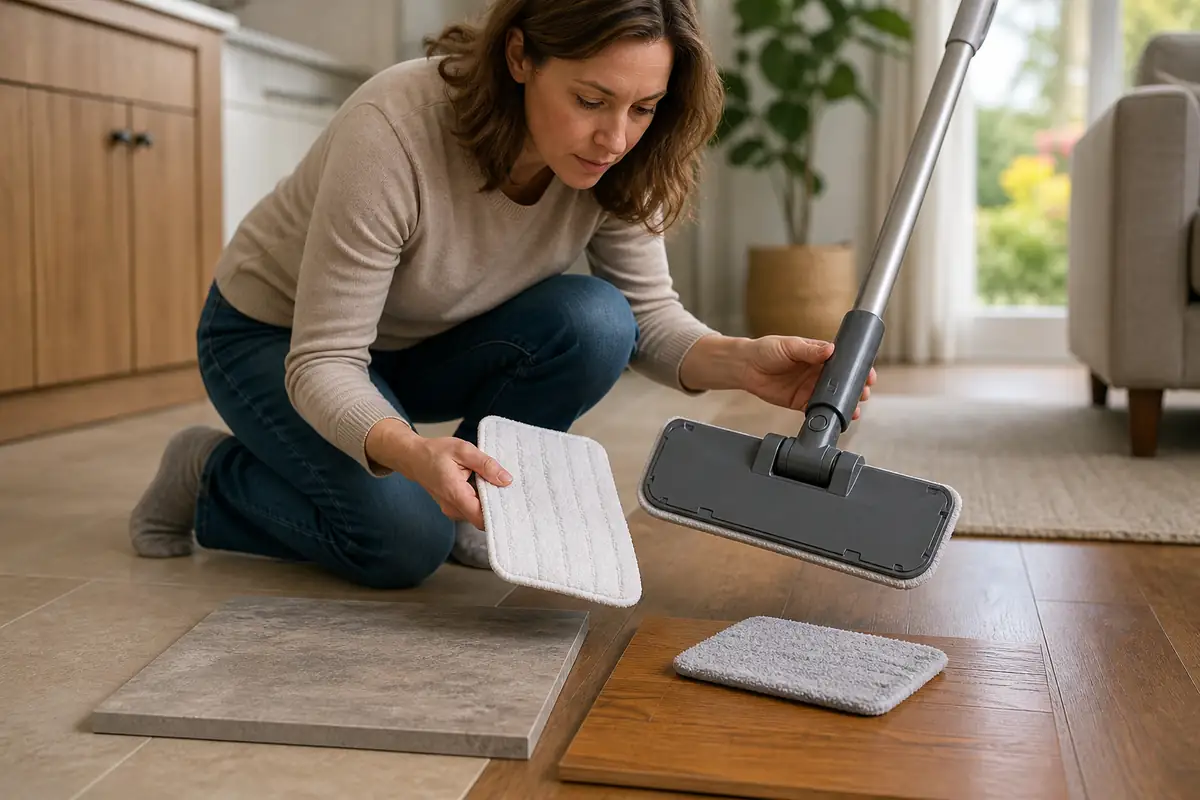
We did not test a steam mop or approve a floor. Flooring, seals, installations and appliance instructions vary. Recheck both exact manuals and safety notices before purchase. The image is an editorial illustration, not a photograph from a product test.