Microwave types explained: solo, grill and combination models
A solo microwave handles reheating and defrosting. A grill adds direct browning, while a combination model adds oven-style hot air. Choose only the functions you will use in the available space.
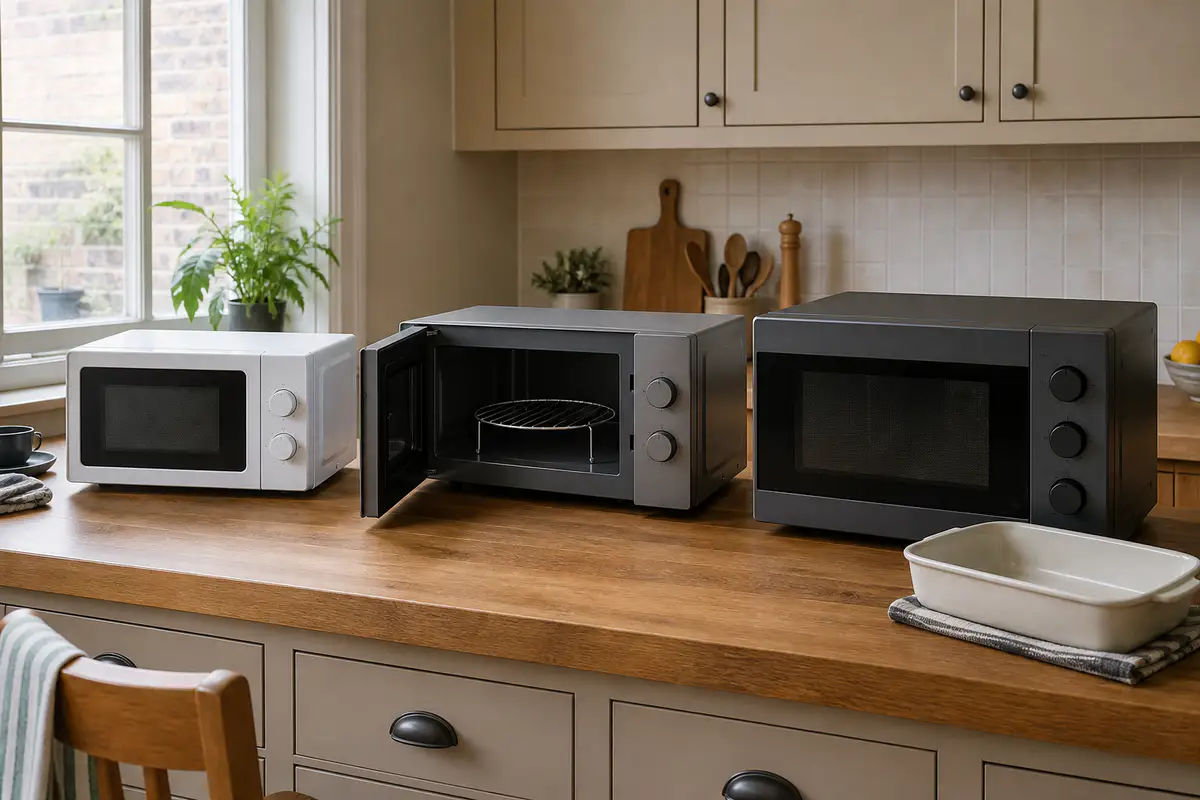
In this guide
Choose by cooking method first, then verify usable cavity size, ventilation and controls
Buy a solo model for dependable reheating, drinks, defrosting and straightforward microwave cooking. Choose a grill model when browning toast, toppings or small portions matters. Consider a combination microwave when you genuinely need convection baking or roasting as well as microwave speed. Extra modes add cost, cleaning and a steeper control sequence, so they are not automatically better value.
This guide explains functions and specifications rather than recommending named models. We reviewed current UK manufacturer guidance and Electrical Safety First advice. Recommended Today did not cook with, measure or safety-test an appliance.
Solo, grill and combination microwaves compared
| Type | Heating available | Best suited to | Main compromise |
|---|---|---|---|
| Solo microwave | Microwave energy only | Reheating, defrosting, drinks, porridge, vegetables and recipes designed for microwave cooking | Does not provide the dry direct heat needed for convincing browning or crisp pastry |
| Microwave with grill | Microwave plus a top heating element, separately or in a programmed sequence | Solo jobs plus browning cheese, toast, bacon or the surface of a small dish where the manual permits | Rack position, food height and mode-specific cookware matter; it is not a full fan oven |
| Combination microwave | Microwave, grill and convection hot air, often usable in combinations | Baking, roasting and crisping small meals while retaining microwave speed for suitable stages | Larger footprint, more complex controls, more cleaning and often less obvious usable capacity than the headline litres suggest |
What a solo microwave does well
A solo microwave transfers energy into suitable food and drink without heating a conventional oven cavity in the same way as an element. That makes it efficient for short, moisture-rich jobs: warming a plate, melting, steaming vegetables, defrosting in controlled bursts and following microwave-specific recipes. Power is normally expressed in watts, but a higher number is not a guarantee of even results. Cavity shape, turntable movement, sensor or programme design and how you arrange food also matter.
A solo model suits a household that already has an oven or air fryer and wants an uncomplicated second appliance. It can also be a better accessibility choice when a clear dial or a small set of direct buttons is easier than nested menus. Compare the controls in person where possible. Check whether opening the door, pausing, adding time and clearing a mistaken setting are obvious without repeatedly consulting the manual.
Its limitation is physical: microwave cooking does not normally create the same dry surface heat as a grill or oven. Bread can soften, pastry can become limp and cheese may melt without browning. If crisp texture is central, a solo machine should complement rather than imitate another appliance. Our air-fryer size guide helps compare another compact dry-heat option.
When the grill function is genuinely useful
A grill microwave places a heating element above the food. The grill can finish a microwaved dish, or the programmes may alternate microwave energy and direct heat. This is useful for a browned topping, toast or a small portion that would otherwise need a separate grill. Panasonic’s current guidance stresses that results depend on food placement and the rack or tray specified for the mode.
Do not treat the supplied wire rack as permission to put arbitrary metal into every programme. A rack may be designed for grill or combination operation and unsafe in a microwave-only mode unless the manual explicitly permits it. The element and cavity surfaces become hot, so allow clearance, use appropriate oven gloves and expect splashes to bake onto the ceiling. Check whether the grill can operate independently; some cheaper products offer only preset combinations.
Ask what you will grill weekly. If the answer is only an occasional cheese topping, a separate oven grill may be simpler. If small fast lunches regularly need colour and texture, the extra function can be worthwhile. Compare the total cost and counter space with our total-cost framework, not just the launch discount.
What combination microwaves add
A combination model includes convection heating: a fan circulates hot air around the cavity, enabling oven-style baking and roasting. Depending on the recipe and programme, it can use convection alone, grill alone, microwave alone or more than one source in sequence. Combining microwave energy with hot air can reduce cooking time for suitable dishes, but it does not remove the need to understand temperature, food safety and browning.
This type makes most sense when the main oven is too large for regular small meals, when a rented or compact kitchen lacks another oven, or when a second cooking cavity solves real scheduling problems. It is less persuasive if the household already owns a capable small oven or air fryer and will avoid multi-stage controls. A feature that remains buried in the manual has no practical value.
Check whether convection temperature and preheating are clearly displayed, which shelves or trays are supplied, and whether the cavity can accept your baking dish without touching walls. Combination cooking can make the case, door and accessories very hot. Children and anyone with reduced grip or reach need a safe landing space for a hot dish.
Capacity: litres do not tell the whole story
Headline capacity is an internal volume, not a promise that your widest plate or tallest jug will fit. Measure the largest dinner plate across, including handles or rim, and the height of regular containers with lids loosened as directed. Then compare the manufacturer’s usable cavity dimensions, turntable diameter and door opening. A curved rear wall, projecting grill or low rack can reduce practical space.
| Dimension to record | Why it matters | Common mistake |
|---|---|---|
| External width, height and depth | Determines whether the appliance fits the counter and allows required ventilation | Measuring the cabinet gap but not the door swing, cable or rear clearance |
| Turntable diameter or flatbed area | Shows whether a plate can rotate freely or a rectangular dish can sit flat | Assuming stated litres equal usable width |
| Internal height | Important for jugs, baby-bottle vessels, racks and risen bakes | Ignoring the grill element or rack position |
| Door opening and control side | Affects safe loading in a corner and access for left- or right-handed users | Planning only for the closed appliance |
Flatbed models remove the turntable and can accept some differently shaped dishes, but food may need rearranging for even heating. Turntables make movement visible and simple but require clearance to rotate. Neither layout guarantees evenness. For any appliance, use the exact instructions and verify the electrical load as explained in our energy-efficient appliance guide.
Controls, programmes and cleaning
Auto programmes are only helpful when their assumptions match the food weight, starting temperature and container. Look for direct power and time adjustment, sensible increments, a clear pause, child lock where needed and a display visible from your normal angle. Sensor programmes can reduce guesswork, but they are not a substitute for standing time, stirring and checking that food is safely hot throughout.
Cleaning difficulty rises with exposed grill elements, racks and convection vents. Wipe splashes before repeated heating bakes them on, following the manufacturer’s cool-down instructions. Avoid abrasive materials that damage the cavity coating or door seal. A removable turntable is easy to wash but can be awkward when hot; a flatbed avoids the glass plate but still needs regular wiping.
Installation and electrical safety
Countertop microwaves normally use a UK fused plug. Electrical Safety First advises plugging high-powered kitchen appliances directly into a wall socket rather than overloading an extension lead, keeping vents clear and registering the appliance so safety notices can reach you. Never operate a damaged door, seal, cable or plug, and do not attempt internal repairs.
Built-in products require the correct housing and ventilation arrangement. Do not place a freestanding microwave into a cupboard merely because it physically fits. Use the installation instructions and a competent installer where required. Keep the appliance dry, stable and away from a hob or sink unless the manual permits the location. Our warranty and guarantee guide explains why installation evidence can matter later.
Use microwave-safe containers and follow mode-specific instructions. Metal, foil, sealed containers and some recycled papers can cause hazards unless expressly approved for the selected mode. Pierce foods as directed, allow standing time and take care with steam. If an appliance arrives damaged or develops a fault, preserve evidence using our purchase-documentation checklist and review the UK faulty-goods guide.
You need speed and simple, repeatable jobs
Pick solo for reheating and defrosting; add a grill only when regular browning justifies the extra cleaning and controls.
You will use a compact second oven
Pay more when convection baking, roasting and mixed-mode cooking solve a real capacity or timing problem.
Microwave buying checklist
- List five weekly jobs and match each to microwave, grill or convection heat.
- Measure the counter and vessels, including ventilation, cable, door swing and landing space.
- Test the control sequence for power, time, pause and clearing mistakes.
- Read accessory rules for racks, trays and permitted materials in every mode.
- Plan cleaning around the ceiling element, vents and removable parts.
- Confirm installation and returns before buying a built-in or unusually large model.
Balanced verdict
A solo microwave is the best-value default when the job is reheating, defrosting and microwave cooking. A grill is a targeted texture upgrade, while a combination model earns its space only when it will perform real oven work. More modes can widen capability, but they also create more decisions and surfaces to clean.
Choose the simplest appliance that covers the documented weekly use, then verify cavity geometry and safety instructions. Before paying an unfamiliar seller, use our genuine-shop checklist.
Check current official guidance:
Electrical Safety First: microwave ovensPanasonic UK microwave buying guidePanasonic UK grill microwave guidance
Frequently asked questions
Can a solo microwave brown food?
It can heat and melt food, but it does not provide the direct dry heat of a grill or convection element, so crisping and browning are limited.
Is a grill microwave the same as a combination microwave?
No — A grill model adds a direct heating element. A full combination model also adds convection hot air for oven-style baking and roasting.
Can I put the supplied metal rack in microwave mode?
Only if the manual explicitly permits that rack in the selected mode. A rack designed for grill or combination use is not blanket permission to use metal in microwave-only cooking.
What microwave capacity do I need?
Use litres only as a starting point. Verify turntable or flatbed width, internal height, door opening and the exact dishes you intend to use.
Do combination microwaves need ventilation?
Yes — Required clearances vary, and built-in models need the specified housing. Never block vents or enclose a freestanding product without manufacturer approval.
How we researched this guide
Recommended Today reviewed Electrical Safety First microwave guidance and current Panasonic UK explanations of solo, grill and combination operation on 28 August 2026. We compared functions, cavity considerations, controls, accessories and installation advice; we did not test a named model.
Limitations
Features, cavity geometry, permitted cookware, electrical load and installation clearances vary by model. Always use the exact manual and seek competent installation advice where required.
It contains no manufacturer imagery, logo, copied design, readable interface or hands-on claim.