Choosing freezer storage containers: portions, shape, closure and labels
A freezer container should protect food, fit the drawer and support safe portions, dates and thawing. Capacity printed on a box is less useful than usable shape, closure, temperature directions and a system the household will actually rotate.
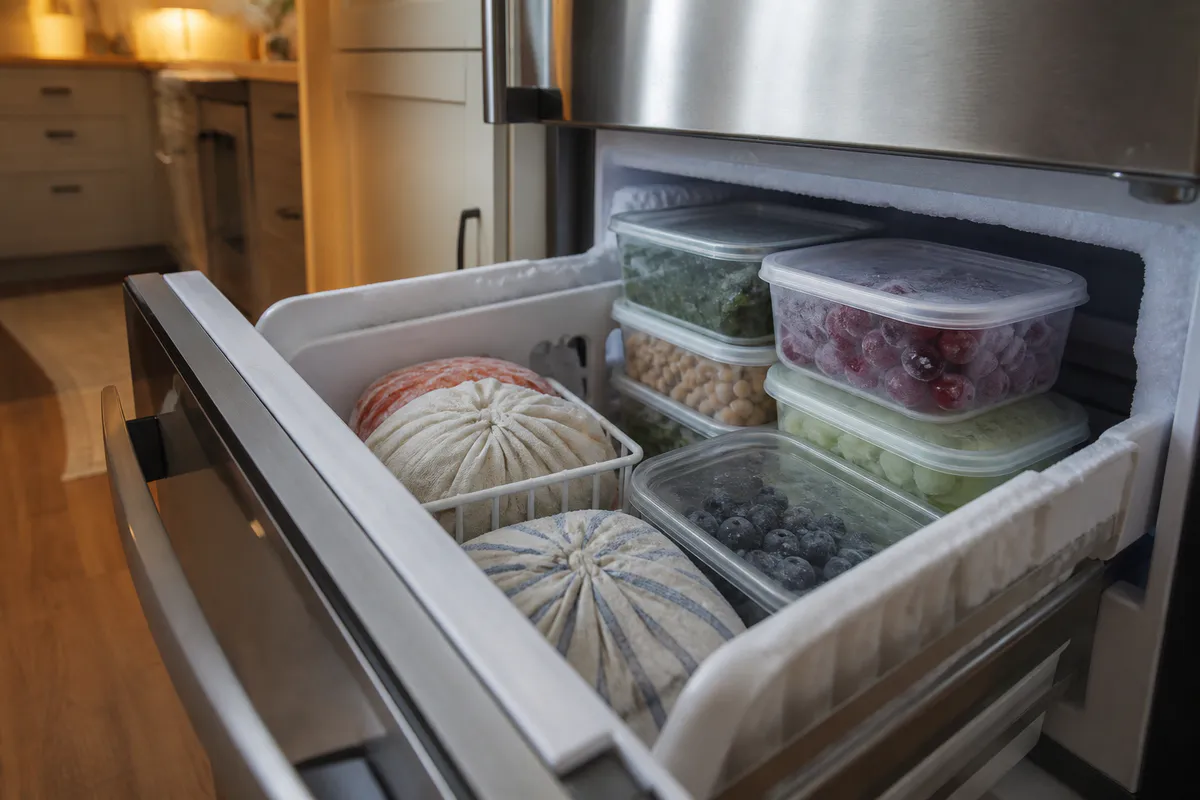
In this guide
Design the storage system around portions and retrieval
Choose plain containers or bags explicitly suitable for freezing, with useful portions, secure closure and readable labels. Leave appropriate expansion space, cool and freeze food safely, and avoid a perfect stack that hides old meals indefinitely.
Plan appliance space with the chest freezer guide, monitor rotation through the fridge-freezer framework, and use dimension tolerances before buying a matching set.
| Use case | Best evidence | Useful shape | Common failure |
|---|---|---|---|
| Single meals | Freezer suitability, usable volume and closure | Flat shallow rectangle | Deep box freezes slowly and wastes headroom |
| Soups and sauces | Leak resistance and expansion allowance | Rigid container with clear fill margin | Overfilled lid lifts or liquid leaks |
| Loose ingredients | Cold-flexible closure and portion access | Bag or compact lidded box | One large frozen block cannot be portioned |
| Drawer organisation | External dimensions including lid and handles | Repeatable modules with visible labels | Nominal capacity fits but geometry does not |
Freezer storage setup
- Measure drawer width, depth, height and obstruction.
- List realistic meal and ingredient portions.
- Confirm freezer, food-contact and thawing directions.
- Choose shapes that freeze and stack efficiently.
- Leave product-appropriate expansion space for liquids.
- Label contents and freeze date before the surface frosts.
- Rotate older food to an accessible position.
- Discard damaged containers and follow food-safety guidance.
Start with portions, not a giant coordinated set
List what is actually frozen: two-person meals, individual lunches, stock, chopped vegetables, bread or batch-cooked sauces. Measure typical portions in existing bowls. This reveals which capacities repeat and which oversized boxes would sit unused.
A mixed system can be more efficient than one decorative set. Shallow rigid boxes suit prepared meals, flexible bags can suit flat ingredients, and small boxes can isolate garnishes. Every format still needs explicit freezer and food-contact directions.
External dimensions decide whether capacity is usable
Measure the drawer at several points and note rails, slopes, baskets and handle intrusion. Include lid rims, clips and tapered sides. A container advertised by volume may waste substantial space when its footprint or shoulder does not align with neighbours.
Make a paper footprint and a cardboard height gauge before buying multiples. The measure-before-buying method applies at smaller scale: access and real obstruction matter more than a nominal interior number.
Shallow portions freeze and thaw more predictably
The Food Standards Agency advises dividing food into smaller portions and using containers or freezer bags. Smaller portions can freeze and defrost more quickly and reduce cross-contamination risk when handled correctly.
Do not use this as permission to freeze hot food carelessly. Follow current food-safety guidance on cooling, date limits and appliance temperature. A broad shallow layer often creates a more manageable meal portion than a deep central mass.
Material suitability must be explicit
Look for manufacturer confirmation that the exact container and lid are intended for freezing and food contact. A visually similar storage box may become brittle, distort or have a closure not designed for cold use.
Check permitted temperatures and whether microwave, dishwasher or oven claims apply to the base, lid or neither. “Freezer safe” does not automatically mean safe for reheating. Move food according to the product and food directions.
Liquids need closure and expansion allowance
Soups, sauces and stews expand as they freeze. Follow the container maker’s fill instructions and leave the stated headspace rather than filling to the rim. Keep the box upright until frozen and verify the lid is seated evenly.
A clip is not proof of leak resistance in every orientation. Test a new container with cool water over a sink before relying on it in a crowded drawer, then dry it fully. Store liquids where a minor leak can be contained.
Shape affects air, frost and retrieval
Straight-sided rectangles usually use drawer area more efficiently than strongly tapered or round vessels, but nesting and hand grip can favour some taper. Compare the working set both full and empty.
Very tight packing can obstruct air circulation or make the drawer difficult to close. Use the appliance manual and avoid placing food against vents or mechanisms. The fridge-freezer placement guide explains why airflow remains part of appliance performance.
Transparent walls help, but labels still matter
Frost, condensation and similar foods can make visual identification unreliable. Label contents, date frozen and any essential reheating note before the surface becomes cold and wet. Use a marker or label method approved for the container.
Put the label where it remains visible in the actual stack. Do not rely on memory or colour-coded lids alone. A simple inventory on the freezer door or household list can prevent older meals becoming permanently buried.
Lids deserve the same inspection as bases
Check seal, hinge, clips, removable gasket and replacement availability. A complex lid can trap food or water; a loose lid can admit air and odour. Wash and dry every channel according to the maker’s directions.
Do not keep a cracked clip by compensating with tape or pressure from another box. A compromised closure should be replaced. If spare lids are unavailable, include likely whole-container replacement in the value decision.
Stacking must work when the contents are irregular
An empty showroom stack can behave differently when lids bow, liquids freeze or bags settle. Test a small number under normal load before buying a complete cupboard system. Keep heavier stable boxes low.
Avoid towers that require removing six items to reach one meal. A basket for loose bags or a front-to-back file arrangement can improve retrieval. The best geometry reduces handling and forgotten food, not only unused cubic centimetres.
Flexible bags need support and closure discipline
Use bags explicitly intended for food freezing, expel air as directed without contaminating the seal and freeze liquids flat on a contained tray if permitted. A thin frozen sheet can later store upright and thaw evenly.
Do not reuse single-use bags contrary to directions. Inspect reusable bags at seams and closures, clean and dry thoroughly, and retire them when damage, odour or residue cannot be resolved.
Thawing route should influence the container
Decide whether food will thaw in the refrigerator, be transferred to another vessel or be reheated according to specific instructions. A container convenient for freezing may not be the correct heating vessel.
Never infer microwave safety from clear plastic or a loose lid. Follow both food-safety and product directions, vent only as instructed and handle hot contents carefully. The freezer decision should not create an unsafe shortcut later.
Cleaning and drying control long-term practicality
Wide openings and simple corners are easier to inspect. Tomato, spice and fat staining may be cosmetic, but persistent odour, residue, warping or damaged seals deserve attention. Do not use abrasive methods the maker prohibits.
Let every part dry completely before stacking closed. Trapped moisture produces odour and makes the cupboard unpleasant. A ventilated storage arrangement may use more space but reduce hidden damp.
Value comes from a repeatable rotation system
Count how often each size is used over a month. Buy additional units only after the trial proves that they fit, seal, label, wash and retrieve well. A discounted 30-piece set is poor value when most shapes conflict with household portions.
Review the freezer weekly, move older food forward and use current FSA guidance for safe freezing and thawing. Containers support a food system; they do not extend safe storage indefinitely or correct temperature problems.
Run a four-week trial with the smallest useful mix. Record portions that leave excess air, lids that are difficult with cold hands and shapes that disappear beneath other food. This evidence is more useful than assuming every container in a matching range deserves an equal place.
Choose rigid containers or freezer bags?
Stacking, liquid control and protection matter
The exact base and lid are freezer-suitable, fit the drawer, leave correct expansion room and clean easily.
Flat portions and flexible use save meaningful space
The bags are designed for food freezing, close securely, label clearly and can be supported, cleaned or discarded as directed.
Balanced verdict
The best freezer container is part of a measured rotation system. Match portions, external geometry, material directions, closure, labels and thawing route. Trial a few units before buying a set, and follow current food-safety guidance.
Browse the Home & Kitchen archive and plan maintenance with the chest freezer ownership plan.
Official checks:
Food Standards Agency safe freezing method ↗
Food Standards Agency chilling and freezing guidance ↗
Frequently asked questions
Can any plastic box be used in a freezer?
No — Check the exact maker’s food-contact and freezer directions for both base and lid; appearance alone does not establish cold suitability.
Should freezer containers be filled to the top?
Follow product directions. Liquids generally need an appropriate expansion allowance, and overfilling can lift or distort the closure.
Are round or rectangular containers better?
Rectangles often use drawer area efficiently, while taper and grip can aid handling. Measure external geometry and trial the real stack.
Can food be reheated in the same container?
Only when the exact base and lid are approved for the intended reheating method and food directions allow it. Freezer suitability alone is insufficient.
How should frozen food be labelled?
Record clear contents and freeze date, plus any essential handling note, using a method suitable for the container and visible in the stored position.
Methodology and limitations
We reviewed current Food Standards Agency material on safe freezing and chilling, then evaluated containers by portion, external geometry, freezer suitability, closure, expansion, labels, stacking, thawing, cleaning and rotation. We have not frozen, drop-tested or repeatedly washed the container models discussed, so the framework cannot establish a particular lid’s leak resistance or a box’s long-term resistance to cracking.
Limitations
Container directions, appliance layouts and household portions vary. This is general buying guidance, not a substitute for current food-safety advice, an appliance manual or the exact container instructions.