Choosing doormats and hall runners: size, backing, pile and cleaning
An entrance mat must clear the moving door, stay stable on the actual floor and release dirt through a cleaning routine the household can maintain.
In this guide
Measure the moving path before choosing colour
Open every door fully, measure the narrowest walkway and test total pile plus backing against the lowest clearance. Use an outdoor scraper for coarse dirt and an indoor absorbent mat where space permits. A runner must have a floor-compatible stability system and lie flat at every edge.
A doormat manages one threshold; a hall runner covers a travel route. They are not scaled versions of the same object. The entrance needs soil removal, moisture handling and door clearance. The runner needs safe edge behaviour, repeat footfall, furniture clearance and a cleaning plan that reaches its entire length.
Map entrance problems to the right layer
| Position | Main job | Evidence to check |
|---|---|---|
| Outside scraper | Remove coarse soil | Weather suitability, drainage and stable base. |
| Inside doormat | Absorb moisture and fine dirt | Door clearance, washable surface and backing. |
| Hall runner | Protect a traffic path | Width, flatness, floor compatibility and cleaning. |
| Recessed mat | Sit level inside a frame | Exact recess depth and approved insert. |
| Washable mat | Support frequent cleaning | Machine dimensions, weight wet and drying time. |
| Coir-style mat | Firm scraping texture | Shedding, moisture limits and pile clearance. |
Measure the door through its complete swing
Measure the gap beneath the door at several points because floors and doors are not always level. Include thresholds, weather bars and any point where the door drops or the mat compresses unevenly. Test the handle side and hinge side. A mat that allows partial opening is not suitable for the route.
For an inward-opening front door, mark the entire swing on paper or removable tape. Add the thickness of backing, pile and any separate underlay without double-counting compressed claims. Fire doors and accessible routes may have specific requirements; do not obstruct them.
Size the mat for real foot placement
The user should be able to plant both feet and make several ordinary steps without aiming for a decorative centre. Measure the clear landing after accounting for skirting, radiator pipes, cupboards and door furniture. A narrow mat that moves under a turning foot can create more risk than bare floor.
For a runner, leave a consistent visible border where practical and keep the usable walkway clear. Very long runners can creep, ripple or twist more than small mats. Break a route into zones only if every new edge remains stable and obvious.
Choose surface texture for the dirt type
- Ridged scraper: useful for dried soil but can be uncomfortable for bare feet.
- Looped absorbent pile: holds moisture and fine dirt, with slower drying.
- Low flat weave: supports door clearance and vacuuming but scrapes less.
- Dense cut pile: feels soft while showing footprints and retaining debris.
- Open outdoor grid: drains when installed correctly but lets fine soil through.
- Natural coarse fibre: can shed and has product-specific moisture limits.
“Dirt trapping” is incomplete without a test method and capacity. More retention also means more material to remove during cleaning. Check whether grit becomes visible, whether the surface can be shaken safely and whether edges remain firm after repeated vacuuming.
Backing must match the exact floor
Rubber, latex, PVC, textile and sprayed backings interact differently with timber finishes, vinyl, tile, laminate and underfloor heating. A “non-slip” claim does not guarantee grip on dust, moisture or every coating. Ask the floor and mat makers about compatibility, marking and heat limits.
Separate underlays should be slightly smaller and approved for both surfaces. Do not stack improvised grippers that create a ridge. Lift the mat regularly to inspect condensation, trapped grit, discolouration and floor finish. The online quality guide helps test vague backing claims.
Edges and corners are structural features
Bound edges should lie flat without thick knots at corners. Moulded ramps can reduce a sharp edge but increase overall footprint. On a runner, check that binding tension does not curl the long sides. A decorative fringe is poorly suited to many entrance routes because it moves, tangles and complicates vacuuming.
Unroll the product on a flat surface for the permitted settling time. If corners remain raised, do not rely on furniture or tape that the maker has not approved. Return or replace a mat that cannot become stable.
Plan cleaning before choosing washability
Vacuuming, shaking, hosing, spot cleaning and machine washing are different systems. “Washable” must specify method, temperature, detergent limits and drying. Measure the washing-machine drum and door; a dry mat that fits loosely can become heavy and unbalanced when wet.
Outdoor cleaning needs a drainage and drying location. Do not return a damp mat to a timber or sealed floor. Thick backing can remain wet after the pile feels dry. Follow the care-label guide and local water restrictions.
Use a two-zone entrance when space allows
An outdoor layer removes stones and mud; an indoor layer collects remaining moisture. Their tasks should be distinct rather than two decorative mats stacked together. Leave enough bare floor or threshold structure that neither mat overlaps the door or slides against the other.
In flats or shared corridors, confirm permission and escape-route rules before placing anything outside. A communal landing is not automatically private storage. Choose an indoor-only solution if the outside layer would obstruct neighbours or building management.
Account for pets, prams and mobility
Claws can catch open loops, while pets may chew loose fibres or move lightweight mats. Wheels bring concentrated dirt and need a flat stable route. Walking aids require predictable contact, not deep compressible pile. A person who shuffles may be affected by an edge that others step over easily.
Test the route with the household’s ordinary movement and loads. Seek an occupational therapist or appropriate professional where fall risk or accessibility matters; a style guide cannot approve a mat for an individual mobility need.
Inspect material and construction
Read fibre content and outdoor/indoor use. Check density, edge attachment, backing uniformity, odour and shedding. Pulling one loose tuft should not unravel a channel. Printed motifs can hide dirt or wear; a medium-value pattern may make cleaning need easier to judge.
Product photographs rarely show the underside. Ask for it, then use our fabric guide and home-quality checklist to compare construction evidence.
Replace based on stability and cleanability
Replace a mat when backing cracks, corners curl, pile creates bare slippery channels, odour remains after correct cleaning or the product no longer dries fully. Rotate only if construction and wear pattern permit; turning a shaped mat may place an unfinished edge into traffic.
Include realistic cleaning and replacement in the cost-per-use framework. A cheap mat that marks the floor or needs constant adjustment is poor value.
Test the layout with a temporary paper footprint
Before ordering, mark the proposed mat or runner outline with low-tack tape or sheets of paper. Walk through it carrying shopping, open nearby cupboards and observe where feet actually land after closing the door. The exercise reveals whether a narrow decorative mat misses the traffic path or a long runner creates an awkward step at a turn.
Repeat the test with the least steady likely user in mind. Check that walking aids, pushchairs, pets and parcel deliveries can cross without catching an edge. Do not place loose layers on top of one another to correct a sizing error: the overlap introduces another change in level and can move differently under load.
Plan cleaning before choosing a pale or deep pile
Estimate how much outdoor dirt, rain, salt, grit and pet hair enters in a typical week. Confirm whether loose debris can be vacuumed without lifting corners and whether the backing tolerates the intended cleaner. A machine-washable claim is incomplete unless the dry dimensions, wet weight and drying arrangement suit the household.
Rotate only when the construction and pattern permit it, and inspect the same pressure points each time: corners, doorway edge and the first step onto a runner. Promptly dry moisture trapped underneath, following the flooring supplier’s advice. A mat that remains damp against timber, laminate or a sealed floor can create a maintenance problem even when its face looks clean.
Which entrance setup is appropriate?
Door clearance is the hard constraint
A flat washable surface, compatible backing and sufficient foot area solve moisture without catching the door.
The dirt path extends through the hall
The walkway remains wide, every edge is stable and the complete length can be cleaned and dried.
Balanced verdict
The right entrance textile stays flat, clears the door and can be cleaned before retained dirt becomes the problem. Choose separate scraping and absorbent jobs where space allows, match backing to the floor and reject curled edges.
For room-scale textiles see the living-room rug guide and dining-room sizing guide, then browse Style & Gifts or the shop directory.
Check current official guidance:
GOV.UK textile labelling ↗GOV.UK product labelling ↗GOV.UK returns and refunds ↗
Frequently asked questions
How wide should a doormat be?
Wide enough for ordinary two-foot placement within the clear landing, without obstructing the door or walkway.
Can rubber backing damage a floor?
Some backings can interact with finishes or heat. Confirm compatibility with both manufacturers.
Are washable runners machine washable?
Only when the exact label permits it and the wet item suits the machine’s capacity.
How do I stop corners curling?
Use only approved settling and backing methods; return a product that cannot lie safely flat.
Should a hall runner reach the whole corridor?
Not automatically. Stable edges, doors, turns and cleaning access matter more than maximum length.
Methodology and limitations
We assessed doormats and runners through clearance, walkway, surface, backing, edges, cleaning, users and replacement. Official UK textile, product and returns guidance was checked on 29 August 2026. No slip-resistance or wash test was performed.
Limitations
Floors, mobility and building rules vary. Confirm exact compatibility and seek professional accessibility advice where needed.
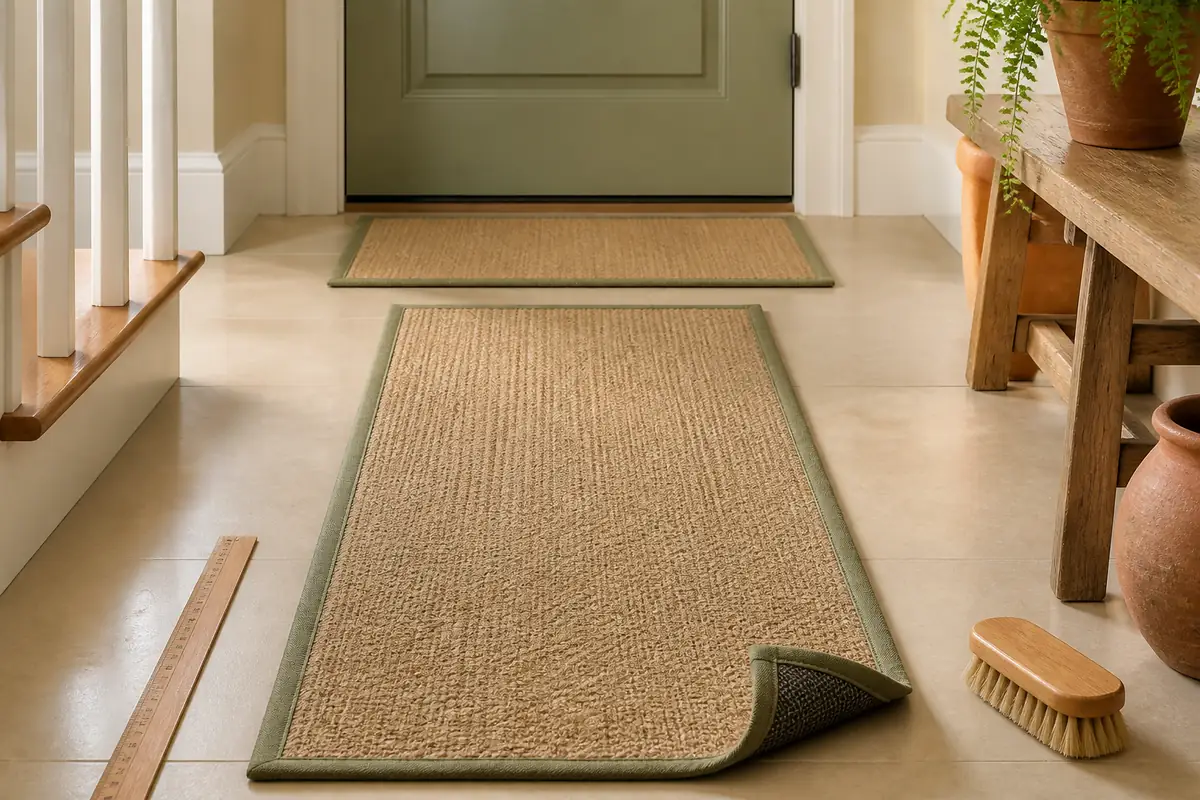
The image is an editorial illustration, not a photograph from a product test. Links are editorial and non-affiliate.