Choosing curling tools: barrel size, temperature, clamp and safety
Barrel shape changes the styling task, while controllable heat and a stable place to set the tool down shape the risk. Choose for the result, hair length, section size and handling.
In this guide
Choose the lowest workable heat and the barrel you can control
Match barrel diameter and shape to the intended curl and hair length, decide whether a clamp aids control, and prioritise clear temperature settings, a stable stand or mat, sound cable and documented automatic shut-off. Compare broader categories in our hair styling tools guide; for flat irons, use the dedicated straightener size, temperature and safety guide.
This is a selection and risk-control guide, not a guarantee of a particular curl or a prescription for hair damage. Hair condition, section size, technique and product instructions vary, so the exact manual and a conservative starting point matter.
| Feature | What it changes | Evidence to seek | Do not assume |
|---|---|---|---|
| Barrel size | Curl diameter and usable wrap | Dimensions and heated length | Bigger is automatically easier |
| Clamp or wand | How the section is held | Clamp pressure, tip and glove | A glove prevents all burns |
| Temperature | Heat exposure and flexibility | Clearly labelled selectable levels | Maximum heat is most effective |
| Stand and cable | Safe handling and placement | Stable rest, swivel and lead condition | Auto shut-off replaces unplugging |
Check these details before purchase
- Exact barrel diameter, shape and usable heated length.
- Clamp, cool tip and controls that suit the preferred grip.
- Selectable temperature range and clear indication method.
- Heating and ready-state information in the exact manual.
- Integrated stand or compatible heat-resistant mat.
- Cable length, swivel, plug and storage guidance.
- Automatic shut-off behaviour and what it does not replace.
- Warranty, spare support and electrical safety route.
Define the curl result without relying on model photographs
Decide whether the aim is a tight defined curl, loose bend, root lift or polished wave. Product photographs combine hair length, section size, direction, preparation and finishing, so they cannot isolate the barrel’s effect.
Save a small set of realistic requirements: shortest hair section to wrap, preferred curl scale, time available and whether uniform or varied results are wanted. This turns “salon finish” into features that can be compared.
Read barrel diameter and heated length together
A smaller diameter generally supports a tighter wrap, while a larger barrel tends towards broader bends, but the result also depends on section size, tension, time and hair. The usable heated length determines whether longer sections can sit without crowding.
Compare stated dimensions, not labels such as small, medium or large. A tapered wand also changes diameter along its length, so record both ends rather than treating it as one fixed size.
Match the barrel to reachable hair length
Very large barrels can be difficult to wrap with short layers, while a short heated area can crowd long hair. Check whether the shortest important pieces can make a controlled wrap without fingers approaching the hot surface.
Do not select solely for the finished look on long model hair. Consider the wearer’s own length, layers and dominant-hand control, and preserve the return condition while checking reach and grip with the tool cold.
Choose between a clamp and a wand deliberately
A spring clamp can hold the hair end and produce a more controlled, uniform wrap, but its edge or pressure may mark a section when handled poorly. A wand permits flexible placement but requires the user to hold and release hair close to a hot barrel.
Neither design is universally safer or better. Test control cold, check the clamp opens smoothly and assess whether buttons sit where the hand may press them accidentally. A heat glove is an aid, not permission to touch the barrel.
Treat tapered and oval shapes as technique choices
A tapered barrel can create different curl sizes along one tool; an oval or non-circular barrel may create a different wave pattern. These shapes add options but also demand consistent placement if repeatable results matter.
Look for a clear diagram or official demonstration for the exact model. Do not assume an unusual shape shortens learning time or works equally on every layer.
Prefer controllable temperature over a headline maximum
Selectable levels allow a conservative starting point and adjustment only if necessary. A single high setting offers less control, while a wide range is useful only when the display or indicator makes the chosen level understandable.
BaByliss model documentation, for example, specifies a range and tells users to start lower for delicate hair and use higher settings only for thicker hair. That is model guidance, not a universal temperature prescription. Follow the exact manual and hair professional advice where needed.
Use the lowest setting that achieves the task
Begin with dry hair and the lowest temperature appropriate under the exact instructions, using a small test section and limiting repeated passes. Increase cautiously only if the result and manufacturer guidance justify it.
Do not compensate for an oversized section, poor wrap or product buildup by automatically selecting maximum heat. More heat is not proof of better value and can increase the consequence of contact or prolonged exposure.
Check how the selected temperature is communicated
A screen can show a number; a dial or lights may show levels. Whichever system is used, it should be legible in normal use and resistant to accidental changes. Confirm whether the tool remembers the last setting on restart.
Avoid assuming a coloured light represents a particular temperature without the manual. If controls sit beneath the grip, test them cold to see whether fingers can alter the setting inadvertently.
Assess the rest, mat and hot-zone clearance
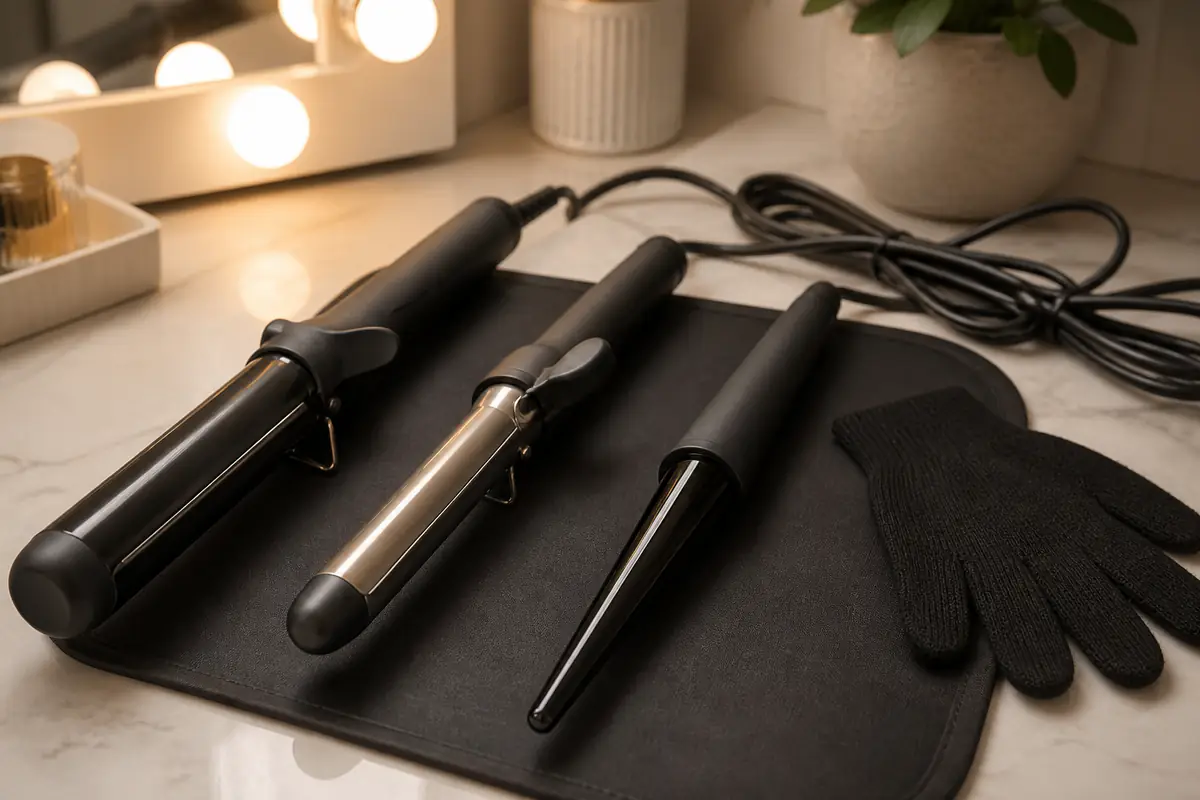
Electrical Safety First advises placing heated styling appliances on a heat-resistant mat and allowing them to cool before storage. An integrated stand should keep the barrel stable and away from the surface, cable and nearby fabrics.
Plan an uncluttered dry position before switching on. A vanity edge, bed, carpet or towel is not a suitable improvised rest. Check that children and pets cannot reach the hot tool or pull its cable.
Treat automatic shut-off as a backup only
A documented shut-off timer can reduce the consequence of forgetting, but timings and behaviour differ. It does not make the tool cool immediately, protect against water or replace switching off and unplugging after use.
Confirm the exact manual statement rather than trusting a retailer filter. If shut-off is essential, retain the model evidence and test only as the manufacturer permits.
Inspect the cable, swivel and plug route
A swivel can reduce twisting during rotation, but the lead still needs clear travel without wrapping around the wrist or hot barrel. Choose enough length for the intended socket without creating a loop across a walkway.
Electrical Safety First advises checking cords and plugs and stopping use after damage, sparks or abnormal behaviour. Never wind the lead tightly around a hot tool; cool it completely and store it as instructed.
Keep water and wet hands out of the setup
Do not use the tool with wet hands, on wet hair unless the exact product expressly supports that mode, or near baths, basins and other water. Bathroom electrical risk is not cancelled by a familiar routine.
If the appliance falls into water, do not reach for it while connected. Isolate power safely and follow official electrical advice. A cosmetic result never justifies improvising around water.
Plan sectioning before the barrel is hot
Arrange clips, mirror, mat and cable while the tool is unplugged. Separate manageable sections so the hot tool is not held in the air while searching for hair or accessories.
Keep aerosol sprays and other flammable materials away from the hot appliance and follow product warnings. Apply styling products only as directed and avoid residue that makes the barrel difficult to inspect or clean.
Use heat protection without treating it as immunity
A compatible heat-protection product may form part of the routine, but it does not eliminate thermal exposure or contact-burn risk. Follow its application and drying instructions and avoid combining products in a way the manufacturer has not supported.
Hair already fragile, chemically treated or affected by a scalp or medical issue may require professional advice and a different decision. This guide cannot diagnose suitability.
Clean only when unplugged and completely cool
Product residue can affect surface condition and heat transfer. Follow the exact cleaning instructions, typically using a suitable soft cloth without immersing the electrical appliance or scraping its coating.
Stop if the barrel coating is lifting, the clamp is damaged or the tool heats or smells abnormally. Our heated-tool ownership guide explains evidence and retirement decisions in more detail.
Protect the trial and return route
Before purchase, check whether hygiene-related return conditions affect opened styling tools. On arrival, verify model, plug, barrel, clamp, controls, stand and manual before heating it, and contact the seller promptly about damage or misdescription.
Use our online returns guide and purchase-evidence method. Do not repeatedly heat a visibly damaged tool to prove the fault.
Compare value through control and safe ownership
Useful value may come from a suitable barrel, clear lower settings, stable rest, sound cable, reliable support and a design the user can control. Decorative accessories or a very high maximum temperature do not substitute for those basics.
Our heated-tool value framework shows how to consider control, cable wear and replacement rather than comparing headline heat alone.
Choose a clamp or a wand?
You want the section held consistently
The clamp opens smoothly, does not trap the hand position and helps control ends without forcing the barrel close to skin.
You prefer flexible wrapping
You can section and release deliberately, have a stable mat and can keep fingers away from the hot surface even with a glove.
Balanced verdict
A good curling tool gives the user control over shape, temperature, placement and shutdown. Choose the barrel for the real hair length and result, start with conservative heat, create a dry stable setup and treat every safety feature as part of a complete routine.
Use the linked styling, straightener, ownership, returns, evidence and value guides.
Official checks:
Electrical Safety First guidance for straighteners and tongs ↗
BaByliss curling tong product information example ↗
ghd heated styling tool safety guides ↗
Frequently asked questions
What barrel size should I choose?
Choose from the intended curl scale, hair length, layers, section size and control. Compare exact dimensions rather than small or large labels.
Is a wand better than a curling tong?
Neither is universally better. A clamp holds the section; a wand offers flexible wrapping but requires closer hand control around heat.
How should I choose a curling-tool heat setting without treating its maximum as a target?
Follow the exact manual and start at the lowest workable setting. There is no universal safe or effective number for every person and tool.
Does automatic shut-off make it safe to leave plugged in?
No. The curling tool’s shut-off timer is a fallback protection rather than permission to leave the heated appliance plugged in. Switch off, unplug and allow the tool to cool fully on a heat-resistant surface.
Can a heat glove touch the barrel?
Do not use a glove as permission to grip a hot barrel. It provides limited assistance and does not prevent every burn.
Methodology and limitations
We separated curling-tool selection from the broad styling-tools guide and the straightener buying, value and ownership series. We assessed barrel dimensions, clamp and wand handling, temperature control, rest, shut-off, cable, water risk, cleaning and returns. Current Electrical Safety First and manufacturer information was checked on 2 September 2026. No appliance or hair was tested.
Limitations
Hair, technique, tools, temperature systems, safety features and retailer terms vary. This is not hair, medical or electrical advice and does not replace the exact manual. Recheck the model, instructions and official safety information before purchase.