Hair-styling tools explained: heat settings, attachments and safety
A good styling tool gives enough control to achieve a repeatable result without making maximum heat the default. Compare usable settings, attachment purpose, weight, cable design, cleaning and safety—not the number of accessories in the box.
In this guide
Buy for one regular routine, then add versatility
Choose the simplest tool that performs your main style with controllable heat, a comfortable grip and clear care instructions. A dryer with concentrator or diffuser, a straightener with stable plates, or a curler in the correct barrel range can be better value than a large kit of attachments you will not learn or store safely.
“Salon”, “ionic”, “ceramic” and “intelligent heat” are not complete specifications. The useful questions are what temperature or airflow choices exist, whether they can be changed independently, which hair section each attachment handles and how the tool behaves when put down, cleaned and stored.
Start with the job, not the technology label
| Tool type | Best-defined job | Specification to verify | Common buying mistake |
|---|---|---|---|
| Hair dryer | Removing water and directing airflow for a brush finish. | Separate heat/speed controls, cool shot, filter access and nozzle fit. | Equating maximum wattage with faster, gentler drying. |
| Straightener | Smoothing or forming bends with two heated plates. | Temperature range, plate dimensions, hinge alignment and auto shut-off. | Choosing very wide plates when roots or short sections need access. |
| Curler or wand | Creating a curl size set mainly by barrel shape and technique. | Barrel diameter, clamp design, stand, controls and supplied glove guidance. | Expecting one barrel to create every curl pattern and hair length. |
| Hot brush | Smoothing and shaping mostly dry hair with a brush form. | Bristle layout, barrel access, heat control and cleaning. | Treating it as a full-power dryer for soaking-wet hair without instructions. |
| Hot-air multi-styler | Combining airflow with brushes, barrels or smoothing heads. | Air/heat combinations, attachment locking, storage and replacements. | Paying for many heads that duplicate one another or are awkward to swap. |
Write down the style completed most often, the time available and the difficult area: roots, fringe, long lengths, a sensitive scalp or limited shoulder movement. Use our shortlisting method to compare no more than three tools against those needs.
Heat controls should create meaningful steps
A display with many numbers is useful only if the range is disclosed, stable and easy to change deliberately. A low, medium and high setting can be sufficient when the instructions explain their intended use. On a dryer, separate airflow and heat controls offer more combinations than one switch that raises both together.
Hair condition, section size, water content, product use and technique affect the result. There is no single universally safe temperature for every person. Begin lower, reduce repeated passes, keep moving where instructions require it and follow professional advice for damaged hair or scalp conditions. A heat-protectant cosmetic does not make unlimited heat harmless.
- Read the manual before first use. Confirm intended hair dampness, operating distance and prohibited surfaces.
- Find the control without looking. It should not be easy to raise heat accidentally while holding the tool.
- Check the coolest useful mode. It must still deliver enough airflow or plate control for the intended routine.
- Time the real routine. Repeatedly restyling a weak result may expose hair to more heat than one controlled pass.
- Stop at damage or discomfort. Burning smell, unusual noise, damaged cable or excessive case heat needs investigation, not another test.
Materials claims need a mechanism and a limitation
Ceramic can describe a solid component, a coating or a small part of a heating system. Tourmaline and ionic claims may describe how static or water droplets are managed, but the word alone does not quantify finish, durability or hair protection. Titanium is often associated with efficient heat transfer; that does not make higher temperatures appropriate for everyone.
Ask whether the plate or barrel surface is coated, how temperature is controlled and what the warranty excludes. Scratched, chipped or lifting coatings can catch hair and change contact. Do not continue using a damaged tool simply because it still heats. Our beauty-claims guide helps separate a named mechanism from an unsupported outcome.
Attachments should change a real part of the result
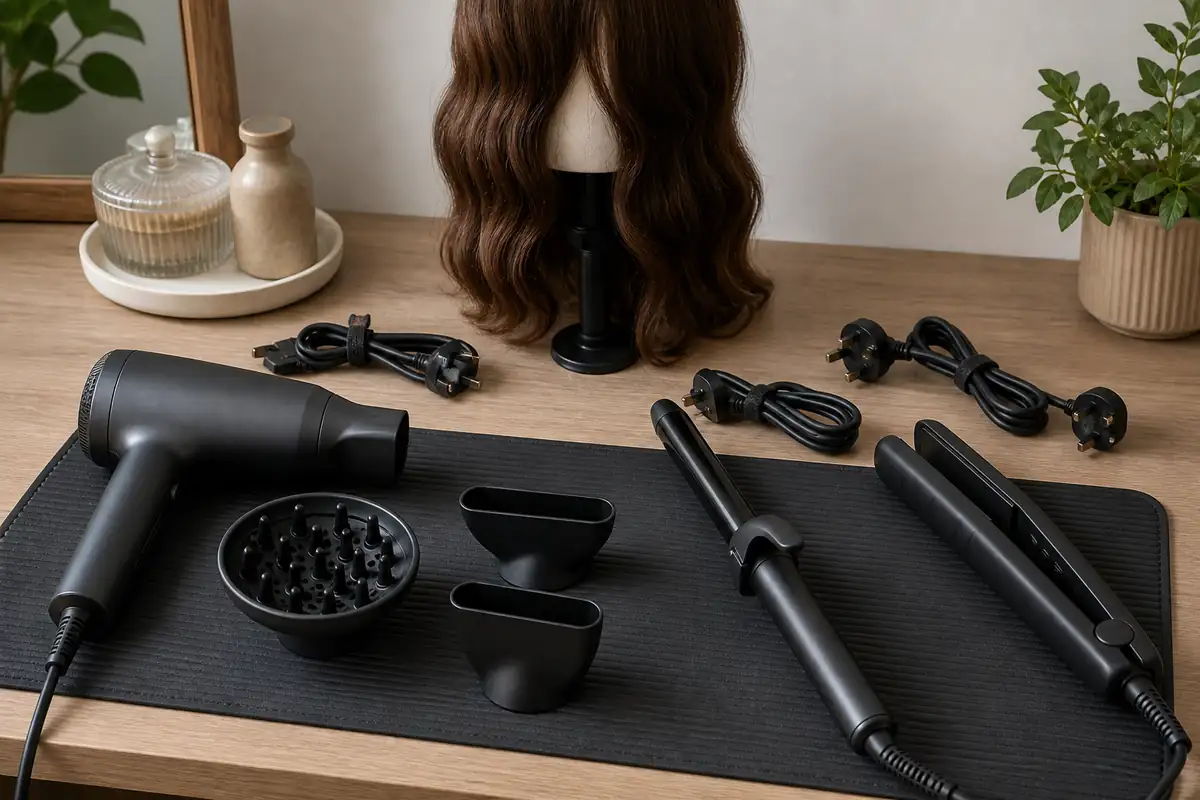
A concentrator narrows dryer airflow for controlled sections; a diffuser spreads airflow and supports curl patterns; a smoothing brush combines tension and airflow; a round brush adds shape; curling barrels set a diameter and direction. Two heads with slightly different fins may not create two meaningful jobs.
Check whether each attachment locks positively, can be removed only after cooling, and has a heat-safe gripping area. Find the price and availability of replacements. A proprietary system loses versatility when one essential head breaks and cannot be bought separately. Include cases, filters and replacement parts in the total ownership cost.
Ergonomics matter over the full styling time
Published weight may exclude the cable and attachment, while the balance point can matter more than the number. A top-heavy dryer or long multi-styler amplifies wrist effort. Compare the ready-to-use configuration and imitate the intended movements before committing where a demonstration is available.
Look at grip diameter, button position, swivel movement and cable length for the actual socket and mirror arrangement. An extension lead across a wet room is not a sensible workaround. A stand or heat-resistant mat must suit the hot surface, and the tool should not roll toward an edge.
Electrical safety is a pass-or-fail check
Buy from a traceable seller, check the manufacturer or UK responsible party information, model identifier, instructions and correct UK plug. Product-safety markings are part of compliance evidence, not proof by themselves. Search the official Product Safety Alerts, Reports and Recalls page for the exact brand and model, especially when buying old stock or second-hand.
Never use a mains styling tool near water contrary to its instructions, wrap the cable tightly around a hot body, carry it by the lead or ignore exposed wires. Allow it to cool on a suitable surface and unplug it as directed. Bathrooms have specific electrical-installation requirements; do not improvise socket or adaptor arrangements.
If a product is recalled, stop using it and follow the official remedy rather than attempting a home repair. A listing disappearing after purchase is a reason to preserve order details and contact the seller. Our guides to checking an online shop and identifying the responsible seller help before checkout.
Cleaning and storage determine whether controls stay useful
A dryer filter clogged with lint restricts airflow; product residue on plates or barrels can create uneven contact and odour. Follow the maker’s unplugging, cooling and cleaning method. Do not insert tools into a filter, immerse an appliance or apply a solvent unless expressly permitted.
Store attachments dry and protected so locking tabs are not crushed. Avoid closing straighteners on a cable, putting hot tools straight into a closed case or leaving small heat-resistant gloves where a child could treat them as toys. If the kit is too awkward for its storage location, unused heads become clutter rather than value.
Which tool format should you choose?
Your routine is stable and repeatable
You mainly dry, straighten or curl in one way and value simpler controls, easier storage and the ability to replace one device independently.
You will use several distinct attachments
You can name the job for each head, the combined handling suits you, replacements exist and the stored kit fits the space available.
Balanced verdict
Control, handling and safety are more valuable than attachment count. A tool earns a place when its low and medium settings work for the normal routine, the hot surfaces remain manageable, the filter or plates are easy to clean and the instructions are specific. A multi-styler is worthwhile only when several heads replace several real routines—not when they merely make the box look comprehensive.
Before buying, check online product-quality evidence, assess suspicious praise with our review guide, and read the UK returns guide. Browse more independent Beauty guidance.
Check current official guidance:
UK product safety alerts and recalls ↗Electrical Equipment (Safety) Regulations guidance ↗Electrical Safety First hair-care advice ↗
Frequently asked questions
Does higher wattage mean a hair dryer is better?
No. It describes electrical input, not the complete drying result. Airflow design, controls, nozzle, handling and technique also matter.
Is ceramic always gentler than metal?
No. “Ceramic” can describe different constructions, and temperature, surface condition, pressure and repeated passes affect exposure.
Do I need every multi-styler attachment?
No. List the routine for each head. An attachment without a distinct, repeated job should not drive the purchase.
What should I do if the cable becomes damaged?
Stop using the tool, unplug it safely and follow the manufacturer or retailer remedy. Do not tape over damage or attempt an unauthorised repair.
Can I use a UK styling tool abroad?
Only if its voltage/frequency specification, plug arrangement and instructions suit the destination. A plug adaptor does not convert voltage.
Methodology and limitations
We compared common styling-tool formats by control range, intended hair state, attachment function, handling, cleaning, storage and electrical-safety evidence. We checked current UK government safety and recall sources on 29 August 2026. No named tool or cosmetic was used or ranked.
Limitations
Hair and scalp needs vary, while manufacturers may change models, instructions and included heads. This guide is not medical, electrical-installation or professional hairdressing advice. Recheck the exact model manual, safety notices and seller terms before use.
The image is an editorial illustration, not a photograph from a product test. Links are editorial and non-affiliate.