Hair straighteners buying guide: plate size, temperature control and safety
Choose controllable straighteners that suit section size and handling, then plan the legitimate UK supply, heatproof surface, cable and cooling routine.
In this guide
Control and safe handling beat maximum heat
Prioritise stable plates, a temperature range you can set deliberately, clear status, auto shut-off, a secure grip and an intact UK fused plug. Use on dry hair only when the manufacturer permits, keep away from water and children, unplug after use and cool fully on a heat-resistant surface.
Compare the category with our straightener explainer, hair-styling tool guide and hair-dryer buying guide before choosing another heated appliance.
| Feature | What to assess | Common mistake | Safer decision |
|---|---|---|---|
| Plate width | Section size, root access and tool bulk | Assuming wider is always faster | Match plate to routine and reach |
| Temperature | Adjustable range and clear control | Choosing the maximum as the default | Use maker and hair-care guidance |
| Handling | Weight, hinge, grip, cord and controls | Testing only while switched off in a box | Preserve returns and assess safely |
| Safety | UK plug, status, auto shut-off and mat | Relying on auto-off instead of unplugging | Build a complete cool-down routine |
Check before buying
- Exact UK model and legal seller.
- Plate width, length and edge shape.
- Temperature range and adjustment steps.
- Heat-up and ready indication.
- Auto shut-off timing and conditions.
- Tool and cable weight.
- Swivel, cord length and storage method.
- Heat mat, pouch and warranty support.
Start with the hair section and styling route
A wider plate can cover a larger section of long, dense hair, while a narrower body can be easier around shorter styles, fringes and roots. Neither is universally faster: oversized sections may heat unevenly and require repeated passes, while a bulky tool can reduce control. Follow the manufacturer’s sectioning guidance and avoid choosing width solely from a dramatic time claim.
Rounded outer edges may support certain bends, but the casing can still be hot and a straightener is not automatically designed as a curling tool. Decide whether the real task is smoothing, straightening or occasional shaping and choose a model documented for it. If several tools duplicate the same job, our shortlisting guide helps remove features with no defined routine.
Understand plate alignment and movement
Plates should meet as intended without obvious sharp edges, chips or loose movement. Some designs use floating plates that move slightly to maintain contact; movement is not automatically a fault, but it should match the manual and remain stable. Poor alignment can encourage squeezing or repeated passes. Inspect a cool, unplugged tool on arrival before exposing hair to heat.
Ceramic, titanium, mineral and coating claims are not standardised performance guarantees. A surface label does not tell the reader coating thickness, temperature consistency or lifespan. Ask what the manufacturer actually specifies and whether independent evidence uses the exact model. Do not claim that a material is universally healthier for hair; technique, temperature, section size and prior condition matter.
Choose controllable temperature rather than a record maximum
Electrical Safety First notes that straighteners can reach temperatures up to about 220°C. That capability is a burn hazard, not a target. A useful control should be deliberate, visible and difficult to change accidentally in the grip. If a tool has only one high setting, confirm that it matches qualified hair-care advice and the manufacturer’s intended use before purchase.
Start from the maker’s instructions and use the lowest setting that achieves the intended result without repeated passes. Hair that is bleached, chemically treated, fine or damaged may need different professional advice. This guide cannot prescribe a temperature for an individual. Stop if the tool or hair produces smoke, abnormal odour or unexpected heat behaviour, and do not use improvised liquids or oils unless expressly permitted.
Assess controls, weight and cord together
Check whether the power and temperature controls sit under the fingers during normal use. An accidental button press can change heat without notice. A lock can help only if its operation is clear. Include the cable in handling: a heavy or stiff cord can pull the tool, while a short cord can tempt unsafe extension arrangements. The swivel should move smoothly without exposing conductors.
Grip the unplugged display model if a retailer safely provides one, but do not treat a few seconds as a full routine. Consider the longest session, dominant hand, reach to the back of the head and where the hot tool will be set down between sections. The review-reading guide helps identify recurring control or hinge complaints without accepting unverified burn stories as model-wide proof.
Require a legitimate UK electrical product
Buy from an identifiable seller and confirm the exact product is intended for the UK supply with a standard fused three-pin plug and appropriate instructions. Electrical Safety First advises being cautious of counterfeit electrical beauty products, which may omit essential safety components. An unusually low marketplace listing, misspelt brand page or two-pin plug with an adapter deserves rejection, not an experimental power-on test.
Check the seller and domain independently using our genuine-shop guide. On arrival, compare model, plug, cable, casing and accessories with the order. Do not use a tool with cracks, exposed parts, loose plates, cable damage or evidence of overheating. Save serial and receipt details privately and check the UK product safety alerts database.
Build a heatproof use and cooling station
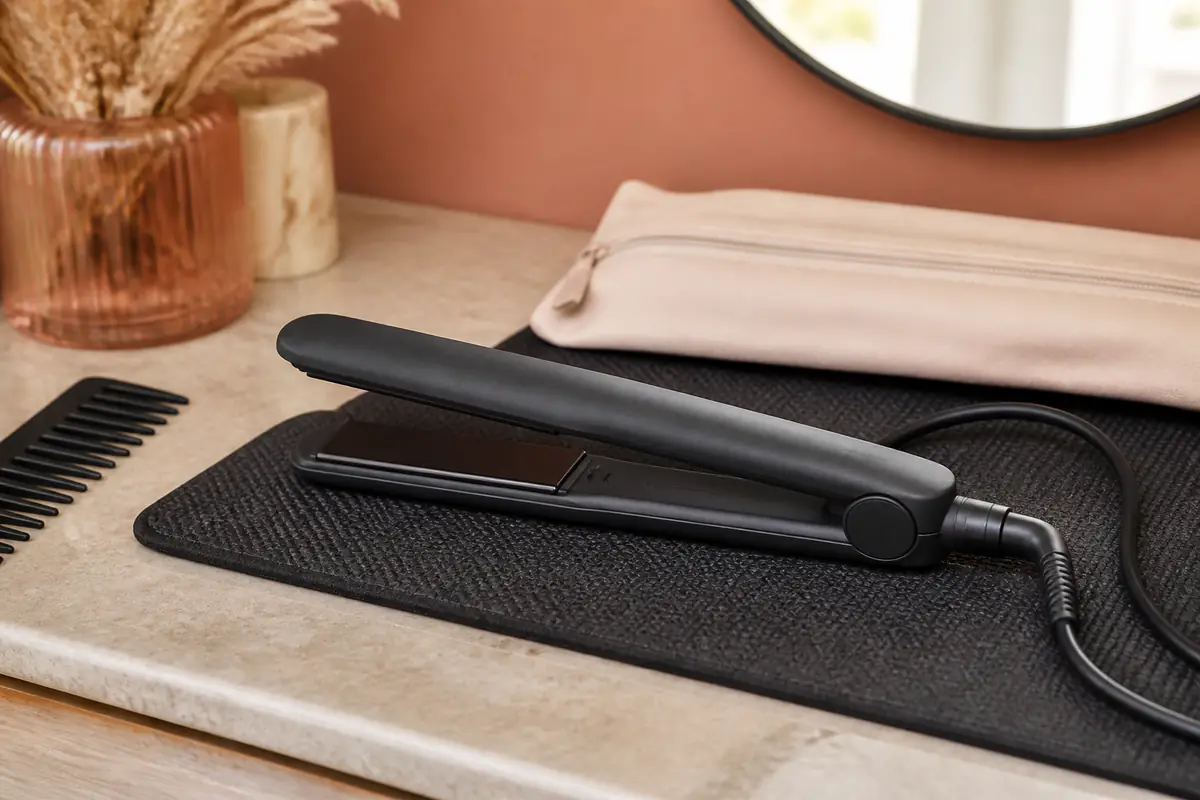
Place the straightener on a stable heat-resistant mat away from towels, bedding, carpet and polished surfaces that can scorch. Keep it away from baths, basins, wet hands and any place where it could fall into water. Electrical Safety First says not to use straighteners on wet hair and warns that they can remain hot for up to around 40 minutes after use.
Keep children and pets out of reach during use and cooling. A pouch is heat-resistant only to the extent stated by its manufacturer; do not assume a travel case accepts a live or hot tool. Unplug by holding the plug, not pulling the cable, and leave the plates open or closed only as instructed. Auto shut-off is a backup feature, not permission to leave the appliance connected.
Protect the cable and storage route
Do not wrap the mains lead tightly around the straightener. Repeated bending at the entry point can damage conductors, and residual heat can affect insulation. Allow complete cooling, loosely coil the cord according to the instructions and store the tool where plates and hinge are protected without crushing the cable. Keep the heat mat dry and inspect it for damage.
A travel lock can reduce bulk but should never be forced against trapped cable or debris. For overseas use, confirm voltage and plug compatibility from the exact rating plate and manufacturer; a physical adapter does not convert voltage or certify the local installation. If unclear, leave the tool at home rather than relying on a generic travel claim.
Clean only when unplugged and cold
Product residue can collect on plates and edges, affecting glide and smell. Follow the manufacturer’s cleaning method, normally only after unplugging and full cooling. Do not immerse the tool, allow liquid into controls or scrape a coating with metal. Avoid solvents or abrasive pads unless the manual explicitly permits them.
Inspect the plug, flex, strain relief, body, plates and hinge regularly. Stop using the appliance after sparking, burning smell, unusual noise, erratic temperature, exposed wiring, a cracked body, repeated tripping or a relevant recall. Do not tape a mains cable or attempt a home internal repair. The faulty-goods guide covers retailer evidence and remedies.
Record ownership and react to safety alerts
Register the appliance with the manufacturer or the Register My Appliance service when appropriate so model-specific safety information can reach the owner. Registration does not replace consumer rights and should be completed only through an official route. Keep model, purchase date and serial details somewhere separate from the tool without posting them publicly.
Search the official UK safety alerts database for the exact model when buying and if behaviour changes. A recall for one batch does not make every straightener unsafe, but a matching identifier requires following the stated action rather than continuing to use it. Our warranty and registration guide explains how to preserve evidence without confusing a voluntary warranty with statutory rights.
Choose wider or narrower plates?
Long dense sections dominate
The tool remains controllable and the documented plate and temperature settings fit the routine.
Precision and shorter sections matter
Root access, fringes or compact handling are more important than maximum coverage per pass.
Balanced verdict
Choose the straightener you can control at an appropriate setting and cool safely, not the one advertising the highest temperature. Plate size, alignment, controls, cord, legitimate UK supply and the heatproof routine all matter.
Use the linked straightener, styling, dryer, shortlisting, reviews, genuine-shop, faulty-goods and warranty guides.
Official checks:
Electrical Safety First straightener and tong guidance ↗
Electrical Safety First beauty burns information ↗
UK electrical product safety alerts and recalls ↗
Register My Appliance service ↗
Frequently asked questions
Are wider straightener plates always faster?
No. They cover more area but can reduce precision or encourage sections too large for even styling. Match width to hair and handling.
How should I choose a controllable straightener heat setting?
Follow the exact manufacturer and qualified hair-care advice. Use controllable heat and do not treat the maximum as a target.
Can I straighten wet hair?
Electrical Safety First advises not using straighteners on wet hair. Follow the exact tool instructions and keep the appliance away from water.
Is auto shut-off enough?
No. Automatic shut-off is a secondary protection, not a substitute for finishing the straightener’s safe shutdown routine. Switch off, unplug safely and cool the tool fully on a heat-resistant surface after every use.
When should I stop using straighteners?
Stop after cable, plug, plate or casing damage, erratic heat, burning smell, sparking, tripping or a matching safety alert.
Methodology and limitations
We reviewed current Electrical Safety First guidance on hair straighteners, tongs and beauty burns, the UK product-safety alerts route and appliance registration information on 2 September 2026. We assessed plate, heat, handling, seller, cable, cooling, cleaning and ownership decisions. We did not heat, style with or electrically test individual products.
Limitations
Hair condition, technique and accessibility are individual. Specifications, prices, recalls and warranties change. This guide is not hair-health, medical or electrical advice and does not replace manufacturer instructions or a qualified professional assessment. Recheck the exact UK model and current alerts before purchase.