Cordless vacuum cleaners buying guide: floor heads, battery, filtration and weight
A cordless vacuum is a floor head, airflow path, battery and maintenance routine carried in one hand. Match it to floor mix, stairs and storage, then check weight in working positions rather than comparing headline suction alone.
In this guide
Choose the floor head and handling before maximum mode
Map hard floor, carpet, rugs, stairs, upholstery and pet hair, then confirm the supplied tools suit those surfaces. Quoted runtime often depends on low power without a motorised head; useful cleaning time, balance and easy maintenance matter more.
Decode endurance with battery-life claims explained, compare repair through spare parts and repairability, and plan cost with total ownership cost.
| Home need | Prioritise | Test | Watch for |
|---|---|---|---|
| Mostly hard floor | Soft or suitable roller and edge pickup | Fine debris along skirting | Head that scatters larger crumbs |
| Carpet and rugs | Agitation control and manageable push force | Several pile types | Strong suction that stalls or lifts rugs |
| Stairs | Balanced handheld weight and secure tools | Reach and wrist angle | Top-heavy body and loose attachments |
| Pets | Hair-resistant brush access and filtration | Hair on floor and upholstery | Hidden cutting and filter workload |
Pre-purchase vacuum record
- Map every floor and rug type.
- List stairs, car and upholstery needs.
- Record body and working-position weight.
- Check supplied heads and tool storage.
- Compare runtime with powered head.
- Review filter washing and drying.
- Price battery, filters and brush parts.
- Measure charging and storage space.
Map surfaces before comparing specifications
Count hard floor, low and deep carpet, loose rugs, stairs and upholstered areas. Note thresholds, narrow gaps and furniture clearance. A head excellent on one surface may push badly or scatter debris on another.
Check maker guidance for delicate boards and rugs. Do not assume a soft roller is safe for every finish or that maximum agitation suits fringes.
Treat the floor head as the primary cleaning tool
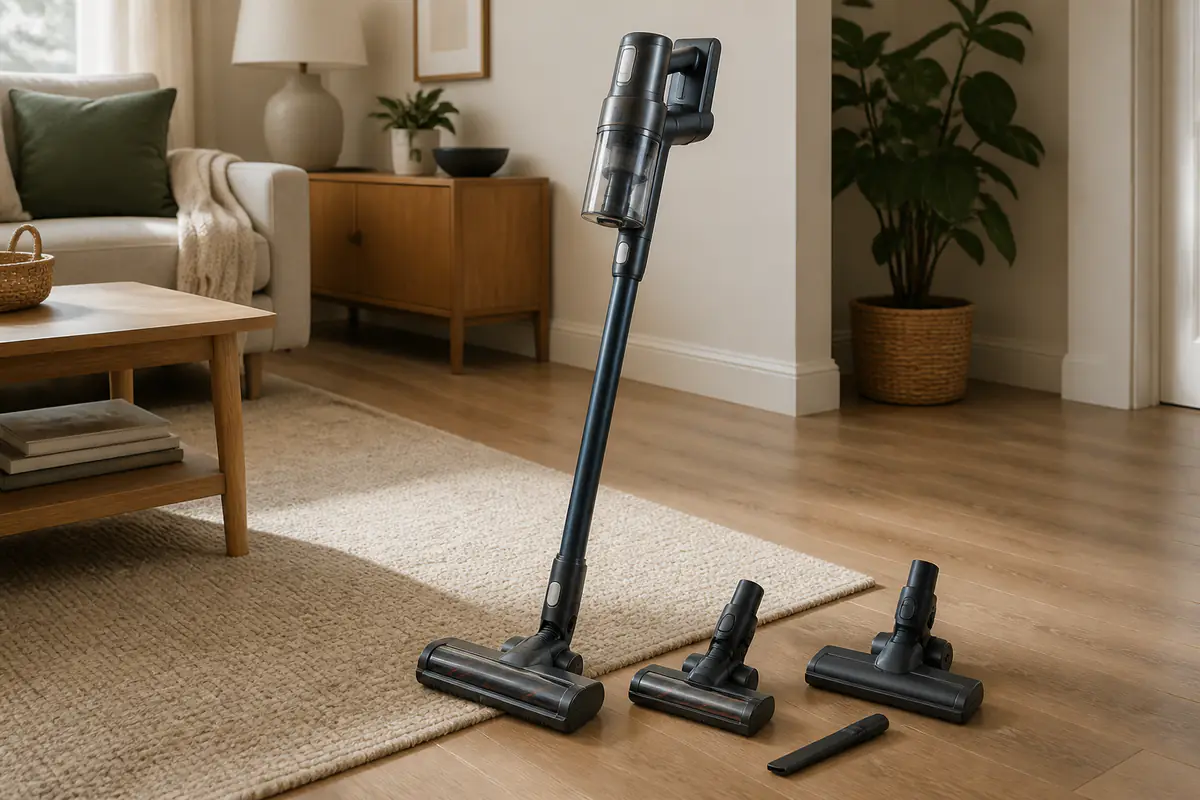
Look at roller type, width, edge approach, articulation, lights and access for hair removal. A wide head covers open rooms quickly but can be awkward between chair legs.
Check whether suction or brush rotation can be adjusted. Motor protection that stops on a rug is different from a cleaning mode designed for it.
Compare runtime in the configuration you will use
Runtime claims vary with mode, floor head, battery age and debris load. Find figures using the motorised head and normal setting, then estimate the area cleaned before recharge.
Maximum mode can be brief and noisy. A second removable battery helps only if it is included or realistically available and can be charged safely.
Judge weight through movement, not one number
Total kilograms do not describe wrist torque, handle shape or centre of mass. Consider floor strokes, overhead reach, carrying upstairs and handheld tool use.
If possible, lift and turn the machine in a controlled demonstration. Users with pain, weakness or balance concerns may need professional ergonomic advice rather than a heavier flagship model.
Inspect bin emptying and dust contact
Check bin volume, maximum line, release direction and whether hair bridges the inlet. A small clean-looking bin may need frequent emptying, while a large bin can make the machine bulky.
People sensitive to dust may prefer a bagged system or lower-contact emptying. Empty according to instructions and never reach near a powered brush.
Read filtration as a sealed system question
A named filter grade matters only with the whole airflow path and correct maintenance. Compare broader claims with vacuum specifications explained. Check pre-filter, exhaust filter, seals, replacement interval and whether washing is permitted.
A washable filter must dry completely for the stated time. Reinstalling damp media can damage performance and hygiene. Filtration claims are not medical treatment advice.
Price routine maintenance before buying
List brush cleaning, hair cutting, filter washing, bin seals and blockage access. Check whether tools are included and whether disassembly is understandable without specialist force.
A machine that needs frequent hidden maintenance may lose useful suction despite an impressive new-product claim. Save the manual before purchase.
Plan charging without heat or cable strain
Measure wall, cupboard or floor-dock space, including tool storage and ventilation. Confirm whether mounting needs drilling and whether the charger cable reaches without an extension.
Use only supported charging equipment and keep the battery away from heat, damp and impact. Stop for swelling, smell, unusual heat or damage and follow official safety guidance.
Check battery and parts support
Look for an official replacement battery, charger, filters, roller and small wear parts with clear model compatibility. Removable does not mean affordable or available throughout ownership.
Opening a battery pack is not a normal user repair. Use product lifespan guidance to compare repair path with replacement.
Treat pet-hair tools as a maintenance trade-off
Powered mini heads can improve upholstery pickup while collecting hair around bearings and rollers. Check access, cutting grooves and whether the tool is suitable for the fabric.
Pet households also need odour and filter care. Do not vacuum wet accidents, hot ash or hazardous dust unless the exact machine is designed for it.
Check noise and household disruption
Compare sound at the setting likely to be used, including the motorised head on hard floor and carpet. A sharp brush or turbine tone can be more disruptive than one headline decibel figure, especially around pets, children or shared walls.
Plan cleaning time and storage so the machine is convenient without remaining on charge in a walkway. Noise preference does not override safety: stop if a new grinding, burning smell or abnormal vibration appears.
Run a return-window route test
Keep packaging and test normal floors, edges, stairs, sofa, bin, noise, charge and storage without abusing the machine. Record mode and powered head so runtime observations are comparable.
Check for wrist strain, head stalling, debris scatter and tool release. Browse Home & Kitchen for separate floor and appliance guidance.
Create a maintenance log for declining performance
Record the date, filter condition, brush cleaning, blockage checks, battery charge behaviour and any error indicator before and after maintenance. Use the manual sequence and allow washed parts to dry fully. A simple log separates gradual workload from a sudden fault and supports a clearer warranty or repair conversation.
Do not compensate for persistent loss of pickup by using maximum mode everywhere. Recheck the head, airflow path, seals and approved filters, then seek the supported service route when symptoms remain. Stop immediately for abnormal heat, smell, swelling, damaged wiring or a grinding part.
Cordless or another vacuum format?
Convenient frequent cleaning outweighs runtime limits
The floor head suits the home, working weight is manageable, one charge covers realistic tasks and battery and filter parts are supported.
Long sessions or low-dust disposal matter more
The home needs sustained power, large capacity, lower-contact emptying or a purchase without battery ageing and charging storage.
Balanced verdict
A cordless vacuum should be selected as a complete handling and maintenance system. Match the head to floors, compare powered-head runtime and price filters and batteries before purchase.
Keep packaging and test the real cleaning route during the return window, including stairs, emptying and storage.
Official checks:
GOV.UK product safety alerts and recalls ↗
Recycle Your Electricals ↗
HSE manual handling guidance ↗
Frequently asked questions
How much runtime does a cordless vacuum need?
Estimate the actual route using the powered head and normal mode, not the longest low-power headline figure.
Is higher suction always better?
No — Floor-head design, sealing, agitation, debris type and push force all affect useful pickup.
Are washable filters cheaper?
They can be, but need correct washing, complete drying and eventual replacement according to instructions.
Should the battery be removable?
It helps only when genuine compatible replacements are available at a reasonable cost and can be charged safely.
Is cordless suitable for allergies?
Consider the complete sealed filtration and emptying method. Seek medical advice for health needs; a bagged low-contact system may be preferable.
Methodology and limitations
We assessed cordless vacuums through surfaces, floor heads, runtime, weight, bin, filtration, maintenance, charging, parts, pet tools and return testing. We did not laboratory-test or rank named models.
Limitations
Homes, users, batteries, debris and floor finishes vary. Verify exact official specifications and surface guidance, and obtain suitable help for mounting or handling concerns.