Bedding Colour and Texture Without a Full Redesign: A Practical UK Guide
Changing the duvet cover and one texture layer can reshape a bedroom without replacing furniture. Build the palette from fixed surfaces, then check dimensions, included pillowcases and care.
In this guide
Change the bed in two layers, not the whole room
Use the duvet cover as the main colour field and add texture with one throw, quilt or pair of cushion covers. Keep at least one colour from the existing walls, curtains, carpet or headboard so the new bedding looks connected rather than accidental. Measure the duvet itself, check whether pillowcases are included and favour a washable fibre you will actually care for.
A bedroom refresh fails when shopping starts with isolated “nice” products. A terracotta throw, green cushion and patterned duvet may each look attractive online yet compete in the same room. This guide builds a small palette from existing finishes, explains what common fabrics contribute, and compares current UK prices without pretending a higher thread count or expensive fibre automatically creates a better bedroom.
Build a bedding colour palette from what cannot move
Photograph the room in daylight and again with its normal evening lamps. List the fixed elements: wall colour, floor, wardrobe, headboard, curtains and any large artwork. Do not rely on colour names such as beige, sage or blush. Two products with the same label can have different undertones, and a cool grey wall can make a yellow-based cream appear dirty.
Choose three roles rather than three equal colours:
- Base: the calm colour covering most of the bed. It can repeat a wall, curtain or neutral already present.
- Bridge: a middle colour that connects the base to the room—for example a muted green that relates warm wood to off-white bedding.
- Accent: a smaller, stronger colour used once or twice, not scattered across every accessory.
A simple ratio is roughly 70% base, 20% bridge and 10% accent across the visible bedding. It is a visual check, not a rule requiring mathematical measurement. If the room already contains a strong patterned curtain or wallpaper, the bed usually works better as a quieter base with texture. If the room is plain, a stripe or restrained floral duvet can provide the pattern while cushions remain solid.
Warm and cool combinations that are difficult to misuse
| Existing room | Useful bedding direction | Controlled accent | What to avoid |
|---|---|---|---|
| Warm white walls, oak or rattan | Oatmeal, clay, warm pink, olive or faded blue | Terracotta or mustard | Large areas of blue-grey that make the white look yellow |
| Cool white or pale grey walls | Blue-grey, charcoal, dusty green or clean white | Berry, ink blue or cool pink | Too many cream and camel tones without a cool bridge |
| Dark blue or green wall | Stone, natural, pale pink or light blue | A small repeat of the wall colour | A matching dark duvet that removes all depth from the bed |
| Patterned curtains or wallpaper | Pull one quiet background colour from the pattern | One minor pattern colour | Adding a second unrelated large print |
Place shortlisted fabric beside the headboard and wall for a full day. A phone screen is useful for comparison, not colour truth. If swatches are unavailable, order the smallest returnable item in the same range, such as a pillowcase, before committing to a king-size set. Check return exclusions because opened bedding may be treated differently for hygiene reasons.
What bedding texture contributes
Texture changes how light falls across a large plain surface. It can make a single-colour bed feel layered without introducing another pattern. The important question is not which fabric sounds most luxurious; it is how the surface feels, washes, dries and looks after the user has lived with it.
| Material or finish | Visual effect | Practical character | Best use in a refresh |
|---|---|---|---|
| Plain cotton or cotton percale | Clean, relatively crisp surface | Familiar care, breathable; exact feel depends on yarn, weave and finishing | A calm base under a textured throw or patterned cushion |
| Washed cotton | Relaxed, softly creased appearance | Designed to look less formal; still check temperature and tumble-dry instructions | Softening a modern or minimal room without extra pattern |
| Sateen | Smoother surface with more lustre | Can show marks and creases differently from matte cloth | A refined base when the room already has rough wood, wool or boucle |
| Seersucker, pintuck or dobby | Visible shadow and relief | Texture is built into the construction; check whether it needs careful ironing | Adding interest to an all-white or tonal bed |
| Muslin | Soft, casual and slightly crumpled | Airy feel; looser-looking surfaces may snag more easily in some homes | A relaxed layer in muted colour |
| Linen | Distinctive slub and natural crease | Often expensive; softens with use, but care and matching pillowcase costs matter | One premium tactile layer when the long-term look is genuinely wanted |
Thread count is not a standalone quality score. Fibre length, weave, fabric weight, finishing and construction can matter as much as the number. A 144-thread-count cotton set that fits, washes well and suits the room can be better value than a glossy high-count set the household dislikes sleeping under. Use the same evidence discipline described in our guide to judging product quality online.
Use one hero texture
Choose a single dominant surface: a seersucker duvet, washed-linen cover, knitted throw, velvet cushion or quilted bedspread. Let the remaining pieces support it. Combining bouclé, pom-poms, heavy cable knit, velvet, tassels and a textured duvet can make a small bed look busy and creates several care regimes.
Think about pets, children, allergies and drying space. A loose weave may catch claws; a heavy throw may not fit the washing machine; decorative cushion covers may require a cycle the rest of the bedding does not. Read the sewn-in care label before discarding packaging and wash any colour-sensitive item separately at first.
Measure the duvet, mattress and visible drop
UK labels are not enough because dimensions can differ between retailers and imported ranges. Dunelm’s current pages commonly list double duvet covers at 200 × 200cm, kingsize around 230 × 220cm and super kingsize around 260 × 220cm. IKEA’s current double example is 200 × 200cm, while Zara Home also lists a 220 × 220cm “double” option alongside 200 × 200cm. Match centimetres to the duvet label—not the familiar word alone.
For fitted sheets, measure mattress width, length and depth including any topper. A sheet’s stated pocket depth needs working allowance; an exact 30cm pocket over an exact 30cm mattress may pull at the corners. For bedspreads and throws, measure mattress width plus the drop wanted on each side. A decorative 130 × 170cm throw may cover the foot of a double bed but will not behave like a full bedspread.
Pillowcase quantity also changes value. Single sets often include one case, while double, king and super king sets often include two; Zara Home duvet covers are commonly sold separately from pillowcases. Record the complete basket, not just the duvet-cover price. Our measurement method uses the same principle: the written dimensions beat the category name.
Current UK bedding price snapshot
These official UK examples were checked on 24 August 2026. They show how fibre, texture and what is included move the basket price. They are not durability rankings, and we did not sleep in or wash the products.
| Exact official example | Checked price | Material / size / contents | Useful role |
|---|---|---|---|
| Dunelm Soft Washed Cotton duvet cover set | £30–£55 across sizes, checked 13 September 2026 | 100% cotton, 180 thread count; double is 200 × 200cm with two pillowcases | A plain base with button closure; compare the selected size and colour at checkout |
| IKEA ÄNGSLILJA | £25 double | Cotton, 200 × 200cm cover and two 50 × 80cm pillowcases; several muted colours listed | Tonal base with a softly relaxed appearance |
| H&M Home striped duvet cover set | £39.99 double/king | Striped set; exact selected size, fibre and contents require confirmation on its product page | Controlled pattern when the room’s fixed surfaces are plain |
| IKEA LÄKEVÄNDEROT | £45, 200 × 200cm | 100% lyocell, 260 thread count, dobby-effect texture and two 50 × 80cm pillowcases | A cooler-feeling textured option whose fibre and sheen differ from plain cotton |
| Zara Home plain linen duvet cover | £85.99–£149.99 displayed range | Certified European-grown linen; size-specific price appears after selection and pillowcases are separate | Premium natural texture; compare the complete basket and care routine |
Dated evidence: the Dunelm Soft Washed Cotton example was checked on 13 September 2026 at £30–£55 across sizes. The IKEA, H&M Home and Zara Home examples were recorded on 24 August 2026: IKEA showed £25 and £45 for the selected 200 × 200cm sets, H&M showed £39.99, and Zara Home showed £85.99–£149.99 across sizes. These examples were checked on different dates and do not establish which retailer is cheapest today. Recheck the selected size, colour, included pillowcases and complete basket before ordering.
The £14 and £149.99 endpoints are not like-for-like. The lower range covers a cotton set with pillowcases, while the linen example is a duvet cover alone. A double linen pillowcase basket can add materially to the total. Compare cost per year only after deciding that linen’s appearance and care are worth keeping; our cost-per-use framework helps challenge a trend-led premium.
Three bedroom refresh plans
Plan one: colour change under £60
Keep the existing sheet and pillows. Choose a plain or striped cotton duvet set in a bridge colour, then add one washable cushion cover or a throw already owned elsewhere in the home. Spend first on the surface covering most of the bed. A £14–£40 cover leaves room for delivery or one accent without forcing several matching accessories.
This plan suits a rental because it does not depend on painting or permanent fittings. Repeat the accent once in a small item already present—book spine, artwork or lamp base—rather than buying a complete themed collection. If the new colour works only with five additional purchases, it is the wrong colour.
Plan two: texture-first tonal bed
Use two neighbouring neutrals—white with oatmeal, stone with taupe, or pale grey with blue-grey—and let the weave create contrast. A seersucker or washed-cotton duvet can be the textured surface; keep cushions smooth. Alternatively, retain a smooth cotton duvet and add one quilted or woven throw across the lower third.
This is the safest route for a room containing strong art, patterned curtains or multiple woods. Texture reads in daylight and under bedside lamps without becoming another competing print. The logic is similar to choosing upholstery: fibre name alone does not explain construction or cleanability, as our sofa-fabric guide shows.
Plan three: controlled warm palette
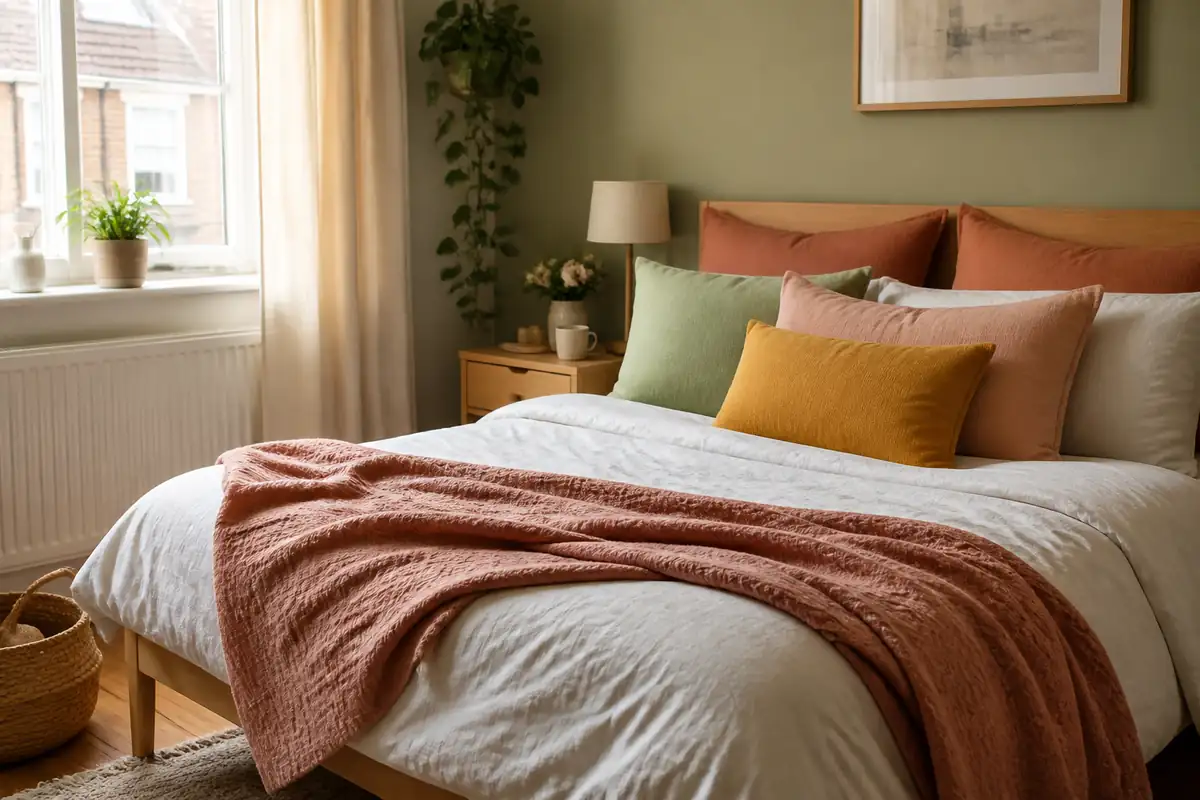
Start with warm white, oatmeal or pale blush bedding. Add a terracotta or coral throw, then one muted sage or mustard cushion as the small contrast. Keep metal finishes and existing wood visible; they help ground the colour. In a cool-grey room, introduce the warm palette through a dusty bridge colour rather than moving directly from blue-grey to orange.
Order only after viewing samples in the room’s evening light. Warm LED lamps can shift pink towards peach and make green appear more olive. A strong store photograph is a prompt to sample, not proof of the result at home.
Delivery, returns and washing checks
Bedding is easy to deliver but not always easy to return once opened. Check the retailer’s current hygiene exclusions, whether a change-of-mind return requires original packaging and whether an online item can go back to a store. Our Dunelm review and IKEA UK review explain their wider fulfilment and return routes; order-specific terms still control the purchase.
Before washing, compare every layer’s label. A duvet cover safe at 60°C paired with a delicate throw does not become one laundry load. Consider drying time and drum capacity: thick king-size linen or a large quilt can overwhelm a small machine. Dark saturated colours may transfer during early washes, while optical brighteners can change some muted shades. Follow the maker’s instructions rather than a universal internet rule.
Inspect stitching, closures and fabric before the first wash. Check that buttons or zips run cleanly, seams lie flat and pillowcases match the listing. Photograph any fault immediately. Once the colour, feel and dimensions are accepted, wash before use if the care guidance permits.
Common bedding styling mistakes
- Buying the accent first. A striking cushion does not establish the 70% base colour and can force an awkward palette.
- Using texture as clutter. One strong weave creates depth; five unrelated surfaces compete.
- Matching names instead of samples. “Natural” from two retailers can mean pink-beige, yellow-beige or grey-beige.
- Ignoring centimetres. Double and king labels can hide different dimensions and pillowcase conventions.
- Pricing only the duvet cover. Separate pillowcases, fitted sheet, delivery and a compulsory insert change the basket.
- Designing for a photograph. A bed with ten cushions may be attractive at noon but irritating every night.
- Choosing care later. The right textile must fit the washing machine, drying space, pets and desired temperature.
A seven-step shopping checklist
- Photograph fixed room colours in daylight and evening light.
- Select base, bridge and accent roles; remove any fourth competing colour.
- Measure duvet, mattress depth, pillows and desired throw drop in centimetres.
- Choose one hero texture and a care routine the household will follow.
- Build the complete basket, including pillowcases and delivery.
- Use the shortlisting method to compare three exact options rather than browsing indefinitely.
- Confirm stock, return eligibility and care before opening or washing.
The palette already works
Introduce one tactile layer through a throw, cushion or cover and judge it in the room’s real daylight before adding more.
The room needs a clearer visual direction
Repeat one controlled accent across a small number of washable pieces rather than buying a full matching set at once.
Our verdict
The most effective bedding refresh is a disciplined edit: one main colour field and one tactile layer. Plain cotton offers the least expensive base, seersucker or washed cotton adds visible texture without another pattern, and linen is worth its premium only when the buyer values its specific creased appearance and care over several years.
Use centimetres, not only UK size labels; compare the complete set; and see colour in the actual room. A £25 cover that links the walls, floor and headboard can look more intentional than a £150 cover bought in isolation. For more practical room guidance, browse Home & Kitchen, our guide to judging furniture quality and the UK retailer directory.
Check current official information:
Dunelm Soft Washed Cotton duvet cover set ↗IKEA ÄNGSLILJA set ↗IKEA LÄKEVÄNDEROT set ↗H&M Home duvet-cover sets ↗Zara Home linen duvet cover ↗
Frequently asked questions
What bedding colour makes a small bedroom look bigger?
A lighter base can preserve visual continuity, especially when it relates to the wall colour, but size perception also depends on contrast and clutter. Keep the largest bed surface calm and use one smaller accent rather than several disconnected dark blocks.
How many colours should bedding have?
Three roles are normally enough: a dominant base, a connecting bridge and a small accent. They need not be three separate products. A striped duvet may already provide base and bridge, leaving only one accent layer.
How do I mix bedding textures without making the bed busy?
Choose one hero texture, such as seersucker, washed linen or a quilted throw, and keep the largest remaining pieces smooth. Repeat a colour across the surfaces so the contrast comes from weave rather than several competing patterns.
Is linen bedding worth the price?
It can be when you value its slub, creased appearance and long-term softening and will follow its care instructions. It is not automatically better for every sleeper. Compare the complete basket because pillowcases may be sold separately.
Are UK double duvet covers all the same size?
No — A common double is 200 × 200cm, but current Zara Home listings also include 220 × 220cm options labelled double. Match the centimetres on the duvet and cover, then check pillow dimensions too.
Should bedding match the curtains?
It should relate, not necessarily match. Pull one background or minor colour from patterned curtains into the bedding. When curtains are bold, a quieter duvet with texture usually prevents two large patterns competing.
How we researched this bedding guide
Recommended Today checked current official Dunelm, IKEA UK, H&M Home UK and Zara Home UK product pages on 24 August 2026. We recorded exact examples, dimensions, fibres, included pillowcases, listed care information, stock warnings and prices, then used those facts to build budget and styling methods rather than a product ranking.
We did not buy, touch, wash or durability-test the products. Retailer descriptions of softness or breathability are not treated as comparative laboratory evidence. Prices, stock and volatile terms remain subject to change after the recorded check.
Prices, colours, stock, dimensions, contents, care and return rules change. Check the exact product variant, centimetres, fibre composition, pillowcase quantity, delivery and hygiene-return conditions before ordering.