Air fryer ownership guide: cleaning, coatings, smoke, safety and running costs
A sound routine matters more than a drawer full of accessories. Use the manual, leave airflow, remove grease before it carbonises and investigate changes in smell, sound or temperature instead of normalising them.
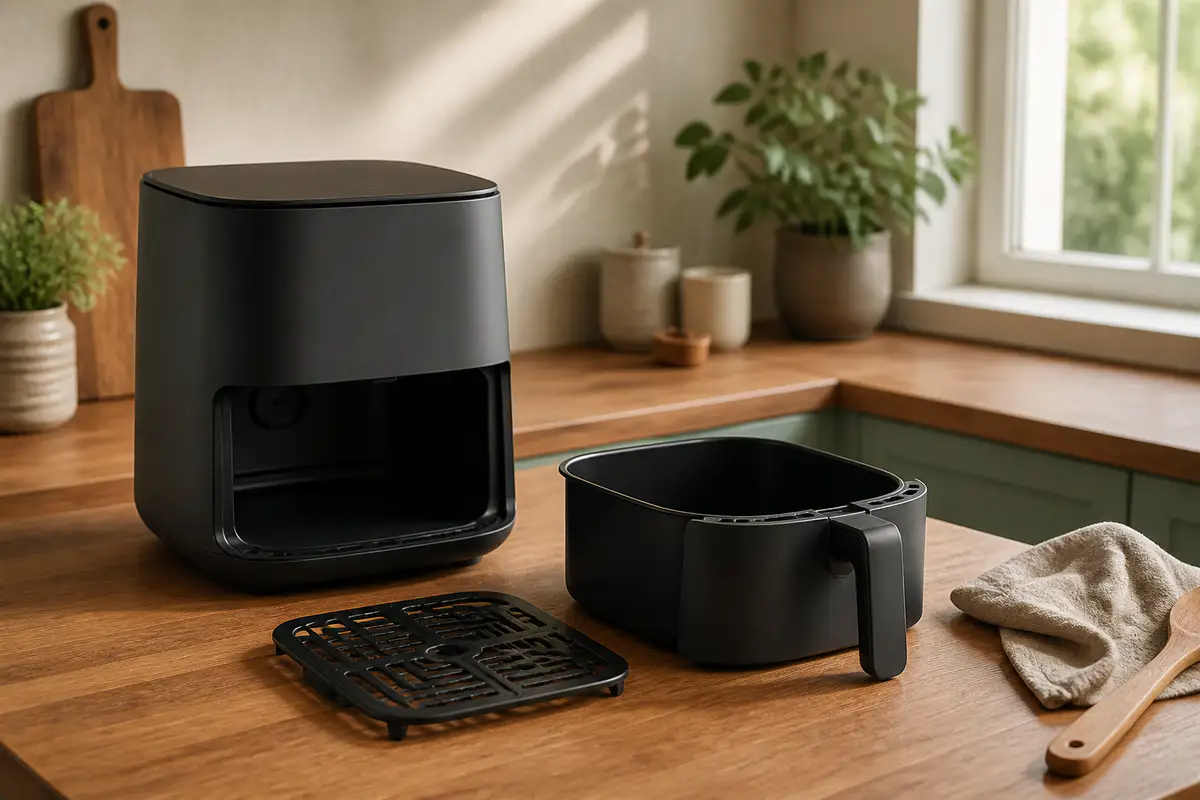
In this guide
Quick verdict
Cool, clean and dry the removable parts after use, and inspect the cavity and heater at the interval stated by the maker. Avoid metal tools and abrasive pads on coated surfaces. Do not crowd the appliance against a wall, drape its cable across heat or place it on a hob. Smoke that persists after grease and food debris are removed, damaged insulation, a loose socket, repeated tripping or unusual electrical smells are reasons to stop and seek competent advice.
This guide starts after purchase. If you are still choosing a size, compare the cooking area and load shape in our air fryer usable-capacity guide, then check the air fryer size guide. Ownership advice cannot override the instructions for an exact model: basket coatings, dishwasher permissions, clearances, maximum temperatures and replacement parts differ.
Record the model before the label fades
Photograph the rating label, serial number and plug while they are clean and legible. Save the manual, receipt and retailer details together. This makes it easier to find the correct cleaning limits, a matching basket or an official safety notice later. Do not assume that a part from a visually similar model is safe.
Read the first-use section before heating food. Some manufacturers require washing, a short empty cycle or removal of packaging supports. A brief manufacturing smell described in the manual is different from an ongoing hot-plastic or electrical smell. If the behaviour is not covered by the instructions, switch off, unplug after it is safe to do so and contact the manufacturer.
A simple after-use routine
- Switch off and unplug as directed, then allow the appliance and oil to cool in a clear area.
- Remove crumbs and grease rather than reheating them through several cycles.
- Wash only the components and by the methods the manual permits.
- Dry parts fully, including seams and handle fixings, before reassembly.
- Wipe the exterior and air openings without allowing liquid into the electrical body.
- Leave the drawer slightly open only if the maker permits it and the appliance cannot be knocked or reached by children.
Clean the basket without shortening its life
Warm water, a suitable washing-up liquid and a soft cloth or non-scratch sponge are the conservative starting point for many removable baskets, but the manual controls. Dishwasher-safe does not mean every detergent and high-temperature programme is harmless to appearance or coating life. If residues are baked on, soak only the removable component for the stated period; never immerse the electrical base.
Wood, silicone or nylon tools are generally gentler than metal, provided the material is rated for the temperature. Do not cut food in the drawer. Replace a liner that has torn, curled into the heater path or become greasy beyond cleaning. Perforated paper must be held down by food and used only when the instructions allow it; loose lightweight material can move in forced air.
Inspect the cavity and heating area safely
Grease mist and crumbs can reach surfaces above the basket. Once completely cool and unplugged, inspect by the access method in the manual. Never bend a heating element, scrape it with metal or spray cleaner into the fan or electrical openings. Some models permit a soft brush or damp cloth; others specify service access only.
Cleaning frequency depends on food, oil and use. A calendar reminder is useful, but visible build-up, smoke or odour should trigger an earlier check. If the appliance must be inverted for cleaning, do so only when the maker says it is safe, with the drawer removed and no liquid present.
| What you notice | Safe first check | When to stop |
|---|---|---|
| More smoke than usual | Cool fully; remove old grease, crumbs and unsuitable excess oil | Smoke persists when clean or comes from electrics |
| Uneven browning | Reduce crowding; confirm preheat and turning guidance | Fan sounds abnormal or heat cuts unpredictably |
| Drawer does not seat | Check correct reassembly and trapped debris | Handle, latch or rail is cracked or distorted |
| Plug or socket feels unusually hot | Stop use and disconnect when safe | Always: seek competent electrical advice |
| Coating is lifting | Stop abrasive cleaning and identify the exact replacement part | Loose material, exposed base or food contamination risk |
Airflow and placement are safety conditions
Set the appliance on a stable, level, heat-resistant surface, with every clearance required by the manual. Air inlets and hot exhaust must remain open. Do not operate under a low wall cupboard if exhaust heat or steam would strike it, and do not place the appliance on or beside an active hob. Keep its lead away from hot surfaces, sharp edges, water and paths where it can be pulled.
Plug arrangements matter. High-power cooking appliances should be used exactly as the manufacturer directs. Do not improvise with an overloaded extension, multi-plug stack or travel adaptor. A socket that is loose, scorched, buzzing or repeatedly trips is not a nuisance to work around.
Manage oil, water and smoke
An air fryer does not make every food oil-free. Follow the recipe or appliance guidance for added oil and maximum fat. Very fatty food can release hot grease; empty it only when safe. Water added to a drawer can create steam, splashing or coating stress unless a manufacturer method specifically calls for it.
Smoke can come from old grease, a crumb near the heater, excessive oil, lightweight material contacting the element or food with a low smoke point. Cool and clean before diagnosing. Never pour water into a live appliance or carry it while hot. If there is fire, follow current UK fire-service advice, keep people clear and do not take risks to save the appliance.
A routine is enough when
- Performance is stable and matches the manual
- The basket, cable, plug and casing are intact
- Odour disappears after permitted cleaning
- Parts fit without force and controls respond normally
Pause and investigate when
- Smoke continues in a clean, correctly loaded appliance
- The plug, lead or socket is hot, loose or damaged
- The fan scrapes, stalls or changes pitch abruptly
- The drawer, latch, coating or thermal controls are damaged
Cook for food safety, not colour alone
Brown surfaces do not prove that the centre of food is safe. Follow current Food Standards Agency guidance for cooking, chilling and reheating, and use a clean food thermometer where appropriate. Do not overload the drawer so heavily that air cannot move around the food. Separate raw and ready-to-eat food, wash hands and utensils, and avoid returning cooked food to a plate that held it raw.
Batch cooking changes time and load conditions. Record a successful quantity rather than assuming that doubling food only doubles time. For repeated weekday use, a written portion and turning note is more reliable than memory.
Calculate running cost from the rating and time
Power in kilowatts multiplied by hours gives kilowatt-hours; multiply that by the unit rate on the electricity tariff. A 1.5 kW appliance used at full rated power for twenty minutes would have a simple upper-bound calculation of 0.5 kWh, although thermostatic cycling can reduce actual consumption. This is not a universal promise because models, temperatures and food loads differ.
Compare the whole cooking job, not appliance labels in isolation. A smaller cavity may heat less space for one portion, while a full-size oven may be efficient for several trays at once. Our UK appliance running-cost method keeps units consistent, and the energy-efficient appliance guide explains why behaviour and load matter.
Coatings, parts and repair decisions
Stop using a basket if its condition conflicts with manufacturer guidance. Cosmetic marks and functional coating failure are not automatically the same, so document the surface and ask the maker. Buy a replacement identified for the precise model; measurements alone do not confirm airflow, latch or temperature compatibility.
A basket, rack, foot or handle may be replaceable, while faults inside a mains-powered heating appliance require competent service. Compare the authorised repair route, parts availability, age and safety rather than opening a sealed body. Our appliance repairability guide provides a structured decision.
Storage and disposal
Store the clean, dry appliance where the lead is not sharply bent and the drawer cannot fall. Do not use the cavity to hold paper manuals or accessories that could be left inside at the next use. If storing for months, inspect for pests, moisture and cable damage before reconnecting.
Electrical appliances do not belong in ordinary household waste. Use a retailer take-back route or local WEEE collection that accepts the item. Keep removable batteries separate where applicable and follow the local service’s instructions. Before buying a replacement from an unfamiliar seller, use our guide to checking a UK online shop.
Balanced verdict
Air fryers are straightforward to own when grease is removed promptly, airflow is respected and components are treated according to the manual. The routine costs a few minutes but protects both food quality and the evidence needed for a warranty claim. Accessories and cleaning hacks add little if they obscure the heater, damage the coating or contradict instructions.
The limitation is that no general guide can diagnose an electrical or thermal fault remotely. When behaviour changes after correct cleaning and loading, stop treating it as normal. Record the model and symptoms, check recalls and use the maker or a competent repair route.
Official UK checks
- Food Standards Agency: cooking food safely
- GOV.UK: product recalls and safety alerts
- GOV.UK: electrical waste responsibilities and collection context
Also use the exact manufacturer manual and current local-council disposal instructions. These can change after publication.
Frequently asked questions
Should an air fryer basket go in the dishwasher?
Put an air-fryer basket in a dishwasher only when that model’s cleaning instructions explicitly allow it. Dishwasher permission does not guarantee that every detergent and programme preserves appearance or coating life.
Why does an air fryer smoke?
Old grease, crumbs, excess oil, fatty food or loose material near the heater are common checks. Persistent smoke from a clean appliance requires investigation.
Can I line the basket with paper?
Only in the way the manufacturer allows. Loose paper can lift in forced air and must never contact the heater.
Is a hot plug normal?
Unusual heat, looseness, scorching, buzzing or repeated tripping is a stop-use signal and needs competent advice.
How often should the heating area be cleaned?
Use the model’s manual and inspect sooner when residue, smell or smoke appears. Never wet electrical openings or bend the element.
Methodology and limitations
We assessed the ownership cycle: records, cleaning, placement, food handling, symptoms, energy calculation, parts, repair and disposal. UK food-safety, recall and electrical-waste sources were reviewed on 30 August 2026. We did not disassemble, electrically test or endorse a particular model.
Limitations
Construction, coatings, dishwasher permissions, clearances and service routes vary by model. The manufacturer manual and a competent professional take priority over generic guidance.