Dish drying racks buying guide: capacity, drainage, materials and storage
A dish rack must fit the available counter, hold the household’s real wash load and move water somewhere safe. External dimensions, wire spacing and drain-tray geometry matter more than a generic place-setting claim.
In this guide
Measure the wet working zone, not an empty worktop
Mark the rack, drain board and opening path beside the sink, then test the largest plates, glasses and pans in a representative wash. Choose removable, smooth parts and drainage that reaches the sink without pooling against a wall or appliance.
A rack is temporary storage for wet, fragile objects. It must balance airflow, stability, drainage and daily cleaning in a small zone. For broader spatial decisions, use the small-kitchen buying guide.
Observe one normal hand-wash load
Count the plates, bowls, mugs, glasses, cutlery, utensils and cookware that commonly need space together. Dishwasher households may need only a compact overflow rack; hand-washing households need capacity for a complete meal. Large chopping boards and pans often decide the footprint more than plate count.
Note the awkward items: deep bowls that lean into one another, stemmed glasses, sharp knives that should not sit loose, bottle parts or children’s items. A rack with many nominal slots can still fail when their angle or spacing does not fit the household’s tableware.
Measure the whole operating area
| Dimension | Include | Common mistake |
|---|---|---|
| Footprint | Feet, tray lip and drain spout | Using basket dimensions only |
| Height | Largest plate and upper tier | Blocking a window or wall unit |
| Drain path | Spout length, rotation and sink edge | Assuming water can cross a worktop seam |
| Loading space | Hand access and cupboard doors | Fitting the rack too tightly against objects |
| Storage | Folded size and removable parts | Buying collapsible without a storage location |
Use removable tape to mark the maximum rectangle while the kettle, soap and other permanent items remain in position. Open nearby drawers, cupboards and windows. A rack that technically fits but blocks the main preparation area can create more inconvenience than it solves.
Drainage is the first pass-or-fail feature
A self-draining tray needs a continuous slope, a spout that reaches over the sink and a rack that remains level on the worktop. Rotating spouts improve placement only when their joints do not trap water. A flat catch tray requires regular emptying and cleaning; it can work away from the sink but should be easy to lift without spilling.
Check whether the tray slides out with a loaded rack or requires everything to be removed. Raised ribs can keep the basket above standing water while creating grooves that need brushing. Water should not collect beneath feet or against a splashback where it is hard to see.
- Trace the route: pour water into the empty tray before full use.
- Check the edge: the spout must clear the worktop and sink lip.
- Protect seams: do not direct persistent water across joins or timber edges.
- Clean traps: remove spouts, plugs and trays where the design allows.
- Keep airflow: do not pack items so tightly that water remains trapped.
Plate slots need the right angle and spacing
Measure plate diameter and rim thickness. Slots that are too narrow can chip thick stoneware or leave plates upright and unstable; slots that are too wide waste capacity and let smaller pieces fall. Deep bowls usually need a wider support area rather than being forced into plate dividers.
Large chopping boards and trays act like sails when placed upright. A secure low divider and a stable base reduce tipping. Do not exceed the maker’s load guidance, and keep heavy cookware low rather than on a light upper tier.
Glasses and cups need protected contact points
Open cups should drain rather than trap water around their rims. Prongs can separate glasses, but their diameter, spacing and protective coating matter. Stemware holders should support the correct part without forcing delicate stems or allowing bowls to collide.
A removable cup rail adds capacity while increasing overall width. Include it in the footprint and check whether drips land in the tray. Soft caps and coatings can prevent hard contact but should be removable or inspectable for trapped residue.
Cutlery holders should separate safety and airflow
Several compartments help keep cutlery upright and separate sharp utensils from ordinary pieces. Drain holes must be large enough to clear water but small enough to retain handles. A removable holder is easier to empty and clean than a fixed deep cup.
Place knives safely in accordance with household practice, keeping sharp edges from exposed hand paths. A horizontal dedicated area may suit some designs. Do not let long utensils destabilise a small outside-mounted basket.
Compare rack types
It will remain in daily use
The footprint is permanently available, rigid structure supports the load and removable trays make cleaning straightforward.
Counter space must be recovered
The folded form has a real storage place, hinges are cleanable and the design still holds the required dishes securely.
Two-tier racks add vertical capacity but raise the centre of gravity and can drip from upper items onto lower ones. Over-sink racks save counter area only when sink width, tap position and access remain workable. Roll-up bars suit a few items and produce drainage directly into the sink, though they occupy sink access while in use.
Materials change corrosion and cleaning risk
Stainless steel can resist corrosion when alloy, finish and care are appropriate, but “stainless” is not invulnerable to salt, chemicals or prolonged deposits. Coated steel relies on an intact finish; chips can expose metal. Aluminium is light and corrosion-resistant in many conditions but still needs suitable care.
Plastic offers colour and moulded drainage shapes, yet thin parts can flex and textured surfaces can retain residue. Bamboo or wood can bring warmth but needs careful drying and should not sit in pooled water. Mixed-material designs should be judged at joints, feet and hidden contact points where moisture remains.
Cleaning must reach every wet surface
Check whether the basket separates from the tray and whether cup rails, cutlery pots and spouts detach without tools. Smooth rounded corners are easier to wipe than narrow channels. Dishwasher-safe claims should identify which parts and what placement or temperature restrictions apply.
Clean on a routine suited to use and local water deposits. Follow manufacturer instructions for cleaners; acids, bleach or abrasive pads can damage some metals and coatings. Dry the worktop beneath the rack as well as the visible tray.
Our countertop cleaning guide explains the same hidden-moisture principle even though a rack has no electronics.
Stability and household access
Non-slip feet should grip without staining the surface. Press gently at loading points on an empty display model if available; a narrow rack that rocks before loading will not improve with heavy plates. Tier clips and folding locks must engage clearly.
In households with children or pets, keep fragile items away from edges and avoid projecting rails in the main path. The rack should not obstruct safe access to the tap, hot pans or sockets. For dimension-led purchases, the dimensions guide offers a useful evidence sheet.
Test the loading order, not only maximum capacity
A rack can hold a full display load yet be awkward during real washing. Heavy plates normally need a stable place before delicate glasses, and the cutlery holder should remain reachable without brushing wet crockery. Simulate the sequence with dry items while the return decision is still open.
Also test unloading. Cups or bowls should lift without snagging an upper tier, and removing one large board should not destabilise the rest. A design that requires perfect loading every time adds avoidable daily effort even when its advertised capacity is accurate.
Value is capacity used, not accessories counted
Compare the delivered price of a rack that holds the actual load. A wine-glass rail, knife block or bottle attachment has no value when unused and can complicate cleaning. Replacement trays or caps improve long-term value only when they are genuinely available.
Repeated review reports of rust at welds, blocked drainage or unstable tiers deserve more weight than praise for appearance on arrival. Use the review-evidence guide to look for consistent product-level patterns.
A ten-minute shortlist
- Count one representative wet load including awkward items.
- Mark footprint, height, loading access and folded storage.
- Trace the entire drainage path to the sink or tray.
- Compare slot width with plates, bowls and boards.
- Check glass support, cutlery safety and weight distribution.
- Identify materials, removable parts and cleaning instructions.
- Review stability, warranty, delivered cost and returns.
Keep packaging until the rack has been tested empty in its intended position. Review the returns-policy checklist before normal wet use if the retailer restricts returns after use.
Balanced verdict
The best dish rack fits a real wash load, drains safely and comes apart for cleaning. Capacity claims and extra tiers are secondary to slot geometry, stability and the water route. Buy a smaller design when it genuinely handles the routine; buy vertical or folding capacity only after measuring access and storage.
Continue with the Home & Kitchen archive or compare sink-side organisation with our kitchen-bin guide.
Official guidance:
Frequently asked questions
Are two-tier dish racks stable?
They can be, but check base width, locking, load guidance and where heavy items sit.
Should a rack drain directly into the sink?
It is convenient when the tray slopes continuously and the spout clears the sink edge without crossing vulnerable seams.
Which material will not rust?
No material label removes care and design factors. Check alloy or coating, welds, deposits and manufacturer instructions.
Are folding racks better for small kitchens?
Only when the folded rack has a real storage place and remains stable and cleanable during use.
Can I put rack parts in a dishwasher?
Only parts explicitly described as dishwasher safe, following placement and temperature instructions.
Methodology and limitations
We assessed racks by representative load, dimensions, drainage, slot geometry, materials, stability, cleaning, storage and value.
Limitations
Tableware and sink layouts vary, while corrosion depends on material, finish, water and care. Verify exact dimensions and instructions.
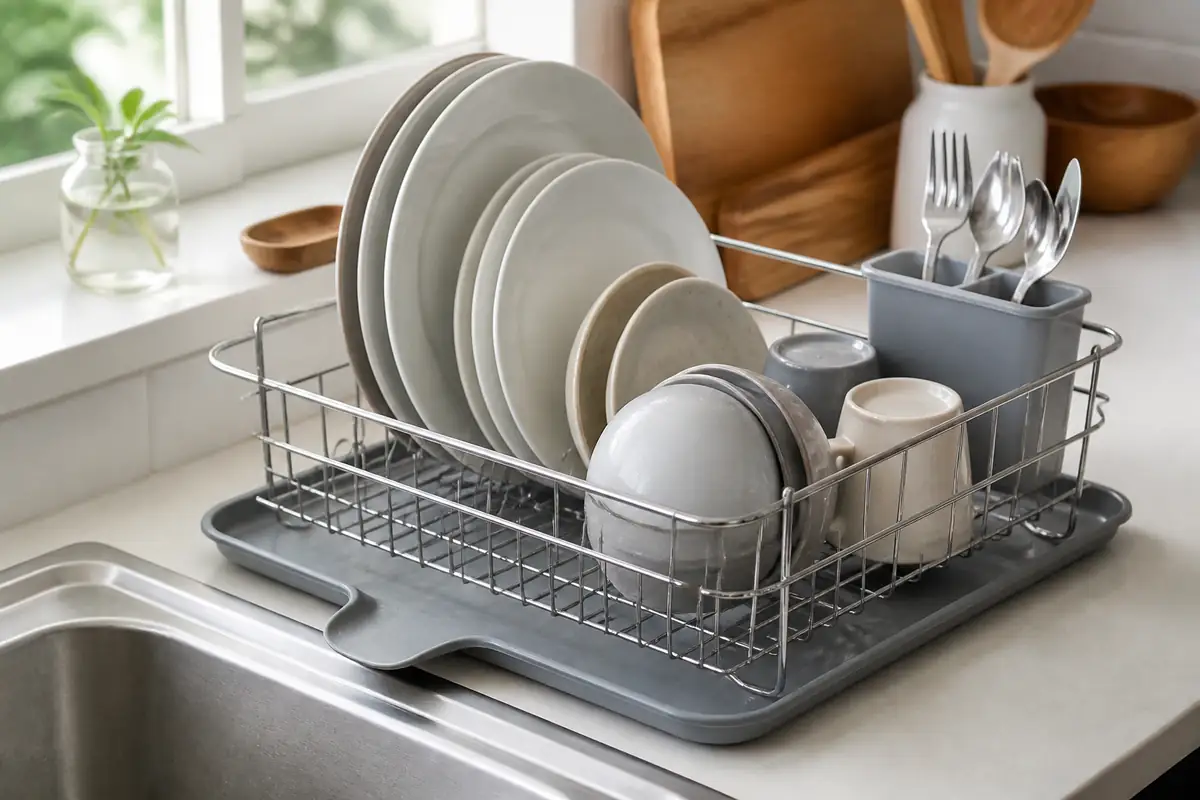
The image is an editorial illustration, not a photograph from a product test. Links are editorial and non-affiliate.