Air fryers buying guide: basket capacity, usable area, controls and cleaning
Headline litres do not show how food fits in one layer. Match the drawer’s internal shape to repeat meals, then check clearance, controls and every cleaning step.
In this guide
Buy for the meal footprint, not the largest litre number
Trace the foods cooked most often, estimate their flat area and choose the smallest basket layout that handles that load without routine crowding. Confirm external dimensions with the drawer open, a UK plug, stable controls, removable washable parts and a credible route for spares.
Air fryers are compact fan ovens with different drawer, tray and paddle layouts. Their usefulness depends on the cook’s portions, food shape, turning routine and tolerance for cleaning. A dual drawer may separate foods but divide usable area; an oven style can hold trays but demand more preheating and vertical space.
Translate capacity into cooking geometry
| Format | Useful strength | Trade-off to test |
|---|---|---|
| Single basket | Simple workflow and one broad cavity | Foods needing different times share one programme. |
| Dual drawer | Separate time and temperature zones | Each drawer may be narrow and total volume is split. |
| Flexible divider | One large zone or two smaller zones | Divider seal, programme logic and cleaning add complexity. |
| Oven style | Flat trays and several shelf positions | Results can vary by level and door cleaning is broader. |
| Paddle type | Automatic movement for suitable foods | Paddle can damage delicate pieces and uses basket space. |
| Round basket | Compact body and easy shaking | Rectangular portions can waste perimeter area. |
Build a meal map before comparing models
List five repeat uses: for example vegetables, chips, reheating, fish portions and a complete two-part meal. Record number of portions, approximate dimensions, whether pieces can overlap, and whether shaking or turning is acceptable. Include the largest awkward item rather than only grams.
A basket can hold a stated weight yet cook unevenly when airflow is blocked. Manufacturer recipes can reveal recommended layer depth and batch size, but use them as model-specific guidance, not universal capacity. Our air-fryer size explainer covers household sizing; this guide focuses on actual workflow.
Measure internal base and external operating space
Ask for the usable flat basket length and width at the base, not just the rim or litre volume. Allow for crisper plate handles, sloped sides and divider rails. Draw the base on paper and place representative uncooked items within it without stacking. This simple footprint test exposes a tall-but-narrow basket.
Measure the appliance body, cable route, handle projection and the drawer’s full pull-out distance. Follow the maker’s ventilation clearances above, behind and beside the unit. It must sit on a stable heat-resistant surface away from worktop edges and other hot surfaces, with the plug accessible.
Dual drawers solve timing only when both sides fit
Separate drawers can synchronise finishing times and protect different flavours, but a family-size food may not fit either side. Check whether both zones offer the same temperature range, programme list and power, and whether “sync” starts one drawer later or alters settings. Confirm what happens when one drawer is removed.
Combined wattage matters for the socket and household circuit, while energy use depends on time and load. Do not infer running cost from wattage alone. Compare realistic cycles with our appliance running-cost method.
Controls should show the state at a glance
- Direct time and temperature: adjustment should not require several hidden menu levels.
- Clear zone indication: dual controls must make the active drawer unambiguous.
- Pause behaviour: check what happens when a drawer opens and when it returns.
- End signal: it should be noticeable without being impossible to mute where needed.
- Safe default: power loss and restart behaviour should be documented.
- Readable markings: essential settings must remain legible in normal kitchen light.
Preset names are starting points, not food guarantees
A chip, chicken or bake button stores time, temperature or fan behaviour; it cannot measure thickness, starting temperature or quantity unless the model has a specific sensor. Treat presets as editable reminders. Compare the manual’s adjustment range, increment size and ability to change settings during a cycle.
Very high maximum temperature adds value only for foods and accessories the maker approves. A dehydrate mode needs sufficiently low stable settings and practical tray area. Rotisserie, grill plates and racks add storage and washing. Count only functions that replace an existing process.
Check the complete cleaning path
Remove the cool basket, crisper plate, divider, rack and any silicone feet as instructed. Look for narrow channels around handles, exposed screw heads, folded metal seams and non-removable mesh. Dishwasher-safe does not mean every part is dishwasher-safe, and machine washing may affect coatings over time; follow the exact care instructions.
Electrical Safety First advises waiting at least 30 minutes before cleaning and never immersing the main appliance. It also advises following the maker’s guidance about paper, which can move into a heating element if not weighted. Liners can reduce residue but may obstruct airflow or exceed instructions.
Inspect coating, seals and replaceable parts
A smooth intact coating is easier to clean, but “non-stick” does not identify chemistry, thickness or lifetime. Use only permitted utensils and replace damaged removable parts through the maker’s route. Check the availability and price of baskets, plates, feet, filters and dividers before purchasing.
Door-style models add hinges, glass and crumb channels. Drawer models add runners and contact points. Neither is automatically more durable. Apply the repairability and spares checklist, and keep serial and purchase evidence for registration.
Account for noise, steam and the serving step
Fan noise is part of normal operation, but listings rarely describe it under comparable conditions. If sound matters in an open-plan room, look for a documented test method and a return route rather than relying on adjectives. Unusual grinding, crackling or changing noise is a safety signal, not a feature to tolerate.
Hot air and steam can escape when the drawer opens. Position the handle so the cook can stand clear, keep children away and use only the gripping points in the manual. A heavy full drawer needs a safe landing area; carrying it across the kitchen may be less practical than transferring food with approved utensils.
Time the whole serving cycle. If one batch waits while another cooks, the first may soften or cool. A larger zone can be more useful than two small zones when the meal is served together, while two zones earn their space when their sync function matches genuine timing differences.
Use electrical and heat safety as a gate
Choose a traceable appliance with a standard UK three-pin plug and fuse. Electrical Safety First recommends buying from a reputable retailer, keeping cables away from heat and edges, not overfilling, supervising use, switching off after use and registering the product for recalls. Stop after unusual smell, noise, scorch marks, repeated tripping or excess heat and contact the retailer or maker.
Do not improvise an extension arrangement or place the appliance under a wall cupboard contrary to clearance instructions. Never put the body in water. Check the UK seller-verification guide and current product recall route before trusting an unknown listing.
Test the workflow inside the return window
Start with a simple food and the maker’s instructions. Record preheating, basket loading, turning, end signal, serving and cooling. Then clean every removable part. The result matters, but so do hot handles, steam direction, unstable baskets, confusing controls and the time needed before the kitchen is reset.
Repeat with the common two-food meal. If it still requires several batches, moving food between drawers or another oven, the capacity claim has not solved the brief. Keep the unit clean and lightly handled while deciding, and understand the UK returns route.
Which format should you choose?
One broad food layer drives the purchase
The base fits repeat portions, shaking is acceptable and a simple cleaning path matters more than simultaneous programmes.
Separate timing or tray shape is essential
Every zone fits its assigned food, worktop clearance is sufficient and extra parts earn their cleaning and storage cost.
Balanced verdict
The best air fryer is the smallest safe model whose usable base fits the meals that recur, not the model with the loudest litre figure. Map food geometry, open-drawer clearance, controls and washing before comparing presets or accessory counts.
Plan the room with our small-kitchen guide, compare energy evidence, and browse more Home & Kitchen guidance or the shop directory.
Check current official guidance:
Electrical Safety First air-fryer advice ↗UK product recalls and alerts ↗GOV.UK returns and refunds ↗
Frequently asked questions
How many litres should an air fryer have?
Litres alone are insufficient. Match usable basket base and permitted layer depth to repeat foods and portions.
Is a dual-drawer model always better for families?
No. Separate timing helps only when each narrow drawer fits its assigned food.
Can air-fryer parts go in a dishwasher?
Only the exact parts the maker marks as dishwasher-safe, using the stated programme and care.
Can I use paper liners?
Follow the model instructions. Loose paper can reach the heating element and airflow may be obstructed.
Should I unplug an air fryer after use?
Electrical Safety First advises switching it off at the socket and unplugging when finished.
Methodology and limitations
We assessed air fryers through food geometry, basket layout, controls, clearance, cleaning, parts, electricity and workflow. Current Electrical Safety First, recall and UK returns guidance was checked on 29 August 2026. No appliance was heated or food-tested.
Limitations
Cooking performance varies by recipe, load and model. Dimensions and parts change. Confirm the exact manual, kitchen space, food plan and electrical advice before purchase.
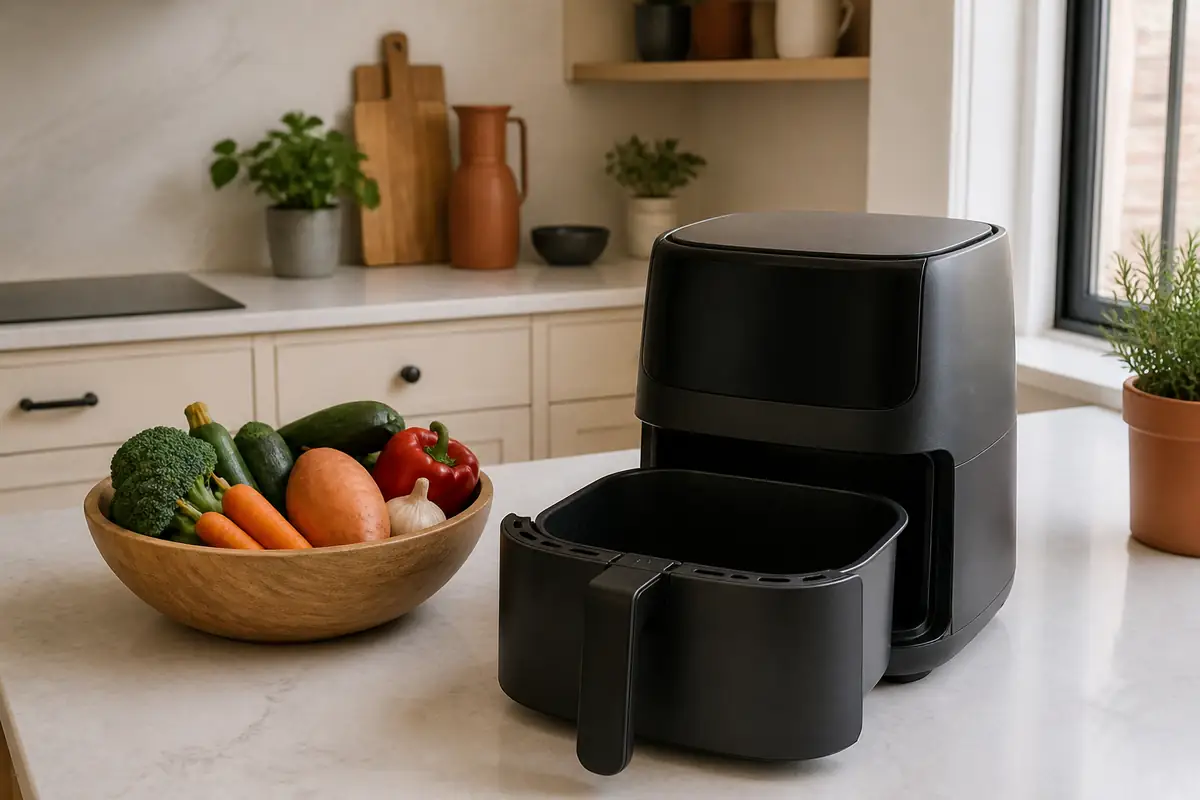
The image is an editorial illustration, not a photograph from a product test. Links are editorial and non-affiliate.