Stand Mixer Buying Guide: Bowl Size, Tools, Power and Storage
The best stand mixer is not the one with the largest bowl or highest wattage. It is the machine that handles your smallest and heaviest real recipes, fits beneath your cupboard with the head raised, and has tools and spare parts you can still obtain later.
In this guide
Choose from recipe weight, not bowl litres alone.
A 4–5 litre mixer is enough for many households, but published maximum dough, cake and egg-white capacities reveal more than headline volume. Measure the full operating height, check the machine’s weight and decide which attachments you will genuinely use. Wattage cannot be compared cleanly across different motors and transmissions.
This guide is based on official UK product pages, specifications, manuals and compatibility information. Recommended Today did not mix, knead, measure noise or durability-test these machines. Current product examples show how to read a listing; they are not a ranked test.
Current UK stand mixer price and specification snapshot
| Exact model checked | Displayed price | Useful published detail |
|---|---|---|
| Kenwood Multi Tasker KHC30.000WH | £149.99 | 4.3L bowl, 4.46kg machine, 1.6kg dough limit; beater, whisk, dough tool and splashguard included. |
| Kenwood Go KZM35.000RD | £199.99, shown against £249.99 | 4L bowl, 6.3kg body and three main bowl tools; compact format aimed at smaller kitchens. |
| Bosch Series 4 MUM5XW10 | £249.99, shown against £399.99 | 1000W machine with integrated scales; verify the precise bundle because MUM5 suffixes include different accessories. |
| Kenwood kMix KMX754ABK | £299.99 | 5L glass bowl, 9.26kg body and published 1.35kg dough capacity. |
| Kenwood Chef KVC3100W | £419.99 | 4.6L stainless bowl, 7.52kg body, 2.18kg dough capacity and Chef attachment system. |
Price snapshot: official Kenwood GB and Bosch UK pages checked on 15 August 2026. Promotions, codes, bundles and stock change. Compare the complete model suffix, supplied tools, guarantee and delivered basket again before purchase.
Start with the recipes you actually make
Write down five demanding and five common recipes. The demanding list might include two loaves of bread, Christmas cake or a large buttercream. The common list may be one sponge, six egg whites or a small batch of biscuits. A mixer that manages the first list but leaves the whisk floating above the second is poorly matched.
Translate each recipe into total dough, flour, batter, cream or egg-white weight. Manufacturer capacities use different units, so avoid comparing “servings” with litres. A 5L kMix page, for example, publishes 1.35kg dough and 2.72kg cake capacities, while a 4.6L Chef page publishes 2.18kg dough. The smaller nominal bowl can therefore carry the higher stated dough load. Bowl geometry, motor control and tool shape all matter.
Bowl capacity: litres are only the outer boundary
A bowl’s brim volume is not the safe working volume. Flour needs space to hydrate without escaping, cream expands and bread dough climbs a hook. Published maximums are limits, not ideal everyday targets. Regularly running at the ceiling can make ingredient incorporation, stability and motor temperature less forgiving.
| Your usual work | Practical starting point | What to verify |
|---|---|---|
| Small cakes, whisking and occasional dough | Compact 4–4.3L class | Minimum whisking quantity, 1–1.6kg dough limit and whether the bowl is easy to scrape. |
| Routine family baking and mixed recipes | 4.6–5L class | Published flour, dough and batter limits; bowl handle; second-bowl availability. |
| Large batches or frequent bread | 6.7–7L class where justified | Minimum quantities, machine footprint, stability and actual need for the capacity. |
A second smaller bowl can be more useful than one enormous bowl, especially for recipes with separately whisked egg whites. Nesting bowls save storage. Check whether both fit the machine directly and whether tools reach them correctly.
Power: why watts do not settle performance
Input wattage describes electrical consumption at a rated condition; it does not directly state torque at the tool, efficiency, cooling, speed regulation or permissible run time. A lower-wattage direct-drive design may behave differently from a higher-wattage belt or gear system. Comparing numbers across brands without the engineering context creates false certainty.
Use recipe capacities, published duty guidance and speed control instead. Dough benefits from controlled low-speed torque, not simply a fast headline. Meringue needs a whisk that reaches a modest quantity. Cake batter benefits from even planetary coverage and a tool that does not leave a wide unmixed strip. Read the manual before buying to find maximum quantities, speed settings and rest instructions.
Tools included: the core three are not identical
Most stand mixers include a flat beater, whisk and dough hook. Check their material and cleaning instructions. Aluminium tools can oxidise or mark if put through an unsuitable dishwasher cycle; coated tools can chip if knocked; stainless tools tend to be robust but can increase cost. A splashguard should leave enough room for adding ingredients and should not be awkward to remove when dirty.
Specialist beaters can matter more than an attachment port. A flexible creaming beater reduces bowl scraping for butter and sugar. A folding tool can be useful for delicate mixes. A second bowl avoids washing between stages. Price the tools you need today rather than counting every accessory the ecosystem could theoretically support.
Attachments and compatibility
Pasta rollers, mincers, slicers and blenders can turn a mixer into a preparation system, but only if the precise outlet and model accept them. Kenwood publishes a compatibility guide because Chef, kMix, Prospero and Go accessories are not interchangeable by assumption; some older attachments need adapters. Model suffixes and regional bundles also change what is included.
Before paying for an ecosystem, list three attachments you would use at least monthly, record their current cost and confirm their product codes. Add this to the total cost of ownership. A separate food processor may be easier to clean and store than an attachment assembled across the mixer, while a dedicated pasta tool may outperform an occasional add-on.
Measure the mixer in its operating position
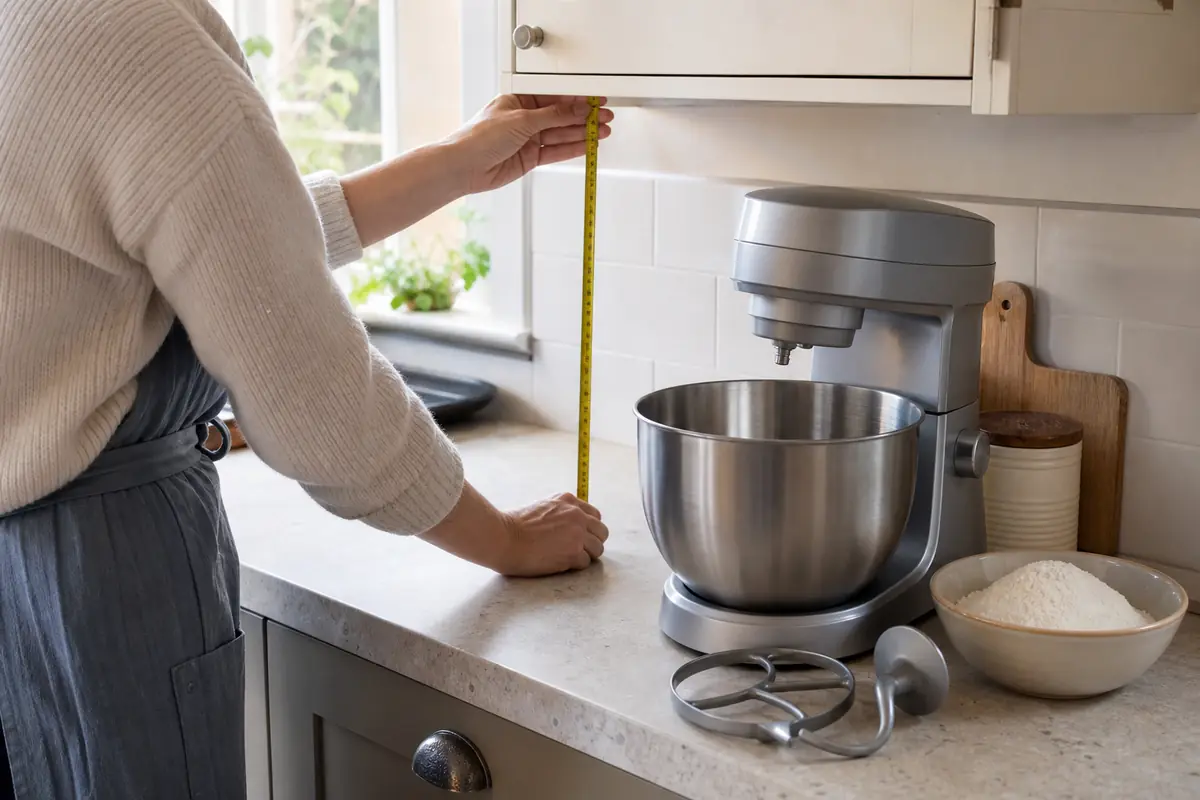
Manufacturers usually publish closed dimensions. A tilt-head model needs additional height and sometimes rear clearance when opened. A bowl-lift design can be taller but avoids a large backward arc. Measure worktop width and depth, the cupboard gap, socket position and clearance for removing the bowl.
Place a cardboard footprint on the intended counter. Simulate the raised head with a vertical ruler. Confirm that the mixer can remain far enough forward for the head to open without the feet approaching the edge. Our small-kitchen buying guide helps distinguish appliances that deserve permanent worktop space from those that will become cupboard ballast.
Weight cuts both ways. A 9kg mixer can be stable under dough load but unpleasant to lift from a low cupboard. A 4.5kg machine is easier to move but may walk if overloaded or used on a slick surface. If it must be stored, test whether the route involves bending, reaching or carrying past fragile items.
Noise, stability and speed control
Official listings rarely provide comparable noise measurements. Reviews can flag rattles or movement, but room acoustics, recipe load and speed affect impressions. Look for gradual start-up that limits flour clouds, a pulse or fold option if useful, non-slip feet and clear head-lock engagement.
Never leave a mixer unattended merely because it is hands-free. Heavy dough can make any machine move. Follow the manufacturer’s load, speed and run-time limits; stop if the head, bowl or tool behaves unusually.
Cleaning and food-contact practicalities
Check every removable part rather than accepting “dishwasher-safe” as a blanket claim. Bowl, whisk, beater, hook and splashguard may have different instructions. Inspect crevices around the tool shaft, head hinge and speed control. Polished bowls show water marks but are easy to inspect; glass is heavy and can break; coated bowls may need gentler handling.
A machine that takes fifteen minutes to clean after a five-minute task will be used less. Compare this friction with a hand mixer for light work. Our kitchen-appliance framework asks whether the time saved in preparation exceeds setup, cleaning and storage time.
Repairability, guarantees and spare bowls
Search the manufacturer’s support site for the exact model before buying. Can you download a manual, identify the bowl and tools, and find a repair route? Are consumable attachments and splashguards sold separately? Long availability matters more than a large launch bundle. Use our repairability and spare-parts guide for the checks.
A guarantee is not the same as expected life or statutory rights. Kenwood pages show different guarantee language across ranges, sometimes requiring registration and applying longer periods to a motor rather than every component. Save the terms and proof of purchase; see warranty versus guarantee before treating a headline period as comprehensive cover.
Stand mixer buying checklist
- Record real recipe weights, including your smallest and heaviest batches.
- Compare published maximums, not litres or watts alone.
- Measure closed and operating dimensions, socket access and lifting route.
- List included tool materials and individual cleaning instructions.
- Verify attachment codes against the exact model suffix.
- Price the complete system, including second bowl and likely tools.
- Check manuals, spares and repair route before the model disappears.
- Save the live guarantee and basket when ordering.
Ordinary cakes and occasional dough are the job
Bowl size, low-speed control, attachments and storage fit the kitchen without paying for unused motor headroom.
Frequent bread or large batches justify it
Capacity, stability, thermal limits, service support and lifting weight work for repeated demanding use.
Our verdict
For most UK households, a well-specified 4–5L stand mixer is a better purchase than an oversized machine chosen from watts and colour. Published recipe capacity, low-speed control, working clearance and tools determine whether it solves the job. Ecosystem value comes later, after the basic mixer fits the recipes and kitchen.
Use our energy-efficient appliance guide for interpreting consumption claims, browse Home & Kitchen for adjacent equipment decisions, or compare retailers in the UK shop directory.
Check current manufacturer information:
Kenwood stand mixer range ↗Kenwood attachment compatibility ↗Bosch MUM5 range ↗
Check current official information:
Kenwood stand mixer range ↗Kenwood attachment compatibility ↗Bosch MUM5 range ↗
If the main task is chopping or blending rather than mixing dough, start with our Blender vs food processor: which jobs each appliance handles best.
Frequently asked questions
What stand mixer bowl size is best for a family?
A 4.6–5L class suits many households, but published dough and batter limits matter more than litres. Match the figures to recipe weights and confirm the machine can handle small batches.
Is a higher-wattage stand mixer always better?
No — Wattage alone does not reveal tool torque, gearing, efficiency, cooling or speed control. Compare recipe capacities, manuals and permissible loads.
Can I knead bread in every stand mixer?
Only within the model’s published dough weight, speed and run-time guidance. Heavy or low-hydration dough can be particularly demanding.
Which stand mixer attachments are essential?
A beater, whisk and dough hook cover the core jobs. A splashguard and second bowl can be useful. Buy specialist attachments only after confirming exact compatibility and realistic use.
Should a stand mixer stay on the worktop?
Usually yes if it is heavy and used often. Measure operating height beneath cupboards. If it must be stored, make sure the weight and lifting route are safe and convenient.
How we researched stand mixers
We checked current Kenwood GB and Bosch UK model pages, published prices, bowl and recipe capacities, dimensions, weights, included tools, manuals and attachment guidance on 15 August 2026. We did not mix food, measure noise or endurance-test a machine.
Limitations
Published capacities and specifications do not establish mixing consistency, measured noise, thermal endurance, cleaning effort or long-term reliability. Recipe hydration, ingredient temperature and batch technique can also change real performance.
Prices, bundles, promotions, specifications, guarantees and accessory compatibility change. Recheck the exact model suffix and official documentation before purchase.