Frying pan sizes explained: 20cm, 24cm, 28cm and 30cm
A frying pan is measured across its top rim, but that number does not tell you the usable base, hob fit or comfortable portion. This guide turns the common UK sizes into practical cooking, storage and value decisions.
In this guide
For many UK kitchens, 24cm is the compact all-rounder and 28cm is the more flexible family pan
Choose 20cm for one-person breakfasts and small sides, 24cm for one or two portions, 28cm when ingredients need room to brown, and 30cm only when the hob, cupboard and lifting strength genuinely support it. Measure the pan’s flat contact base and total handle length—not just the advertised rim—and choose the cooking surface separately from the diameter.
Pan size is not a quality ranking. A larger pan creates more cooking area, but it also needs a suitably sized hob zone, more cupboard width, a stronger wrist and enough food to prevent exposed oil or coating from overheating. The most useful pan is the smallest one that gives the ingredients room to cook as intended.
What does a 20cm, 24cm, 28cm or 30cm frying pan measurement mean?
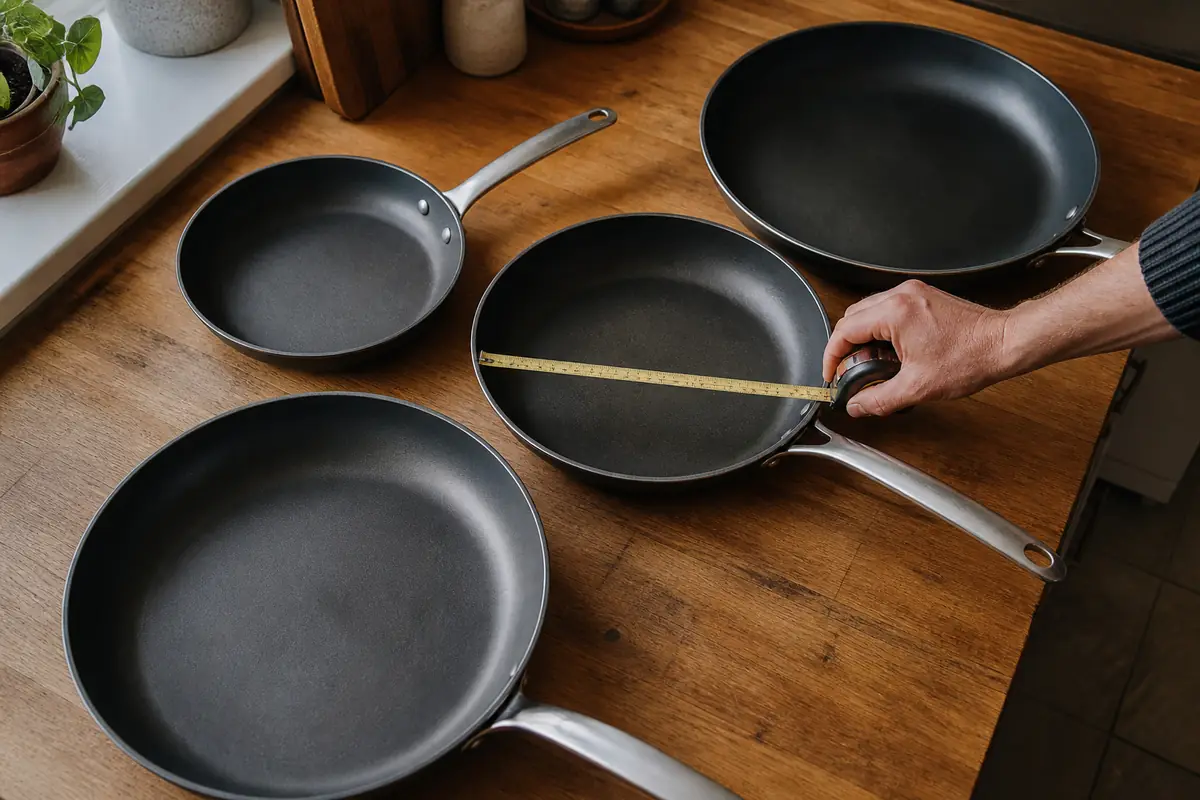
The advertised diameter is normally measured across the upper inside rim. Sloping sides make the flat cooking base smaller, sometimes considerably smaller. Two pans both labelled 28cm can therefore hold different amounts of food. One may have a broad, nearly vertical wall; another may flare widely from a compact base.
Before buying, look for the internal base diameter, depth, total length including the handle, weight and capacity. If those details are absent, compare the dimension diagram or ask the retailer. A 28cm pan with a 22cm flat base does not use the full 28cm circle for direct hob contact. The rim figure helps a lid fit; the base figure helps a hob fit.
The area also rises faster than the diameter. In simple geometric terms, a 28cm circle has about 96% more surface area than a 20cm circle, although real pans lose some of that difference through sloping walls. That is why moving from 20cm to 28cm feels like a major change rather than an extra eight centimetres.
Frying pan size chart for everyday UK cooking
| Nominal size | Useful starting point | Where it can struggle | Check before buying |
|---|---|---|---|
| 20cm | One or two eggs, a small omelette, toasted spices, one burger or a side | Crowds ingredients quickly; limited evaporation and browning area | Handle balance, actual base and whether the small hob zone detects it |
| 24cm | One generous or two modest portions, pancakes, two fillets or vegetables | Can still crowd a full family meal | Base width, wall height and storage length |
| 28cm | Two to four portions when browning space matters, larger omelettes and shallow frying | Heavy when clad or cast; may overlap controls or neighbouring zones | Hob-zone match, weight and usable cupboard width |
| 30cm | Large batches, broad pancakes, several portions or reducing a wide sauce | Needs a large zone and considerable storage; awkward to lift one-handed | Total length, base diameter, empty weight and helper handle |
These are planning ranges, not serving guarantees. Tefal’s current Excellence Fusion range, for example, describes 20cm as serving one to two people, 24cm two to three, 28cm four to five and 30cm five to six. Treat that as one manufacturer’s merchandising guide, not a universal standard: three large steaks, four chopped vegetables and four fried eggs require very different areas.
Start with the food: crowding changes the result
A pan does more than contain food. Space controls evaporation. When wet ingredients are tightly packed, released moisture accumulates and the temperature around them falls; mushrooms, mince and courgettes can steam rather than brown. A wider pan can improve the result even when the same food technically fits in a smaller one.
Delicate eggs create the opposite problem. A huge exposed surface wastes oil, can leave a thin egg spreading too far and gives a coating more empty area to overheat. A 20cm or 24cm non-stick pan can be more controlled for one omelette than a 30cm pan. For searing meat or reducing a sauce, a broad uncoated surface may be more useful.
Write down three meals you cook repeatedly and the usual portion count. Arrange the raw ingredients on a dinner plate or inside an existing pan before shopping. If browning matters, allow visible gaps. If the task is primarily one pancake or two eggs, do not pay for unused diameter.
Match the flat base to the hob zone
On induction, ceramic and solid-plate hobs, the pan’s contact base should sit sensibly within the usable zone. A base far beyond a small zone can heat unevenly, while an extremely small base may not be recognised by some induction systems. Consult the hob manual for minimum and recommended diameters rather than assuming the decorative ring is the complete specification.
Gas flames should remain beneath the base rather than climbing the side or heating the handle. On any hob, centre the pan and lift rather than slide it where the manufacturer warns about scratching. Pan-zone fit, preheating time and cooking duration also affect energy use, as our appliance running-cost guide explains.
For a prospective pan, make a paper circle matching the stated flat base—not the rim—and place it on the cold hob. Add a second circle for another pan used at the same time. This exposes collisions between handles, splash zones and touch controls before money is spent.
Diameter is only one part of capacity
A deeper frying pan contains splatter and can hold a larger sauce, but it may be closer to a sauté pan. Low, flared sides make turning and sliding food easier and promote evaporation. Straight sides hold volume. Decide whether the pan’s main job is frying, searing, tossing, simmering or finishing in the oven.
Handle length matters in a compact kitchen. A nominal 24cm pan can exceed 45cm overall, and a large pan can pass 50cm. Check oven depth, cupboard width and whether the handle blocks the neighbouring burner. Removable handles save space but introduce a mechanism whose load rating, fit and availability of replacements must be checked. Our small-kitchen buying guide gives a method for measuring the full storage envelope.
Weight rises with size and construction
A larger pan is not merely wider. It uses more metal, and the weight of food and oil is added at the far end of the handle. A current ProCook stainless example moves from 759g at 20cm to 1,417g at 28cm and 1,716g at 30cm. The listed weight more than doubles between the smallest and largest versions.
Lift a similar weight in store if possible, keeping the wrist neutral. Imagine the pan full and hot. A helper handle becomes valuable when tipping a 30cm pan; it may also consume more cupboard space. Heavy is not automatically better: material, core thickness, balance and construction explain performance more meaningfully. Our cookware materials guide compares stainless steel, aluminium, cast iron and non-stick without turning mass into a quality score.
Current UK frying pan price and weight snapshot
The official ProCook listings below were checked on 27 August 2026. They use one uncoated Professional Stainless Steel family to show how size, price and weight can change within broadly similar construction. They are an example, not a recommendation, and live prices can change before purchase or purchase.
| Exact official listing checked | Displayed price | Listed internal size and weight | What the comparison shows |
|---|---|---|---|
| Professional Stainless Steel Frying Pan Uncoated 20cm | £45 | 20 × 4cm; 759g | Compact, but still a substantial steel pan |
| Professional Stainless Steel Frying Pan Uncoated 28cm | £55 | 28 × 4.5cm; 1,417g | Much more surface and nearly twice the empty weight |
| Professional Stainless Steel Frying Pan Uncoated 30cm | £60 | 30 × 6cm; 1,716g | Deeper and heavier, so capacity and handling change together |
Price note: the pages displayed “typical” reference prices as well as the selling prices above. We recorded the amount payable, not the comparison price. Delivery was listed at £3.95 below £60 and free standard delivery from £60, so a basket comparison must include fulfilment. Recheck the exact variant, stock, delivery and any code at checkout.
Check current examples and care:
ProCook 20cm official listing ↗ProCook 28cm official listing ↗ProCook 30cm official listing ↗Tefal size examples ↗
Choose surface and size as separate decisions
A 28cm diameter does not tell you whether the pan is suited to eggs, steak or acidic sauce. Non-stick can simplify delicate food but is a wear surface that benefits from moderate heat and gentle utensils. Uncoated stainless tolerates browning and oven use but needs temperature and fat control. Cast iron retains heat but is heavy; carbon steel needs seasoning; aluminium responds quickly but is usually coated or clad.
It can be more useful to own two deliberately different pans—perhaps a 20cm non-stick for eggs and a 28cm uncoated pan for browning—than two similar 24cm and 28cm coated pans. Estimate use frequency and replacement before buying a set. The cost-per-use framework and total-cost-of-ownership guide help compare a durable body with a coating that may wear sooner.
Storage, lids and the hidden dimensions
Measure the shelf, drawer or rack in three dimensions. Stacked pans need separators to protect coatings, and fixed handles can make a neat stack wider than expected. Hanging requires a rated rail and enough wall clearance. A lid adds height and may not be included; confirm whether a lid is available in the same rim diameter and whether its knob fits the oven.
Do not assume two brands’ 28cm lids interchange. Rim profiles, pouring lips and internal measurements differ. If a lid matters, buy or test it with the exact pan. If space is tight, favour the one or two sizes used weekly rather than a four-pan graduation. This is the same shortlist discipline used in our product-shortlisting guide.
A five-minute frying pan sizing method
- List the repeated jobs. Record usual portions and whether the food must brown, stay delicate or simmer.
- Measure the hob. Note the recommended pan-base range for the zone and simultaneous-pan spacing.
- Measure storage and oven. Include the handle, helper handle and lid, not just the rim.
- Set a lifting limit. Add expected food weight to the listed empty weight.
- Compare exact construction. Check base diameter, depth, material, coating, oven limit, care and guarantee.
- Include the lid and any compatible accessories in the pan’s total purchase cost. Include lid, delivery, utensils or pan protectors and likely replacement.
Eggs, sides and smaller portions dominate
The cooking surface fits the usual portion, remains easy to lift and heats evenly on the available hob zone.
Family portions or one-pan meals are routine
The usable base, hob size, storage and loaded weight all work; do not buy nominal diameter that the cooker cannot heat evenly.
Balanced verdict: which frying pan size should you buy?
A 24cm pan is a sensible compact default for one or two people, while 28cm gives ingredients more room and is usually the more flexible family size. A 20cm pan earns its cupboard space when small breakfasts or sauces are frequent. A 30cm pan is valuable for genuine large-batch cooking, but only if its flat base suits the hob and its loaded weight remains comfortable.
Do not select by household headcount alone. Select by the repeated cooking task, the pan’s usable base and depth, and the physical kitchen around it. Browse more practical guides in Home & Kitchen and use our expected-lifespan guide to decide where durable construction is worth paying for.
Check current official information:
ProCook 20cm official listing ↗ProCook 28cm official listing ↗ProCook 30cm official listing ↗
Frequently asked questions
Is a 28cm frying pan big enough for four people?
It can be, but the answer depends on the food and usable base. Four eggs require less separation than four pieces of meat that need browning. Compare the actual ingredient footprint and avoid treating a manufacturer’s people count as a universal serving rule.
How is frying pan size measured?
It is normally the diameter across the upper inside rim. The flat base that contacts the hob is smaller when the sides flare. Check both measurements, plus depth and total handle length.
What is the best frying pan size for one person?
A 20cm pan can suit eggs, one burger and small sides; 24cm offers more flexibility for vegetables, fillets and one-pan meals. Choose according to the largest regular task rather than the smallest possible portion.
Can a pan be larger than the hob ring?
A small mismatch may be allowed, but a much wider base can heat unevenly and a very small pan may not trigger some induction zones. Follow the hob manual’s recommended base diameters.
Do I need both a 24cm and a 28cm frying pan?
Not automatically — If the tasks overlap, one may stay unused. Two different surfaces or a 20cm-and-28cm combination can cover more distinct jobs, but storage, hob layout and cooking habits decide.
Does a larger frying pan use more energy?
Not by diameter alone. Material, mass, hob-zone match, heat setting, preheating time, food amount and cooking duration all matter. An oversized empty area can waste heat, while crowding a small pan can prolong cooking.
How we researched this frying pan size guide
Recommended Today reviewed official UK product and care pages from ProCook and Tefal, including stated diameters, depths, weights, hob compatibility, oven limits, care instructions, prices and manufacturer serving descriptions. We compared the dimensions with geometry and practical hob, storage and handling constraints. Prices were recorded from the official pages on 27 August 2026.
Limitations
We did not cook with or physically measure the named pans. Rim diameter, base diameter and capacity are not standardised consistently across every retailer, and manufacturer portion descriptions are illustrative. Prices, delivery thresholds, guarantees and stock can change. Recheck the exact product diagram, hob manual and checkout on publication and purchase day.
This is a sizing and buying-method guide, not a product ranking. Pan-size information sources were linked without affiliate tracking in this measuring guide.