Blender vs food processor: which jobs each appliance handles best
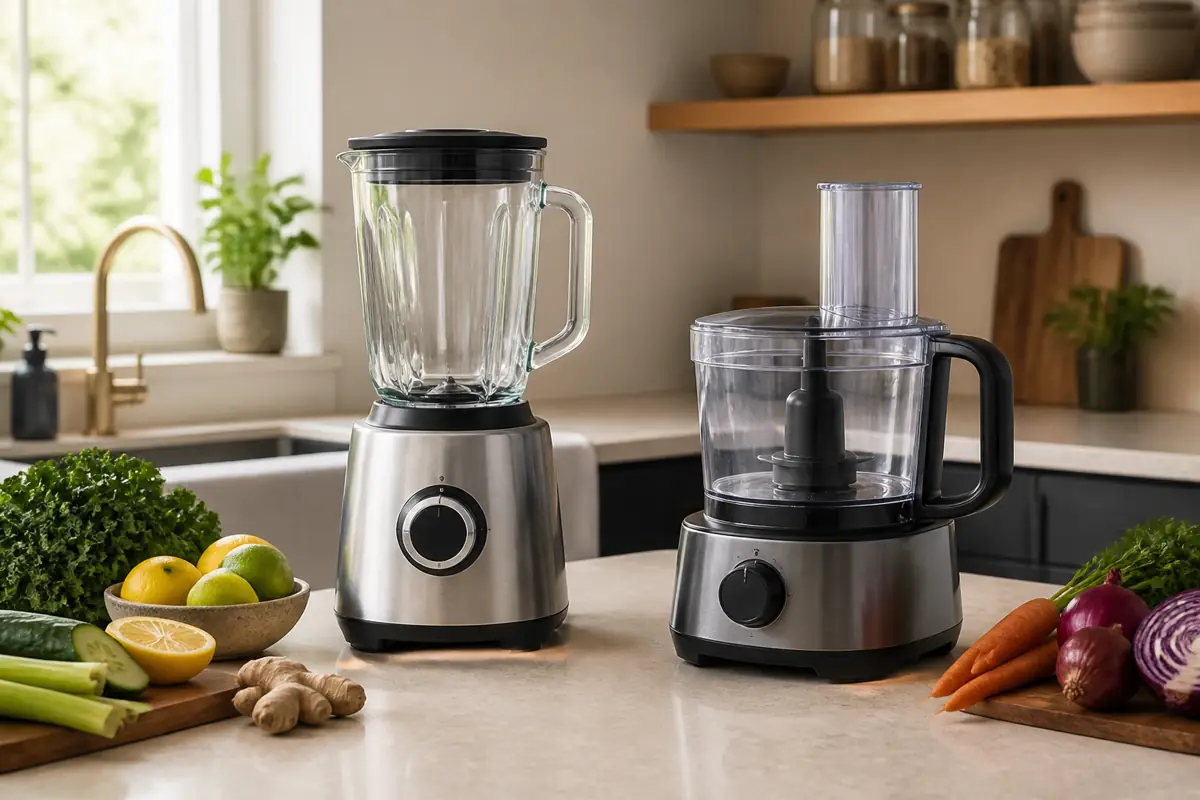
A blender moves liquid through a tall jug; a food processor cuts solid ingredients in a wide bowl. Your regular recipes, safe liquid limits and cleaning tolerance should decide which earns the cupboard space.
In this guide
Choose a blender for pourable mixtures and a processor for preparation
Buy a blender for smoothies, emulsified sauces and permitted soups; choose a food processor for chopping, slicing, grating, pastry and larger solid batches. A combination model can cover both, but only when the supplied jug, blades and discs suit the quantities you actually make. Motor wattage alone cannot establish control, texture or durability.
This is a specification-led comparison, not a hands-on appliance test. We reviewed current official UK ranges, manuals and task descriptions, then translated them into a kitchen workflow. We did not blend hot liquid, measure noise, time recipes or test long-term reliability.
Blender and food processor compared
| Decision | Blender | Food processor |
|---|---|---|
| Best shape for | Liquids circulating in a tall jug | Solid food moving across a wide blade or disc |
| Strong jobs | Smoothies, shakes, dressings, permitted soups | Chopping, slicing, grating, pastry, some doughs |
| Weak jobs | Dry chopping, neat slices, very small thick mixes | Very smooth drinks unless a separate jug is supplied |
| Control to inspect | Low start, pulse, lid and hot-liquid instructions | Pulse, feed tube, disc thickness, working capacity |
| Cleaning burden | Jug, lid, seal and fixed or removable blade | Bowl, lid, pusher, spindle, blade and discs |
Start with the food, not the appliance name
A blender needs flow
A blender works when ingredients circulate down towards the blade and back up the jug. Enough permitted liquid, sensible loading order and a secure lid matter. Thick nut mixtures may stall or form an air pocket; repeatedly running a motor against a stationary mass is not evidence that a higher setting is needed.
- Smoothies need enough liquid for circulation and space for expansion.
- Hot soup is safe only when the exact jug and manual permit it; trapped steam is a serious risk.
- Small quantities can sit below the blade’s effective circulation zone.
A processor needs the correct tool
The standard knife chops by repeated contact, while discs slice or grate as food passes through the feed tube. A dough tool, whisk or blender jug is model-specific rather than guaranteed by the words “food processor”. Compare the box contents and replacement-part availability.
- Use pulse for deliberate chopping instead of turning vegetables into wet paste.
- Match disc thickness and feed-tube width to the vegetables you prepare.
- Read dough weight and run-time limits before treating the bowl as a mixer.
Which one suits your cooking?
Choose a blender if…
- Your repeated jobs are smoothies, shakes, dressings and pourable sauces.
- You value a simple jug over a box of discs and tools.
- The manual expressly supports the temperatures and ice you intend to use.
- You can store the full operating height safely.
Choose a food processor if…
- You regularly chop onions, grate cheese or slice batches of vegetables.
- You make pastry, breadcrumbs, dips or permitted dough quantities.
- Consistent slices save more time than an ultra-smooth drink.
- You have accessible storage for sharp discs and attachments.
Capacity, power and controls
Headline bowl or jug volume is not the working limit. Foaming drinks, hot mixtures and dough may have lower maximum marks. Read the manual for each task and compare usable capacity with your normal batch. A family-size bowl is wasted if the processor cannot handle a small dressing; a compact blender is frustrating if every soup requires three cycles.
Wattage describes electrical input, not blade geometry, gearing, cooling or results. More useful evidence includes a low starting speed, a responsive pulse, published load limits, stable feet and clear safety interlocks. If a retailer lists a powerful motor but omits the manual and working capacities, the comparison is incomplete. Our appliance running-cost guide explains why rated watts and real energy use are different questions.
Cleaning, storage and ownership cost
Count every part that touches food. A processor can save ten minutes of slicing and return the time as washing if the bowl, lid, pusher, spindle and disc are awkward to rinse. Dishwasher-safe claims require the exact temperature and rack position in the manual. Blender self-clean programmes can loosen residue but do not remove the need to inspect seals and blade areas safely.
Measure the tallest assembled appliance, not only its footprint. Check whether the jug or feed tube fits beneath wall cabinets and whether loose blades have protected storage. Combination machines reduce the number of motor bases, yet may create more attachments. Compare replacement jugs, lids, seals and discs before buying; our repairability guide shows what to record.
Also price the parts most likely to make the appliance unusable. A cracked jug, lost pusher or worn seal can matter more than a second accessory supplied at purchase. Search the exact model code on the manufacturer’s support site, record current part availability and check whether a blade assembly can be replaced without buying a complete bowl. This is a better ownership test than counting promotional attachments.
Test difficult recipes on paper
The most revealing shortlist question is not whether an appliance can perform an easy job, but what happens at the edge of its intended use. Write down the thickest mixture, smallest quantity and largest batch you make repeatedly. For a blender, look for the permitted minimum liquid, hot-food restriction, ice guidance and run-time limit. For a processor, check the maximum dough or flour weight, disc options, feed-tube size and minimum quantity around the main blade. If the manual is silent, do not turn retailer language into a safety or performance promise.
Sequence matters as well. Smoothies normally circulate better when suitable liquid reaches the blade before dense frozen pieces, while processor chopping is easier to control when ingredients are cut to a consistent starting size and the pulse control responds promptly. These are operating principles, not a substitute for the model’s instructions. A good manual should tell you how to load the appliance, how long it may run and what signs require stopping.
Reject the shortlist when…
- The working capacity is missing or confused with total vessel volume.
- Hot liquids, ice or dough appear in advertising but not in the instructions.
- Required slicing or grating discs are optional and unavailable.
- The blade cannot be removed, handled or stored in a way you consider safe.
- Replacement seals, lids or jugs have no identifiable part number.
Noise, stability and controls
Without a controlled test, noise claims should remain modest. A higher-pitched blender and a lower-pitched processor can both be disruptive, and the sound changes with load, surface and room. More dependable pre-purchase checks are a broad non-slip base, enough cable length to avoid tension, a lid that locks clearly and controls that can be stopped immediately. Videos may show the mechanism, but they do not provide comparable sound measurements unless the recording method, distance and room are the same.
Also check how the machine behaves between pulses. A processor used for chopped vegetables needs a pulse that stops promptly enough to avoid puréeing the lower layer. A blender used for emulsions benefits from a lid opening or permitted feed method that does not expose the user to moving blades or hot splashes. These small control details can matter more than an extra preset.
A practical five-minute shortlist
- Write the five tasks you performed most often in the last month.
- Mark each as liquid blending, chopping, slicing, grating, whisking or dough.
- Record normal batch size and any hot-liquid requirement.
- Measure worktop height, cupboard clearance and storage.
- Open the manual and confirm tools, limits, cleaning and spare parts.
For small kitchens, compare this result with our small-kitchen framework, stand mixer guide and cookware materials explainer. The Home & Kitchen section and UK shop directory provide further context.
Our verdict
A blender is the focused choice for drinks and pourable mixtures; a food processor is the broader preparation tool for solids. Choose the processor when slicing, grating and chopping dominate. Choose the blender when smooth liquids dominate and the manual supports your temperatures. Buy a combination only after checking that neither attachment is a token compromise.
Check current official information:
Kenwood UK food processors ↗Kenwood UK blenders ↗Kenwood instruction manuals ↗
Frequently asked questions
Can a blender replace a food processor?
Only for liquid-led tasks. It cannot create uniform slices or grating, and thick dry mixtures may not circulate. A supplied processor bowl is a separate capability.
Can a food processor make smoothies?
Some can purée, but a dedicated blender jug usually produces easier pouring and finer circulation. Check whether the exact model includes a blender and its working capacity.
Can I put hot soup in a blender?
Only if the exact manual permits the temperature and method. Steam can expand rapidly. Never assume a glass-looking jug is heatproof or seal a hot mixture contrary to instructions.
Is a higher wattage always better?
No — Blade design, gearing, control, load limits and cooling matter. Compare results-relevant specifications and the manual rather than watts alone.
Which is easier to clean?
A simple blender often has fewer parts, while a processor handles more preparation jobs. Removable blades, seals, disc storage and dishwasher instructions determine the real burden.
How we compared these appliances
We checked official Kenwood GB category pages, current product descriptions and manuals on 18 August 2026, comparing stated tasks, capacities, tools, controls and cleaning instructions. We used manufacturer material to define intended use, not to infer independent performance.
Limitations
We did not process food, measure texture, noise, speed, leakage or durability. Ranges, bundles and specifications change, while results depend on recipe, load and technique. Recheck the exact model manual before purchase and use.