Induction hob vs portable induction plate: which works better in a UK kitchen?
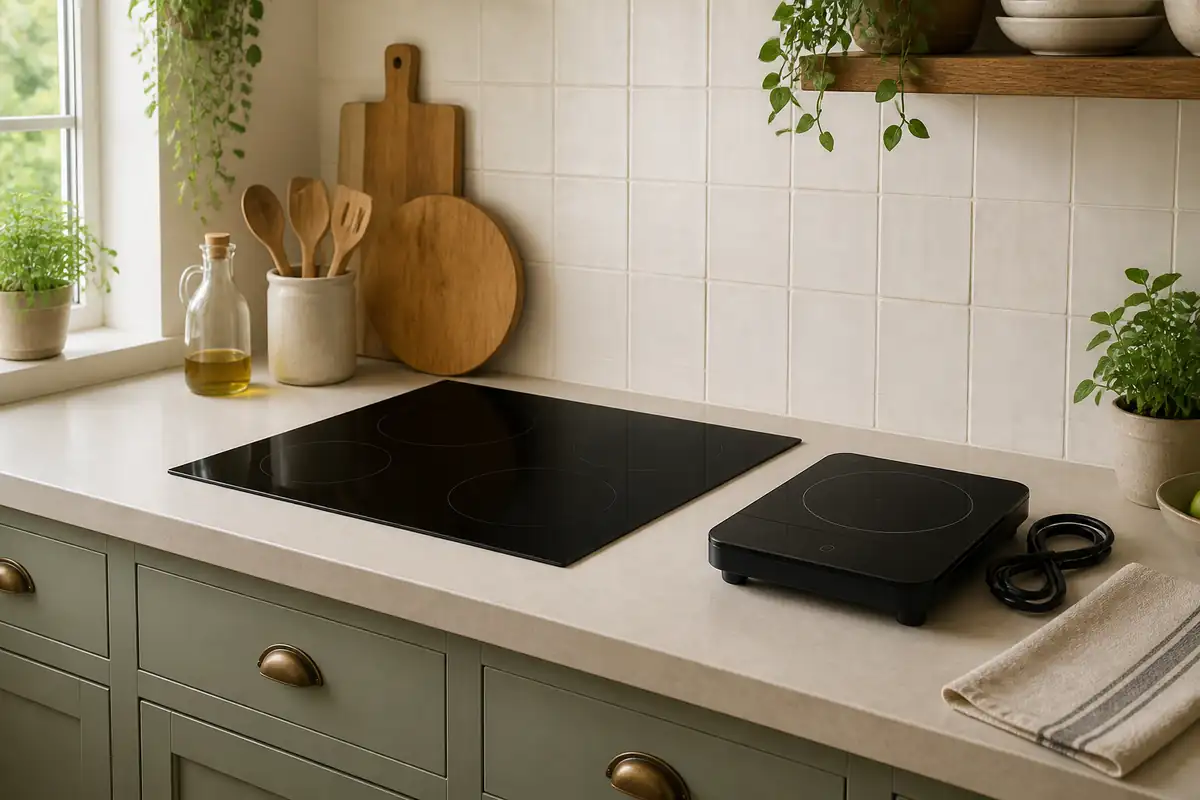
A portable induction plate can add controllable cooking for under £50 and move with you. A built-in hob offers several permanent zones, but electrical supply, installation, worktop fit and cost need checking before you order.
In this guide
Buy around the number of pans and the electrical connection—not the word “induction”
Choose a portable single-zone plate for a rented home, temporary kitchen, occasional extra ring or mostly one-pan cooking. Choose a built-in four-zone hob when several pans genuinely run together and the worktop, ventilation and electrical supply are suitable. A 13A plug-in four-zone hob can avoid hardwiring, but its total available power is lower than that of many hardwired models, so “four zones” does not always mean four zones at full output simultaneously.
Both options use an electromagnetic field to heat compatible cookware rather than heating a conventional element first. That makes their day-to-day behaviour more alike than their installation suggests: quick response, a flat glass surface and a pan that must contain magnetic material. The useful comparison is therefore not whether induction works. It is whether the cooker must be permanent, how many vessels need power at once and what the property can safely support.
Start with our Home & Kitchen guides if you are planning more than one change. The broader guide to choosing kitchen appliances explains why fit, services and access deserve the same attention as a specification sheet.
Built-in hob and portable plate compared
| Decision | Built-in induction hob | Portable induction plate |
|---|---|---|
| Best use | Permanent main cooker; households regularly using two to four pans | One-pan meals, extra zone, studio, rented or temporary kitchen |
| Typical connection | Either a model-specific 13A plug or a higher-rated fixed connection; never assume | Usually a fitted UK plug; follow the stated socket and clearance rules |
| Installation | Correct worktop cut-out, ventilation and electrical provision required | Stable heat-resistant worktop and suitable wall socket; no worktop cut-out |
| Cooking capacity | Usually four zones, sometimes with bridging or flexible areas | Usually one zone; some compact models provide two |
| Storage and moving | Fixed in place | Can be put away or taken to a new home |
| Cleaning | Flush surface is easy to wipe, but spills can spread across the whole hob | Easy to lift and clean around, though edges and cable add clutter |
| Up-front cost | Product plus possible delivery, cutting, connection and removal | Usually the appliance alone, provided a suitable socket already exists |
UK price snapshot: what the extra money buys
These official UK prices were rechecked on 24 August 2026. They are examples rather than permanent offers and must be checked again at checkout. Delivery depends on postcode, while installation depends on the selected product and the existing kitchen.
| Example | Price and published details | What it illustrates |
|---|---|---|
| IKEA TILLREDA, one zone | £45; 2,000W; 10A; 27 × 30.5 × 6.2cm; 2-year guarantee | A low-cost movable ring for one compatible pan |
| IKEA TILLREDA, two zones | £80; 1,500W and 2,000W zones; 2,800W connection rating; 13A; 28 × 52 × 6.2cm | More flexibility without a worktop cut-out, but a larger surface to store |
| AEG 5000 TN64IA04FB at Currys | £389; delivery from £20; four zones; 3kW total rating; standard 13A plug; optional installation shown at £115 | A full-size plug-in hob can simplify connection, subject to the actual socket and physical installation |
| AEG 7000 TI64IB10FB at AO | Listed as available; four zones; hardwired connection; delivery up to £30 for non-members depending on location; £130 connection service | The fitted basket can add delivery and connection even when the live product price changes dynamically |
Important: membership prices, delivery, recycling and connection fees can change the basket. Compare the same model and final delivered service. Our AO vs Currys appliance comparison shows how to separate the product price from optional installation.
The electrical question comes before the shortlist
“Induction hob” does not identify one electrical requirement. A portable plate may be supplied with a normal UK plug. Some full-size hobs are also designed for a 13A socket and manage their available power across the zones. Other models require a dedicated higher-rated circuit and fixed connection. The manufacturer’s connection rating and installation instructions decide the route—not the number of rings, the width or a retailer’s category label.
A plug-in four-zone model can be a practical answer where a full hardwired installation is not sensible. The trade-off is power sharing. If two or more pans ask for a high boost at once, the hob may limit or redistribute output to remain within its total connection rating. That can be perfectly acceptable for a household that usually boils one pan and simmers another, but frustrating for someone who expects several zones to heat at maximum power together.
Do not run a high-load cooking appliance through an extension lead or multiway adaptor unless its instructions explicitly permit that arrangement. Do not assume an existing socket, cable or circuit is suitable because another appliance was previously connected. Fixed electrical work must meet the rules that apply in the relevant UK nation. In England, Approved Document P gives statutory guidance; Electrical Safety First notes that arrangements differ in Scotland and Northern Ireland. For a hardwired hob, a new circuit, damaged accessories or any uncertainty, use a competent electrician.
When a portable induction plate is the better buy
You rent or expect to move
A portable plate avoids cutting a landlord’s worktop and can leave with you. It still needs a stable, heat-resistant surface, the required clearances and a suitable socket. Check the tenancy before treating it as a permanent alteration or using it to replace an appliance supplied with the property.
You mostly cook with one vessel
For porridge, pasta, a wok-style stir-fry in a compatible flat-bottomed pan, soup or a single frying pan, one responsive zone may cover the real workload. Buying four zones because a conventional cooker had four wastes money and worktop space if three remain unused. A portable two-zone model is the middle ground for a saucepan and frying pan, although its total rating still governs simultaneous performance.
You need resilience or an extra ring
A small unit can keep meals possible during a kitchen refit, serve as an overflow zone at a gathering or sit alongside another cooking method. It is also easier to replace than an integrated appliance. That does not make it disposable: keep the air inlets clear, avoid storing it while warm and protect the glass from impacts.
Your budget must stay predictable
With a suitable socket already available, the £45 example is close to the whole entry price. A fitted hob can add delivery, installation, worktop alteration and old-appliance removal. Use the framework in our total cost of ownership guide rather than comparing two product tickets.
When a built-in induction hob earns its place
Several pans are a normal meal, not an occasional event
A family meal may use sauce, vegetables, a main pan and a kettle-sized boiling task at the same time. A four-zone surface reduces sequencing and lets cookware remain in place. Measure the actual pan bases, though: four circles on glass can be too tightly spaced for four large vessels.
You want a permanent, uncluttered preparation area
A flush built-in surface removes the loose cable and raised appliance edge. That matters in a small kitchen where a portable cooker would occupy scarce preparation space even when not in use. Confirm the manufacturer’s cut-out, underside clearance and ventilation requirements before ordering; “60cm hob” is a market class, not a universal hole size.
You value controls and flexible zones
Bridge zones, timers, pan detection and individual sliders can make a full hob easier for varied cookware. Judge each feature against a real task. A flexible zone helps with a long griddle or two suitably positioned pans; it adds little if you always use one small saucepan. Our guide to shortlisting products is useful for separating minimum requirements from attractive extras.
Will either option reduce the electricity bill?
Induction can transfer heat to a compatible pan efficiently and respond quickly, but the appliance format alone does not guarantee a lower bill. Cooking cost is approximately power in kilowatts × time in hours × your tariff. A 2kW zone drawing full power for 15 minutes uses about 0.5kWh; it may then cycle or reduce power. The real result changes with pan size, lid use, food quantity, starting temperature and the selected level.
A portable plate and a built-in zone can have similar maximum power for one pan. The portable unit does not automatically save energy; it may simply prevent you powering additional zones. Record how long a repeated meal takes rather than multiplying the maximum rating by an entire evening. The same discipline is explained in our UK appliance running-cost guide.
Cookware, noise and daily usability
Use a fridge magnet as a first screening test: if it holds firmly to the pan base, the cookware is likely to work. The definitive answer is the cookware or hob instruction. A warped or very small base may not be detected even when the material is magnetic. Budget for replacement pans only after testing the ones you own.
Induction systems can hum, buzz, click or make cookware whistle, especially at high power or when layered pan bases resonate. IKEA explicitly describes hum, whistling and ticking as normal behaviours for its portable models. Noise is not automatically a fault, but an unusually harsh change, error message or damaged glass needs investigation. Read our appliance repairability guide before assuming a low purchase price means easy repair.
Controls also matter. Portable units can have a small panel close to the pan; built-in touch controls may become unresponsive when wet. Look for a clear lock, timer behaviour you understand and a way to reduce power without repeated taps. If anyone in the household has low vision, reduced dexterity or a pacemaker or other implanted medical device, check the manufacturer’s safety guidance and seek appropriate professional advice.
A practical decision sequence
- Count simultaneous pans. Note a normal weekday meal and the busiest meal, not an imagined special occasion.
- Check the property. Record the socket or existing hob connection, worktop material, cut-out, ventilation and landlord restrictions. Do not diagnose wiring yourself.
- Test cookware. Confirm magnetic bases and measure the widest pans together.
- Set the complete budget. Add delivery, electrical work, worktop alteration, pans and removal.
- Compare exact connection ratings. Decide whether power sharing is acceptable.
- Save evidence. Keep the model code, basket, instructions and receipt. The IKEA UK review and Currys review explain retailer-specific checks.
It is a permanent primary cooking zone
The worktop, electrical supply, ventilation and installation budget support a stable multi-zone appliance used every day.
Flexibility or a temporary extra zone matters
The circuit, cookware and ventilation are suitable, and one movable zone solves the task without pretending to replace a full hob.
Verdict
A portable induction plate is the smarter first step for one-pan cooking, rented accommodation, overflow use or an uncertain kitchen plan. It provides the central induction benefits without committing the worktop or paying for unused zones. The £45–£80 examples make that experiment relatively contained.
A built-in hob becomes better value when simultaneous cooking and permanent clear workspace are daily requirements. Before choosing it, decide whether a 13A power-managed model meets the workload or whether a correctly installed higher-rated model is justified. The expensive mistake is not choosing portable over built-in; it is ordering a hob before checking the connection, cut-out and complete fitted price.
Check current official information:
Approved Document P ↗IKEA induction hobs ↗Currys AEG plug-in hob ↗AO AEG hardwired hob ↗
Frequently asked questions
Can I plug a portable induction plate into a normal UK socket?
Many UK models are supplied for a standard socket, but check the exact instruction and rating. Use a sound wall socket in the stated location and follow the clearance rules. Avoid extension leads and multiway adaptors unless the manufacturer specifically permits them.
Can a full-size induction hob use a 13A plug?
Some can, including the AEG example in this snapshot. They manage total power within the connection limit, so several zones may not run at maximum simultaneously. Other hobs are hardwired. The model’s rating and instructions are decisive.
Do I need an electrician for a built-in induction hob?
Use a competent electrician for hardwired connection, a new circuit or uncertainty about the existing supply. Even a plug-in hob still needs correct physical installation, ventilation and a suitable socket; a plug does not make every kitchen automatically ready.
Will my existing pans work?
They need a suitable magnetic base. A magnet test is a useful first check, but very small or warped pans may still fail detection. Confirm against the cookware and hob guidance before replacing anything.
Is a two-zone portable hob as powerful as two separate plates?
Not necessarily — Check the total connection rating as well as each zone’s headline output. The two-zone IKEA example lists 1,500W and 2,000W zones but a 2,800W connection rating, so total demand is managed.
Which is safer around children?
Neither option removes the need for supervision. Induction glass can become hot from the pan, and cables can create a pull or trip risk. Stable placement, rearward pan handles, control locks and following residual-heat warnings matter more than the format alone.
How we researched this guide
We compared connection ratings, dimensions, zones, guarantees, availability, delivery and prices published by IKEA UK, Currys and AO on 24 August 2026. We used UK government electrical-safety guidance for the regulatory context. We did not buy, install or hands-on test these appliances. Price examples show the market structure, not performance rankings.
Limitations and update policy
Prices, member offers, stock, delivery, services and model specifications change. Electrical conditions are property-specific and building rules differ across UK nations. Check the live basket and installation requirements again before ordering. Browse our UK shop-review directory for transaction-specific retailer research.
This is general buying guidance, not electrical or building-regulations advice. Follow the appliance instructions and obtain competent professional assessment where required.