Sony WH-CH520 vs WH-CH720N UK: fit, ANC and the cable question
Choose between a lighter on-ear wireless model and an over-ear pair with ANC and an analogue fallback, using the actual source devices and fit.
In this guide
Pay for the listening route you need
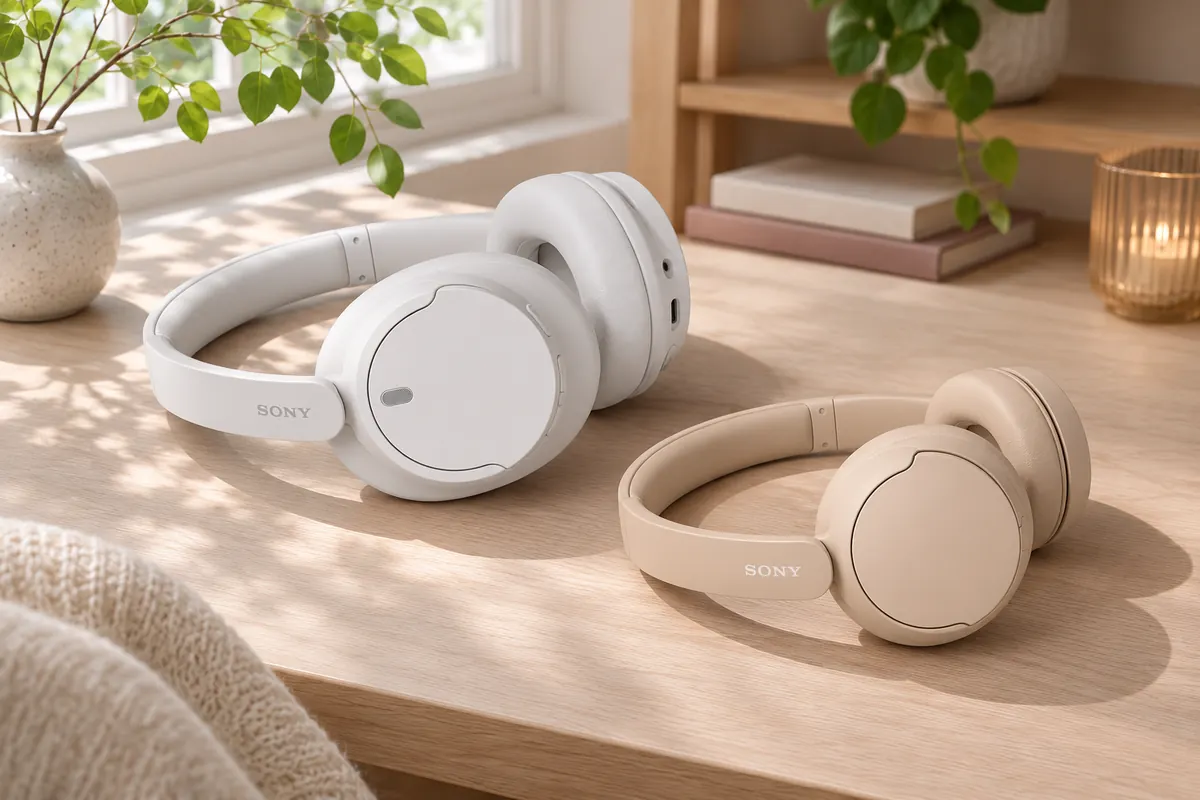
Sony WH-CH520 is the lighter, lower-priced on-ear option in this pair. WH-CH720N adds active noise cancellation, an over-ear format and an analogue cable route. Those differences matter more than treating both as interchangeable wireless headphones. Choose around where you listen, the devices you connect and the fit you can tolerate through a normal session.
Both models originated in Sony’s 2023 range. This is a current UK buying comparison, checked on 22 November 2026, rather than a claim that either is Sony’s newest release. The selected direct-shop offers were beige WHCH520C.CE7 and white WHCH720NW.CE7; other colours, editions and retailers need their own price check.
The features that change the purchase
| Purchase question | WH-CH520 | WH-CH720N |
|---|---|---|
| Ear-cup format | On-ear | Over-ear |
| Published mass | Approximately 147 g | Approximately 192 g |
| Active noise cancellation | Not provided | Provided, with ambient-sound control |
| Analogue input | No audio input or passive operation listed | 3.5 mm input and supplied detachable audio cable |
| Bluetooth codecs | SBC and AAC | SBC and AAC |
| Published music endurance | Up to 50 hours | Up to 35 hours with noise cancellation; up to 50 hours with it off |
| Selected UK direct price on the check date | £24.99, beige reference | £64.00, white reference |
These are manufacturer specifications and observed offers, not results from a matched listening trial. For the meaning of drivers, frequency figures and noise-control labels, see our headphone specifications explainer. A longer feature list should identify a use you have, rather than settle the decision by itself.
On-ear and over-ear create different fit checks
The CH520’s pads rest against the ears, while the CH720N’s larger format is intended to surround them. Actual space, pressure and seal still depend on your ears, head and adjustment. Neither the category name nor the lower mass establishes which pair will feel better to a particular listener.
The stated 45 g difference is useful when comparing what you will carry, but it is not a comfort measurement. Pad contact, headband pressure, glasses and the length of a listening session can matter independently. Check those points in a permitted demonstration rather than repeating a general all-day comfort claim as a personal guarantee.
A fit check that reflects normal use
- Wear the glasses or other everyday accessories that affect the pad seal.
- Adjust the headband without assuming the first position is correct.
- Check whether the ear sits comfortably within or beneath the relevant pad.
- Try the controls without taking the headphones off.
- Consider how the pair will be protected inside the bag you normally carry.
If a demonstration is unavailable, check the seller’s current conditions before opening and trying a sealed product. Do not treat a general returns slogan as proof that unrestricted home use is accepted for every audio purchase.
Decide whether active noise cancellation solves a real problem
CH720N includes active noise cancellation and ambient-sound functions; CH520 does not. This is a functional difference for someone who specifically wants electronic noise management. It does not establish that a reader will prefer the CH720N’s sound or that every distracting voice will disappear.
Think about the actual listening location. A quiet room may not justify paying mainly for ANC, while a regular journey may make the feature worth investigating. Our noise-cancelling headphone buying guide separates the seal, processing, microphones and controls that can otherwise become one vague promise of silence.
Ambient-sound mode is also a convenience feature, not a substitute for judging surroundings or obeying local safety requirements. No setting makes it sensible to assume you can hear every warning while audio is playing.
We have not measured attenuation or compared the models in traffic, on an aircraft or beside speech. A reader who needs a particular noise-reduction result should inspect credible model-specific test evidence or arrange an appropriate demonstration before treating the premium as proven.
The analogue cable is a separate reason to upgrade
Sony lists a detachable approximately 1.2 m audio cable and 3.5 mm input for CH720N, with passive operation supported. CH520’s specifications list neither an audio input nor passive listening. Its USB charging connection should not be advertised as an alternative wired audio socket.
Trace the complete source-to-headphone path. A laptop with an appropriate analogue output raises a different question from a phone with only USB-C, an aircraft socket or a workplace system that blocks Bluetooth. An adapter, connector arrangement or permission may still be needed.
Do not assume the cable preserves every Bluetooth microphone, app or noise-control function. Check the manual for the intended operating mode and power state. Having an analogue fallback is useful, but it does not turn every source or calling platform into a confirmed compatible system.
Wireless codecs and multipoint do not create every feature
Both current specification pages list SBC and AAC, and both product pages describe connection to two Bluetooth devices through multipoint. That shared feature does not mean the two devices’ sound is mixed simultaneously or that every work computer permits the required connection.
Our Bluetooth codec guide explains why a codec name alone cannot guarantee latency, call quality or a particular listening result. The source, software, connection mode and application remain part of the chain.
Sony’s Sound Connect app offers settings such as equalisation, subject to the supported device and software route. Check whether you can install and use the app where needed. A managed phone or computer can make a technically available feature impractical for that user’s routine.
For calls, distinguish being able to connect from getting the microphone performance you require. We did not compare recordings, wind handling or voice pickup in a matched test, so neither model receives an unsupported call-quality victory here.
Compare battery figures under the same mode
CH520’s headline music figure is up to 50 hours. CH720N is rated up to 35 hours with noise cancellation and up to 50 hours with it off. Comparing 50 against 35 without the operating modes would hide the feature responsible for part of the difference.
Sony’s support specifications give approximately three hours for a full CH520 charge and three and a half for CH720N. These figures are not a promise about every charger, battery condition, call pattern or listening level. The battery-life assumptions guide helps keep the usage conditions attached to the number.
Plan the charging routine around your sessions, not a theoretical maximum number of days. A weekly commute, occasional desk use and several long calls produce different needs. Inspect the supplied charging cable and suitable power source rather than assuming a mains adapter is included.
Assess the current UK price gap and ownership
The selected Sony UK pages showed £24.99 for beige CH520 and £64.00 for white CH720N on the check date, both with add-to-basket routes. The observed gap is £39.01. We did not place an order or reserve stock, and the prices should not be extended to every colour or future date.
For that gap, the practical questions are over-ear fit, ANC and analogue listening. If none is useful, the lower-priced option may already meet the brief. If a cable is essential, a saving on a model without the needed input does not produce a workable purchase.
Check replaceable wear items, the official support route and care instructions before assuming that either pair’s pads or battery will be cheap to replace. Our headphone ownership and care guide explains how those longer-term questions differ from initial specifications.
Choose between these two Sony use cases
Choose CH520 for an on-ear wireless brief
The on-ear format suits you, Bluetooth covers the intended sources and you do not need ANC or an analogue fallback. The selected offer costs less and the model has the lower published mass.
Choose CH720N for ANC or the cable route
You have a specific use for noise control or 3.5 mm listening and the over-ear fit works. Check the operating-mode limitations and the exact source connection before relying on either feature.
Our verdict favours the model that fulfils the connection and fit brief, rather than awarding an automatic win to the dearer pair. If your budget and required features are substantially different, the XM5 versus XM6 comparison covers another Sony tier without implying that everyone needs that upgrade.
Sony UK model and support sources
WH-CH520 current UK model, colour selection and offerWH-CH720N current UK model, ANC and selected offerCH520 battery, connections and supplied equipmentCH720N music modes, analogue input and charging specifications
Questions about CH520 and CH720N
Does WH-CH520 include active noise cancellation?
It does not provide ANC. WH-CH720N is the noise-cancelling model in this comparison.
Can I plug an audio cable into CH520?
Sony does not list an analogue input or passive operation for CH520. Its charging socket is not an advertised wired audio alternative.
Do both headphones support AAC?
Sony lists SBC and AAC for both models, with the actual connection depending on the source and operating mode.
Why does CH720N have both 35-hour and 50-hour figures?
The quoted music maximum changes with noise cancellation enabled or disabled, so the setting belongs with the figure.
Is the selected £39.01 difference permanent?
It is the gap between the two specified direct-shop offers observed on 22 November 2026, not a promise for other colours or dates.
How these Sony models were compared
We checked Sony’s UK product pages and official specification tables on 22 November 2026, including selected model references, observed prices, battery modes, inputs and codecs.
Listening and compatibility limitations
No sound, ANC, microphone, battery or comfort test was performed. Model-specific manuals, permitted demonstrations and the intended source devices are required to resolve individual performance and fit questions.