Open-ear headphones value guide: specifications worth paying for
Open-ear headphones trade acoustic isolation and bass weight for awareness, ventilation and a less sealed feel. Value depends on the exact design, stable fit, intelligible calls, honest battery evidence and a use case that benefits from hearing the environment.
In this guide
Pay for stable fit and a defined awareness use, not novelty
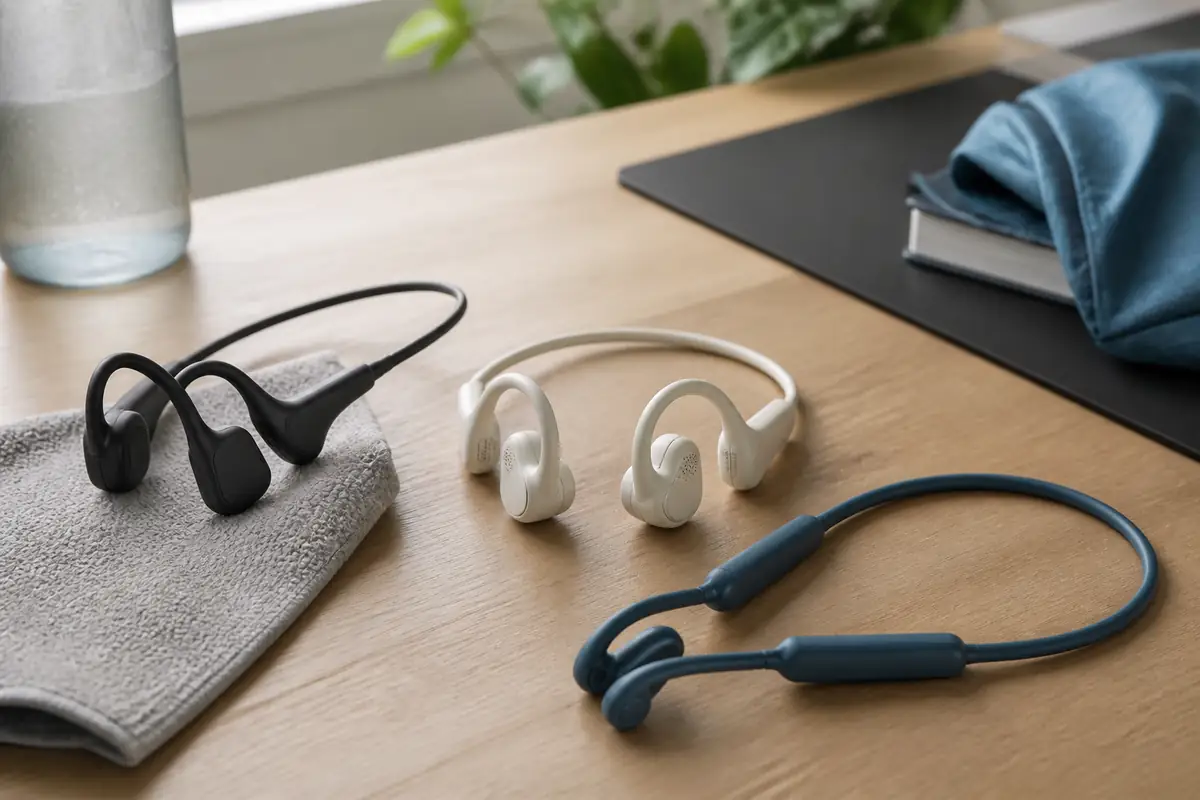
Choose open-ear only when environmental awareness, comfort or ventilation matters more than isolation. The most useful specifications are design type, weight, fit adjustment, codec and multipoint support, microphone behaviour, battery at realistic volume, charging method and water-resistance claim.
Compare the format with our Bluetooth audio value guide, use the tech specification comparison method, and read the electrical safety checklist before buying from an unfamiliar seller.
| Design | Useful for | Evidence to check | Main compromise |
|---|---|---|---|
| Air-conduction ear hook | Walking, office and light exercise | Weight per side, hook shape, leakage and microphone | Fit varies and bass is limited |
| Neckband air conduction | Stable outdoor or work use | Band pressure, clothing contact and controls | Band can catch collars or helmets |
| Bone conduction | Specific awareness and fit preferences | Transducer placement, vibration and stated water rating | Sound character and vibration differ |
| Clip-on open design | Compact casual listening | Clamping comfort, left/right logic and charging case | Position can shift and controls may misfire |
Open-ear shortlist sheet
- Name the environment and why awareness is needed.
- Choose air conduction, bone conduction, neckband or clip format.
- Record weight, contact points and adjustment range.
- Check Bluetooth version, codec, multipoint and device support.
- Compare battery with volume and feature conditions.
- Verify charging connector, case capacity and replacement support.
- Read the exact water and sweat resistance claim.
- Use a safe, comfortable volume and take listening breaks.
Open-ear describes several different mechanisms
Some products use small speakers positioned near the ear canal; some transmit vibration through the bones around the ear; others clip to the outer ear. These designs feel and sound different. A product title saying open-ear does not establish whether it uses air or bone conduction, how it anchors or how much sound escapes.
Require a clear diagram, weight and wearing method. If the listing avoids naming the mechanism or shows only lifestyle images, comparison is unreliable. The right format depends on glasses, headwear, hair, movement and sensitivity at the contact points.
Awareness is useful but not a safety guarantee
An unsealed design can make environmental sound more available than a sealing earbud, yet audio still occupies attention and can mask quieter cues. Never interpret open-ear marketing as permission to ignore road rules, workplace requirements or instructions from an event or transport operator.
Test at the lowest comfortable level in a controlled setting first. For an open-ear set, keep playback at a comfortable low level as advised by the NHS rather than turning it up to overcome traffic; hearing the environment does not make loud playback harmless. If traffic, announcements or conversation cannot be followed, reduce playback or stop rather than relying on the product category.
Fit stability deserves more weight than a codec
A light product can still create pressure when its hook, clip or transducer lands badly. Check weight per side, contact material, adjustment and whether the maker shows use with glasses. Stability should come from geometry rather than painful clamping.
During a return-safe indoor test, walk, turn the head, smile, wear glasses and the normal hat or helmet only where compatible with its safety instructions. A secure stationary fit can move during speech or exercise. Stop if pressure, skin irritation or headache develops.
Sound quality must be judged against the open design
Open products usually provide less acoustic isolation and can deliver lighter low bass than a good sealing earbud or over-ear headphone. Do not pay for exaggerated claims of studio impact without measurements and a suitable environment. Speech, podcasts and moderate music may be the more realistic strengths.
Compare at matched perceived volume. A louder demonstration often sounds fuller, but it increases fatigue and hides tonal imbalance. Equalisation can help preference; it cannot create physical isolation or guarantee deep bass in a noisy setting.
Leakage matters in offices and quiet rooms
Air-conduction open designs can be audible to nearby people, especially at higher volume. Bone-conduction models may also radiate some sound. Listings rarely describe leakage in a standardised way, so independent measurements and a home test are more useful than a privacy claim.
Play speech and music while another person listens from a realistic distance, without exposing them to excessive volume. If private calls or library use are central, a more isolating design may be the honest choice despite reduced awareness.
Microphone quality depends on wind and placement
A microphone count is not a call-quality score. Ask whether the boom or beamforming arrangement captures speech in wind, street noise and a quiet room, and whether processing makes voices thin or unstable. Review controlled recordings where available.
Test calls on the actual phone and conferencing application. Check sidetone, mute controls and device switching. For confidential work, remember that an open speaker can be overheard even when the microphone performs well.
Bluetooth version is only one compatibility field
A newer Bluetooth number does not prove support for every codec, profile or feature. Confirm the exact playback codec on the operating system, multipoint behaviour, call support and whether an app is required for updates or EQ. Our Bluetooth feature guide explains why named support matters more than the version alone.
LE Audio and the LC3 codec can enable useful capabilities when both ends support them, but compatibility remains device-specific. Check the phone, computer and headphones together rather than buying for a logo that only one component can use.
Battery claims require test conditions
Record whether runtime refers to music, calls, a case total or one charge, and note the volume and features used. Multipoint, calls, high output and cold conditions can reduce runtime. Choose enough margin for the longest real day rather than the longest advertised number.
Check low-battery warning, quick-charge conditions, connector and whether the device works while charging. For a case-based design, separate earbud runtime from total case replenishment. A large total is not helpful when one listening session exceeds the per-charge limit.
Water resistance needs an exact rating and scope
Look for the stated IP rating and determine whether it applies to the earpieces, neckband, case or all components. Sweat resistance does not make a charging case washable, and a laboratory rating does not cover every liquid, temperature or wear condition.
Follow drying and charging instructions. Do not charge wet contacts or assume previous impact leaves sealing intact. For swimming, use only a product and storage method explicitly designed for that use; ordinary Bluetooth also behaves poorly through water.
Controls should work without disturbing the fit
Physical buttons offer tactile certainty but can press the unit into the skin; touch surfaces can misread hats, rain or adjustment. Map play, volume, call, mute and assistant actions, and check whether left and right controls can be customised.
Test with gloves if outdoor winter use matters. A product that needs a phone for every volume change weakens the awareness case, because attention moves from surroundings to the screen. Control logic is a daily specification.
Charging and repairability affect ownership value
USB-C reduces cable friction, but inspect the supplied cable, case hinge, contact cleaning and replacement availability. A proprietary magnetic lead can be acceptable when a spare is affordable and obtainable, but losing it should not strand an otherwise working product.
Battery replacement is uncommon in small wireless audio. Include realistic service life, warranty route and recycling rather than dividing price by an implausible number of years. Our refurbished technology guide helps assess used battery risk.
Choose by scenario rather than universal ranking
For quiet office calls, leakage and microphones can outweigh sports stability. For running, secure fit, controls, weather resistance and awareness dominate. For public transport, poor isolation may force unsafe volume, making a conventional isolating headphone the better value.
Write three environments and score the same fields. The specification comparison guide prevents one headline feature from winning every scenario. A model can be excellent for one route and unsuitable for another.
Run a return-safe listening test
Keep packaging and hygiene conditions intact. Test pairing, multipoint, comfort, leakage, calls, controls and a representative hour of listening indoors. Do not wear a return candidate outdoors, in heavy exercise or in rain unless the retailer explicitly permits it.
Record disconnects and battery movement rather than relying on a first impression. If persistent discomfort, unstable fit or insufficient intelligibility appears, return promptly. Do not raise volume to compensate for a use case that fundamentally needs isolation.
Choose open-ear or isolating headphones?
Awareness and ventilation are central
The fit remains stable and comfortable, leakage is acceptable, speech stays intelligible and the environment does not force excessive volume.
Noise control or privacy matters more
Commuting, concentrated music, confidential calls or low-volume listening in noise benefits from a good seal or active noise cancellation.
Balanced verdict
Open-ear value comes from a genuine awareness use and stable, non-painful fit. Pay for clear design information, usable controls, call evidence, realistic battery, exact water resistance and support. Do not pay extra for version numbers or safety language that the complete product cannot substantiate.
Browse the Tech & Audio archive and use our online shop verification guide before ordering from an unfamiliar listing.
Official checks:
NHS hearing-loss prevention advice ↗
Bluetooth SIG LE Audio overview ↗
Bluetooth SIG LE Audio specifications ↗
Frequently asked questions
Do open-ear headphones protect hearing?
No format guarantees safe exposure. Keep volume only high enough for comfortable listening, limit exposure and follow NHS or professional advice.
Are bone-conduction and open-ear headphones the same?
Bone conduction is one open-ear mechanism. Other products use air-conduction speakers near the ear or clip-on designs.
How does sound leakage affect the value of open-ear headphones in a shared room?
Many can be audible nearby, especially at higher volume. Leakage varies by design, fit, content and environment and should be tested.
Is Bluetooth 5.4 automatically better than 5.3?
No — Confirm the specific codecs, profiles, multipoint and device compatibility that the product actually supports.
Can open-ear headphones be used for swimming?
Only when the exact product and storage/playback method are explicitly designed for swimming. Do not infer this from general sweat resistance.
Methodology and limitations
We reviewed official NHS hearing advice and Bluetooth SIG feature documentation, then compared open-ear mechanisms across fit, awareness, acoustics, leakage, calls, wireless support, battery, controls, weather resistance and service. We did not conduct listening tests of named products.
Limitations
Comfort, sound and leakage are individual and environment-dependent. Specifications, firmware and device support change; verify the exact model, phone compatibility, current policy and safe-use instructions before purchase.