Open-ear headphones buying guide: fit, leakage, awareness and call quality
Open-ear headphones leave the ear canal unobstructed, but that does not guarantee comfort, safety or private sound. Choose between ear-hook, clip and neckband forms by head and ear geometry, real background noise, leakage tolerance, call needs, glasses, weather and charging—not by an “awareness” slogan.
In this guide
Fit and environment matter more than headline audio claims
Choose open-ear headphones when you need long-wear comfort and must still hear some surroundings in a controlled setting. Choose isolating earbuds or over-ear headphones when privacy, low-volume detail or loud-commute listening matters more. Open ears do not remove the need to look, listen and avoid distraction.
This guide covers selection before purchase. For a broader comparison with sealed alternatives, read the wireless-earbuds guide and our practical wireless-earbuds ownership guide.
| Form | Potential strength | Main fit question | Trade-off |
|---|---|---|---|
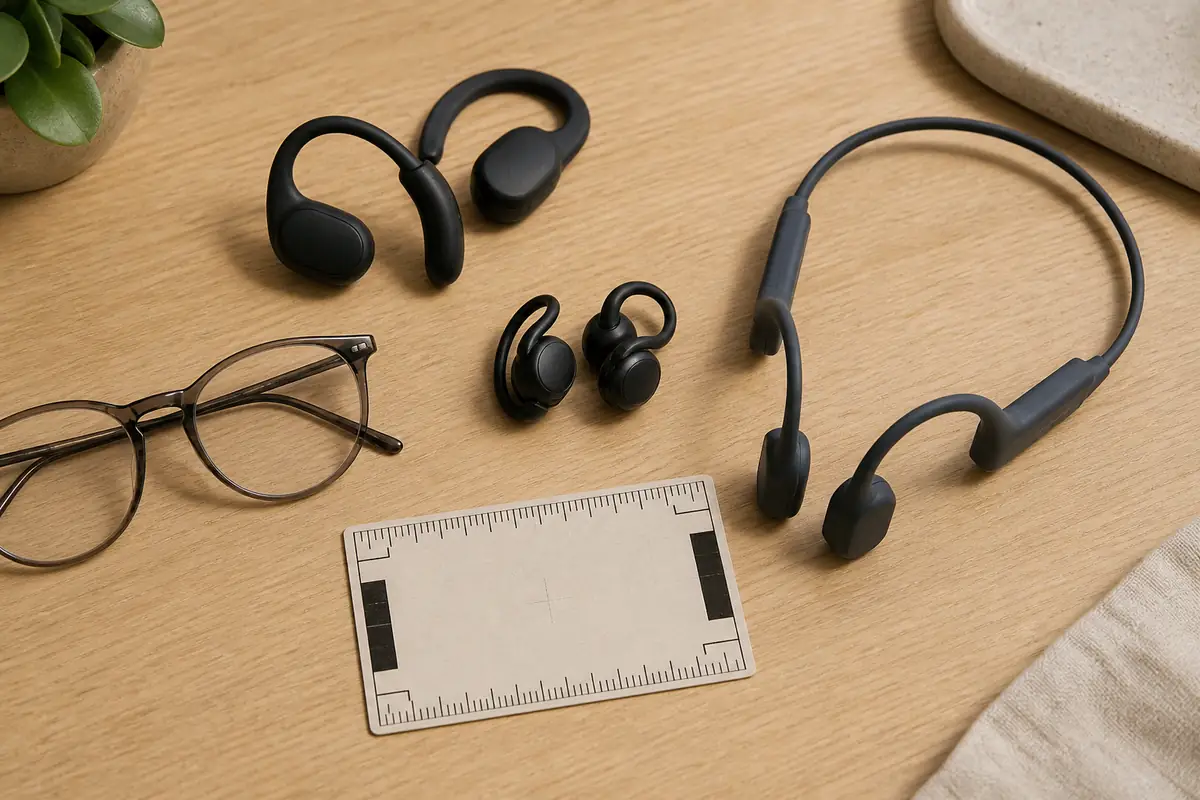
| Ear hook | Stable for walking and exercise | Space with glasses and ear shape | Pressure behind the ear |
| Clip | Compact, no long hook | Pinch, position and left/right balance | Can shift or press cartilage |
| Neckband | One-piece retention, fewer loose parts | Band clearance with collar, hair and helmet | Less pocketable |
| Open speaker | Natural ear canal, easy conversation | Driver alignment to ear opening | Leakage and weak bass in noise |
Start with the listening environment
List where you will actually listen: quiet home office, school run, gym, park, road, train or shared workplace. Open designs compete with ambient sound. In loud places, detail can disappear and the temptation is to raise volume. That weakens the claimed awareness advantage and can annoy people nearby.
The Highway Code tells pedestrians to remain aware and avoid unnecessary distractions. A product cannot make road use safe. Stop or remove audio when traffic, crossings, work instructions or another task requires full attention.
Before buying open-ear headphones
- Choose the form factor before comparing codecs.
- Check compatibility with glasses, helmet, hat and hair.
- Test stability through walking, chewing and head turns.
- Assess leakage at your normal volume in a quiet room.
- Check call samples in wind and realistic background noise.
- Confirm button or touch controls work with gloves or sweat.
- Verify charging connector, case, battery and spare-part route.
Fit is a three-dimensional problem
Ear size alone is insufficient. Hook thickness, speaker position, clamp force, weight distribution and skin contact decide comfort. Glasses can stack pressure behind the ear; a helmet strap can move the speaker; a clip can press one cartilage point.
If possible, buy from a seller with a clear hygiene return policy. Wear the device indoors for the duration of a normal session before treating a short try-on as proof.
Stability and comfort are separate
A very tight hook may remain stable while becoming painful after forty minutes. A loose device may feel invisible but move when running or chewing. Check both ears because geometry differs. Note whether controls push the device into skin.
For exercise, look for the exact ingress rating and maker limitations, then compare with our water-resistance ratings guide. Sweat resistance does not mean swimming or hot-water safety.
Awareness is partial, not guaranteed
Leaving the canal open can preserve some external sound, yet audio still masks, distracts and competes for attention. Wind, traffic, announcements and conversation vary. Directional cues can be changed by both sound level and device position.
Use the lowest workable level, pause at crossings and comply with workplace or event rules. Do not use marketing terms as a substitute for a risk assessment.
Sound leakage matters in shared spaces
Leakage depends on volume, driver direction, fit and frequency content. A quiet-room demonstration is essential if you plan to use them near colleagues, a partner or on public transport. Ask another person to listen from normal seating distance.
Products that compensate for bass loss with higher volume may leak more. Our general headphones guide explains when isolation may deliver better clarity at a lower setting.
Do not expect sealed-ear bass
Without a sealed ear canal, low-frequency energy disperses and background noise masks detail. Compare speech, podcasts, acoustic music and bass-heavy tracks from your own library. Equalisation can change balance but cannot create isolation.
Judge speech intelligibility at a sensible level before maximum loudness. A device that only sounds balanced when pushed hard is poorly matched to the environment.
Call quality needs two-way evidence
Microphone count is not a result. Record a voice note and make a call in a quiet room, near a fan and outside in moderate wind. Ask the other person about clipping, pumping, background suppression and whether your voice drops when you turn your head.
Check whether a boom or beam-forming system maintains position. If calls are central, compare with the headsets-for-calls guide.
Controls and multipoint
Physical buttons can be reliable but may disturb fit. Touch controls can misfire with hair, rain or adjustment. Check volume, play, call, assistant and power actions without needing the phone. Confirm whether controls are remappable.
Multipoint should be tested with the exact computer and phone. Connection to two devices does not guarantee graceful switching during calls or video meetings.
Battery claims need a use scenario
Separate single-charge runtime, total case runtime, call use and standby. Higher volume, calls, cold and processing can reduce real duration. A neckband may use a cable rather than a case; clips and hooks can have awkward charging contacts.
Use our USB-C charger guide to verify permitted input. Do not assume every USB-C cable and high-power adaptor is supported.
Test protocol for a returnable pair
Use the same five-minute sequence each time: quiet speech, familiar music, a voice note, a call beside steady background noise and a walk indoors with head turns. Keep the phone, app, volume and source material constant. This reveals changes caused by fit rather than a louder demonstration track.
Ask another person to judge leakage from one metre away at your normal volume, then repeat in a quiet room. Record whether one side shifts with glasses or chewing. A product that needs continual repositioning is unlikely to improve during ownership.
Apps, accounts and software support
Check whether basic controls, equalisation, multipoint or firmware updates require an account or phone app. Read the supported operating-system versions and whether the product remains usable without permissions you do not want to grant. A good physical design can still be a poor long-term purchase if essential settings depend on abandoned software.
Confirm how factory reset, pairing history and update recovery work. For a gift or shared household device, simple documented controls may matter more than a long feature list.
Repairability and replacement parts
Open-ear devices can use unusual ear hooks, clips and charging contacts. Ask whether charging cases, cables, sleeves or individual sides are sold separately and whether batteries are replaceable through a service route. A lost proprietary case can end the useful life of two working earpieces.
Inspect warranty duration and the evidence needed for a fault claim. Keep the serial number and receipt, and do not confuse accidental damage or gradual battery wear with a manufacturing defect.
Children, shared use and hygiene
Fit and permitted volume require particular care for younger users; adult devices may not sit reliably on smaller ears. Follow manufacturer age guidance and supervise use. Open designs reduce ear-canal contact but still touch skin, collect sweat and should not be casually shared without cleaning compatible surfaces.
Use only the cleaning method permitted for the exact ingress rating. Liquids, solvents and compressed air can damage microphones, mesh or charging contacts even when the product is marketed for sport.
Choose open-ear or closed listening?
Comfort and controlled awareness lead
The fit remains stable with your accessories, leakage is acceptable and the environment is quiet enough for sensible volume.
Privacy or noisy-place clarity leads
You need isolation, stronger low-level detail, very private listening or dependable audio in loud transport.
Latency and video use
Wireless delay varies with the source, codec, app and processing. Test spoken video, keyboard feedback and a live call on every device you plan to use. A low-latency mode may reduce battery life or connection stability, so verify the trade-off rather than assuming a gaming label solves it.
Case and portability
Ear-hook designs can require a much larger case than sealed earbuds. Measure the case if trouser-pocket use matters, check whether it opens one-handed and confirm that each side seats reliably on the charging contacts. Magnets that feel secure on a desk may still allow poor contact when lint or sweat is present.
For neckbands, test whether the cable catches collars and whether the earpieces can be secured when not playing. Portability is part of daily fit, not an accessory detail.
Buying for hearing access
Open-ear products are not hearing aids and should not be presented as a medical solution. If hearing ability, tinnitus, pain or assistive listening is the reason for purchase, seek appropriate professional advice and check compatibility with any existing device. The useful consumer test remains comfort, intelligibility and control at a sensible level.
Balanced verdict
Open-ear headphones are a fit-and-environment purchase, not an automatic safety upgrade. Their best case is comfortable speech, calls and moderate music where some external sound is useful and leakage is acceptable.
Shortlist by form, try with every accessory and test calls and leakage before keeping. See our Tech & Audio archive for alternatives.
Official checks:
The Highway Code: pedestrians and awareness ↗THINK! road-safety guidance ↗UK product safety alerts ↗
Frequently asked questions
Are open-ear headphones safer outdoors?
They may preserve some outside sound, but audio still masks and distracts. Stay visually and aurally alert and pause when needed.
Will nearby passengers hear an open-ear headphone during a quiet journey?
Yes, to varying degrees. Test at your normal volume and normal distance from other people.
Can I wear them with glasses?
Some forms work well; others stack pressure or move. Test with your actual frames for a full session.
Are bone-conduction and open-ear the same?
No — Bone conduction is one open-ear approach; other products use small speakers near the ear canal.
Are open-ear headphones good for calls?
Some are, but microphone performance depends on design, fit, wind and background noise. Test two-way samples.
Methodology and limitations
We compared open-ear form factors, fit interactions, leakage, awareness, call testing, controls, power and ownership evidence, and reviewed current official UK road-safety and product-safety guidance. We did not laboratory-test models or rank brands.
Limitations
Fit, sound and microphone results vary by person, device, environment and software. Test the exact product and recheck specifications.