Power banks ownership guide: battery ageing, storage, travel and safe disposal
Lithium batteries age with time, heat and use. Keep the exact model record, use a compatible charger and cable, avoid crushing or hot storage, investigate swelling or unstable behaviour immediately and verify airline rules for every trip.
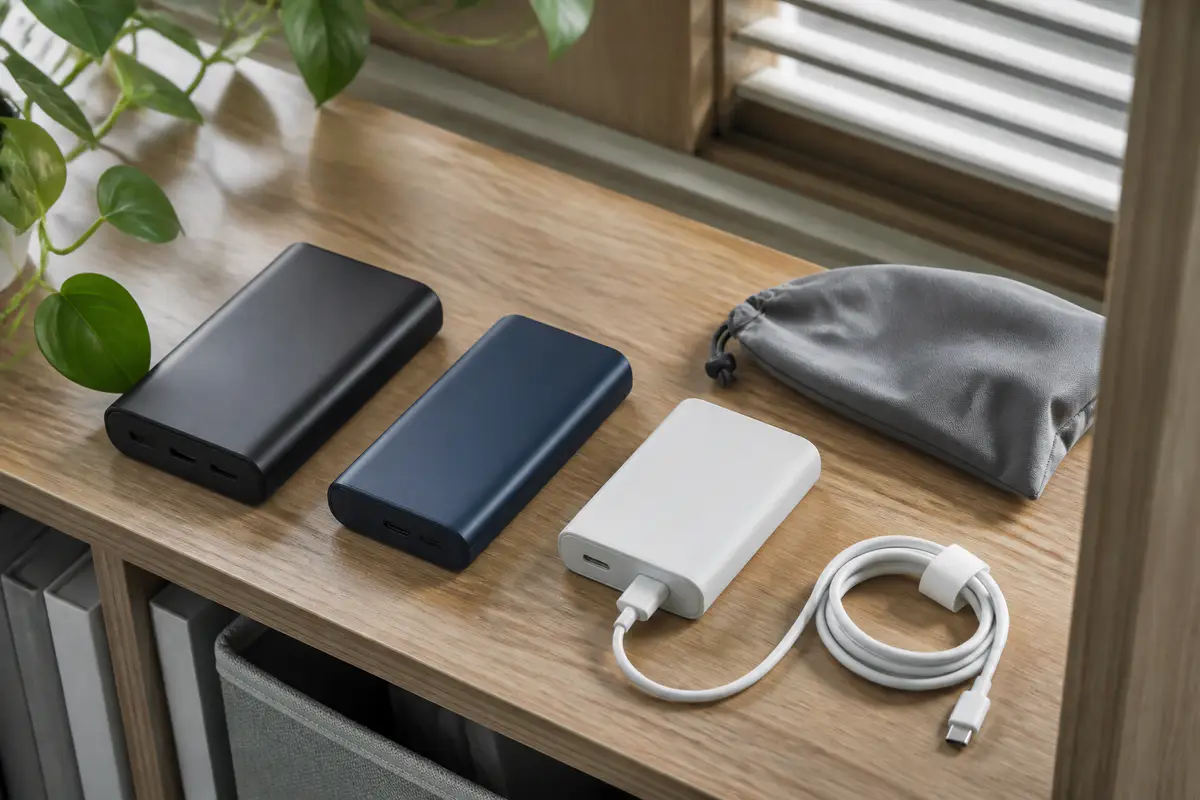
In this guide
Heat, damage and swelling are stop-use signals
Charge on a firm ventilated surface with traceable equipment, then store away from direct sun, moisture, metal objects and physical pressure. Do not puncture, squeeze, tape flat or “use up” a swollen bank. Isolate it from combustible materials where safe and obtain current local battery-disposal instructions.
For capacity, protocols and initial selection, start with our power banks buying guide. This guide begins after purchase and cannot replace the manual for an exact battery, airline or disposal service.
| Observation | Possible first check | Action |
|---|---|---|
| Capacity gradually lower | Temperature, load and cable; compare like-for-like | Monitor and plan replacement if insufficient |
| Repeated connection cycling | Ports, cable and allocation with power removed | Stop if heat, looseness or damage appears |
| Casing swollen or separating | Do not press or recharge | Stop use and obtain disposal guidance |
| Unusual smell, hiss or smoke | Keep people clear | Follow emergency guidance; do not handle dangerously |
| Bank gets hotter than its established pattern | Disconnect when safe; check load and environment | Do not resume until cause is resolved |
Record identity and energy
Photograph the label, model, serial, watt-hour figure, input and output profiles before wear makes them unreadable. Save the manual and receipt. Airline staff, recall notices, support teams and recycling services may need exact identification.
Milliamp-hours are not enough for travel or energy comparison. Keep the printed watt-hour rating and do not cover it with a household label. If capacity cannot be established, a carrier may refuse it even when the bank looks small.
Before each use
- Inspect casing seams, ports, cable ends and plug.
- Check the surface is firm, dry, open and away from heat.
- Confirm the device, port and cable match the intended output.
- Remove coins, keys and conductive debris from the area.
- Do not charge inside bedding, a bag or direct sun.
- Stay alert to new smell, noise, cycling or localised heat.
Charging equipment is one system
Use the bank’s documented input and a reputable compatible charger. Higher advertised wattage does not force a device to accept it, but unknown protocols, damaged cables and poor allocation can cause unstable operation. Our USB-C charger ownership guide covers the whole power path.
Multi-port chargers may divide power when another device is added. If the bank repeatedly starts and stops, simplify the setup and test one known-good component at a time. Do not continue flexing a loose port until contact returns.
Temperature and placement
Battery temperature reflects room conditions, charge rate, conversion loss and device load. Some warmth may be documented; a new hot spot, deformation or rapidly rising temperature is different. Keep the bank off soft furnishings and away from radiators, dashboards and sunny windows.
Do not put a hot bank into a freezer or immerse it. Rapid cooling and condensation create more risk. Disconnect when safe, keep people away and follow maker or emergency advice for abnormal behaviour.
Store for the interval, not forever
For long storage, follow the manufacturer’s recommended charge range and review interval. Do not assume full or empty is universally best. Store in a cool, dry, ventilated location with terminals protected and nothing heavy pressing on the case.
Inspect periodically and recharge only as instructed. A forgotten bank can become deeply discharged or damaged. Do not leave it permanently connected as an improvised uninterruptible power supply unless the exact model explicitly supports that use.
Understand normal ageing
Usable capacity and maximum output can decline with cycles and calendar age. Compare under similar conditions: same device, cable, temperature and starting charge. A phone software update or heavier use can change apparent performance, so one shorter session is not proof of failure. The distinction between headline figures and repeatable use is covered in our battery-life claims guide.
Replace when the bank no longer reliably serves its required job, support is unavailable or physical condition is unsafe. Do not use a questionable bank for low-value devices as a way to postpone disposal.
Keep using or retire?
Condition and behaviour remain stable
The case, ports and cable are intact, charge and output match documented expectations, temperature is normal and the model is not recalled.
Safety or reliability evidence has changed
There is swelling, cracking, liquid exposure, unstable contact, unusual heat, smell, sound, smoke or a relevant recall.
Travel rules require a fresh check
The current CAA baggage table gives power banks their own entry: cabin carriage only, no more than two per person, and operator approval for a rating above 100 Wh up to 160 Wh. An airline or destination may impose tighter conditions, so record the bank’s printed rating and obtain clearance for the full itinerary before packing.
Keep the rating legible and protect against accidental activation or short circuit. Do not recharge the power bank during the flight; the CAA also advises against using one to charge another device on board, even if an old manual permits pass-through charging. Cabin-bag removal at the gate does not automatically make a power bank acceptable in the hold; declare it and follow staff instructions.
Water, impact and pressure
A drop can damage cells without obvious external cracking. After serious impact, water exposure or crushing, stop using the bank and ask the maker or competent service for guidance. Do not dry it with heat or test it repeatedly.
Backpacks and aircraft seats can compress a bank. Use a protective position, not a pocket shared with keys. Inspect after travel. A protective pouch should prevent abrasion without trapping a charging bank in heat.
Recalls and traceability
Search the UK product-safety alerts service and manufacturer notices by exact model. A recall instruction overrides apparently normal behaviour. Keep seller and order evidence, particularly for marketplace purchases where listings can disappear.
Our marketplace responsibility guide helps identify the seller and platform role. Do not post a recalled lithium battery through an ordinary route unless the recall organiser explicitly provides a compliant method.
Disposal is not ordinary rubbish
Power banks contain batteries and electrical components. They do not belong in ordinary household waste. Use a retailer take-back or local service that explicitly accepts power banks, and follow instructions for damaged or swollen batteries because ordinary collection points may use a special route.
Do not dismantle the case to separate cells. Protect terminals only by the disposal service’s method and do not store several damaged batteries together. Use our repairability guide to distinguish a replaceable cable from a sealed battery fault.
Diagnose slow or interrupted charging carefully
Begin with observations, not repeated stress tests. Note the bank’s charge indicator, the device being charged, cable, charger, port, room temperature and whether another port is active. Compare against the manual’s permitted combinations. A bank may reduce output because its charge is low, a device has nearly finished charging, the system is hot or two ports are sharing a limit. None of those explanations should be assumed when the case is damaged or behaviour has suddenly changed.
Disconnect and let equipment return to a normal safe temperature before changing one component at a time. Use a known-compatible cable first, then the documented charger and a single device. Do not clean a port with metal, liquid or compressed methods the maker does not approve. Persistent cycling, crackling, smell, localised heat or a loose port is a stop-use condition, not an invitation to hold the cable at an angle.
Plan charging around real household risks
Choose a repeatable location that is firm, dry, ventilated and visible, with the cable protected from doors, chair legs and pet access. Keep the bank away from papers, clothing and soft furnishings. A tidy drawer is suitable for storage only when the bank is disconnected, cool and placed as instructed; it is not automatically a charging enclosure. Avoid overnight or unattended charging unless the manufacturer’s instructions explicitly support the situation and you can meet general fire-safety precautions.
Make sure other household members recognise which bank, charger and cable belong together. Labelling a storage pouch is safer than covering the product’s rating or warnings. If several people borrow the bank, keep a simple note of drops, liquid exposure and travel. Shared equipment can lose its history quickly, making an abnormal change look like ordinary ageing.
Prepare for failure without handling a damaged cell
Know the manufacturer’s support route, local battery advice and emergency plan before a problem occurs. If smoke, fire or rapidly escalating heat develops, move people away, call emergency services when needed and follow current fire-safety advice. Do not carry a violently failing battery through an occupied home or improvise containment that puts you at greater risk.
For swelling or damage without an active emergency, stop charging and using it, keep it away from combustible materials where this can be done safely, and ask the manufacturer or local hazardous-battery service for exact handling instructions. Ordinary postal systems, kerbside bins and casual drop-off are not safe assumptions. Do not store a damaged bank until the next convenient recycling trip without first confirming an appropriate route.
Balanced verdict
A traceable power bank on a cool firm surface, used with matched equipment and inspected regularly, is straightforward to own. Capacity fade can be planned; swelling, damage and abnormal heat cannot be negotiated.
Travel and disposal are the two points most likely to change after purchase. Recheck them when needed rather than relying on old screenshots. Browse Tech & Audio for related charging and battery guides.
Current official checks:
CAA power-bank and baggage restrictions ↗GOV.UK recalls and alerts ↗GOV.UK local recycling collections ↗
Frequently asked questions
Should I store a power bank fully charged?
Follow the exact manufacturer’s long-storage guidance. Do not assume full or empty is universal, and inspect at the stated interval.
Can a swollen power bank be discharged before recycling?
No — Stop use and charging, do not press or puncture it, and obtain instructions for damaged lithium batteries.
Which flight restrictions should I recheck for a power bank I already own?
The CAA lists power banks separately: carry them in cabin baggage, not the hold, and check the permitted number, watt-hour rating and any approval requirement with each operating airline. Its current guidance also prohibits recharging the bank on board and advises against using it to recharge another device during the flight.
Why does capacity fall over time?
Lithium cells age with time, cycles, temperature and load. Compare performance under consistent conditions.
Can I replace the cells myself?
Not in a sealed consumer bank unless an authorised design and competent route explicitly provide for it. Do not open an unknown battery pack.
Methodology and limitations
We assessed records, charging, temperature, storage, ageing, impact, travel, recalls and disposal. CAA and GOV.UK sources were reviewed on 30 August 2026. No bank was opened or electrically load-tested.
Limitations
Battery construction, airline rules and local acceptance vary. Follow the exact manufacturer, carrier and disposal instructions.