Wireless earbuds buying guide: fit, codec support, controls and battery
Earbuds succeed when they stay comfortable, seal consistently, work with the actual devices and remain controllable without constant app correction.
In this guide
Fit and device compatibility come before codec badges
Choose a returnable pair with suitable tip options, stable physical fit, clear controls and documented support for the phone, laptop and apps actually used. Treat battery figures as controlled claims, confirm how features change endurance and plan for non-replaceable battery ageing.
Wireless earbuds compress acoustic fit, radio behaviour, microphones, software and two small batteries into a product that is difficult to judge from specifications alone. A premium codec cannot repair a poor seal; strong noise cancellation cannot make pressure comfortable; and a long combined figure can hide short earbud endurance.
Turn the specification sheet into decisions
| Claim | Useful question | Common limitation |
|---|---|---|
| Battery hours | Per charge under which settings? | Volume, calls and ANC change results. |
| Combined hours | How many case recharges? | Does not extend one listening session. |
| Codec list | Supported by both source and earbuds? | Apps and operating systems may differ. |
| ANC | Effective for which noise and fit? | Cannot remove every voice or sudden sound. |
| Water rating | Which components and test conditions? | Case may have a different or no rating. |
| Multipoint | Which two devices and feature trade-offs? | Switching behaviour can vary. |
Choose physical style before sound features
Compare sealed in-ear tips, open designs, stems, wing supports and ear hooks against the intended use. Sealed tips can improve bass consistency and passive isolation but may feel occlusive. Open designs can improve awareness but leak more environmental noise into the listening decision.
Check dimensions and mass per earbud, not only the case. A small body can still press the concha, while a long nozzle may create discomfort. No generic shape guarantees fit across ears.
Test tip size and seal independently for each ear
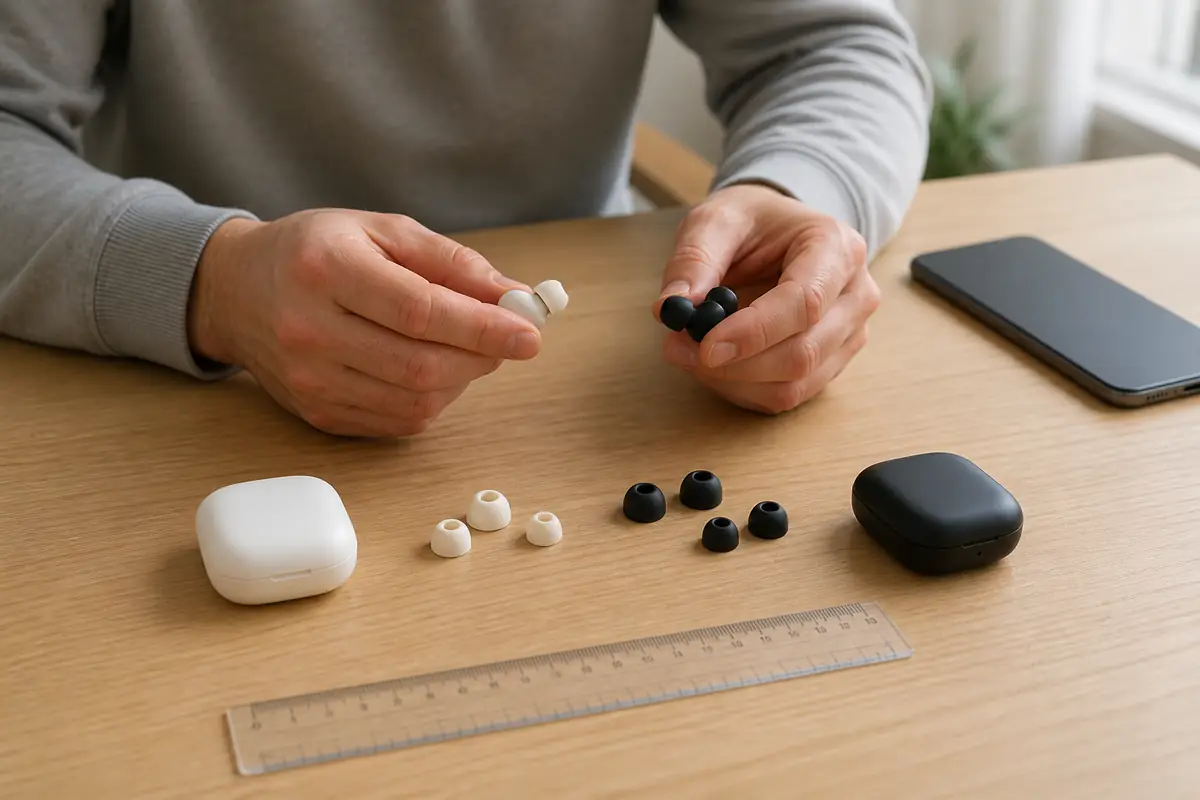
Left and right ears may require different tip sizes. Insert according to the maker’s instructions without forcing, then speak, chew, walk and gently move the jaw. The earbud should remain stable without pain, deep pressure or constant adjustment.
A consistent seal often improves bass and noise control more than an EQ preset. If the app offers a seal test, treat it as one input rather than a medical assessment. Stop use if there is pain, irritation, discharge or hearing concern.
Define the listening environments
- Quiet desk: comfort, low noise floor and easy pause matter.
- Commute: isolation, awareness mode and secure pocketing matter.
- Calls: microphone behaviour in wind and speech noise matters.
- Exercise: stability, sweat guidance and controls matter.
- Travel: single-charge endurance and offline controls matter.
- Multiple devices: switching and multipoint rules matter.
Do not choose solely from one laboratory-style score. Weight the environments by actual weekly use and compare sound expectations with the sound quality and signature guide.
Check codec support end to end
A codec is useful only when the source device, operating system, earbuds and playback route support it together. Confirm the fallback codec and whether high-quality modes disable multipoint, spatial processing or other features. Marketing a codec name does not guarantee an audible improvement in every recording or environment.
Latency depends on the complete path, including app and video behaviour. Gamers and musicians should look for documented low-latency modes and still expect wireless delay. Use wired or purpose-built monitoring when timing is critical.
Evaluate tuning without chasing maximum volume
Look for balanced speech, stable bass with movement and treble that remains comfortable at modest levels. EQ can adjust preference within limits but cannot fix a broken seal or a driver fault. Save a neutral reference track list rather than switching randomly among unfamiliar recordings.
Keep volume at a safe, comfortable level and take listening breaks. Noise cancellation may reduce the urge to overpower background sound, but it is not hearing protection. Follow current NHS advice if hearing changes, ringing or pain occurs.
Test noise cancellation and awareness honestly
ANC is generally more effective against steady low-frequency noise than unpredictable nearby speech. Performance depends on seal, microphones and algorithm. Listen for pressure discomfort, pumping during movement and wind sensitivity.
Awareness modes can help with surroundings but must not replace direct observation near roads, platforms or machinery. Check whether removing one earbud pauses audio and whether that behaviour can be changed without the app.
Map every control before purchase
List play, pause, track, volume, calls, assistant, ANC and power actions. Touch controls can be convenient but trigger during adjustment; physical buttons may require pressure. Confirm whether controls work on both earbuds and when only one is used.
App remapping is useful only while the app and account remain supported. Essential playback and pairing should remain manageable. Review the software-support guide for the ownership implications.
Judge microphones by scenario
Microphone quantity is not a call-quality guarantee. Wind, traffic, room echo and competing speech challenge processing differently. Look for samples recorded in comparable conditions and check whether call quality changes when connected to a laptop.
Sidestone and transparency can make speaking more natural. If work calls are critical, verify platform compatibility and keep an alternative. Do not claim studio quality from a clean indoor demonstration.
Separate earbud endurance from case capacity
Record claimed earbud hours with ANC on and off, call time, case recharge count, charge time and quick-charge conditions. The battery-life claims guide helps translate the scenario. A combined figure cannot cover a flight longer than one earbud charge without a break.
Batteries lose capacity with age and heat. Ask whether batteries or individual earbuds can be serviced and what happens if one is lost. Include replacement tips, case and eventual replacement in the total-cost framework.
Check charging and wireless routine
Confirm cable connector, wireless charging if relevant, supplied accessories and whether the case shows useful status without readable app prompts. Keep contacts dry and clean only as instructed. Do not charge a wet or damaged unit.
Pair and switch among the actual operating systems. Note whether settings live on the earbuds or only one device. Reset procedures and account removal matter when selling, gifting or troubleshooting.
Inspect durability, hygiene and loss risk
Check hinge play, case closure, tip attachment, charging contacts and replacement-part availability. A water-resistance rating has defined test conditions and does not mean waterproof forever. Sweat, soap, salt and impact can change performance.
Clean tips and housings according to instructions, let them dry and do not share in-ear tips. A light-coloured case may reveal dirt; a glossy one may scratch. Use the online quality checklist without treating finish as proof of electronics reliability.
Plan the returns fit check
Hygiene-related return restrictions may apply once seals are broken, subject to legal rights and product condition. Read the exact retailer policy before ordering and distinguish change-of-mind returns from faulty goods. Do not assume every demonstration unit offers hygienic tips.
Where permitted, test comfort, seal, controls, calls, switching and battery over several short sessions while keeping packaging and accessories orderly. Review UK returns before the deadline.
Test one-earbud use and accessibility
Confirm whether either earbud can work independently for calls and playback or whether only one side acts as the primary unit. Check spoken prompts, tones, app text size and control customisation against the user’s hearing, vision and dexterity needs. A tiny touch target or similar-sounding status tone can make routine control unreliable.
Mono use can extend availability across a long day, but alternating buds does not remove the need for safe volume and hygiene. Verify that microphones, pause behaviour and ANC modes remain understandable with one bud stored.
Review privacy and account dependence
Companion apps may request location, contacts, voice features, account creation or diagnostic data. Read the current permissions and privacy information, decline optional access that the feature does not need and check whether firmware updates require an account.
Before transferring the earbuds, remove them from device accounts, reset them as instructed and clear any location-finding association. A lost-earbud feature is useful only if its privacy and platform requirements are acceptable.
Prepare a reproducible comparison
Use the same source device, volume range and familiar tracks for each candidate. Compare comfort after thirty minutes, spoken-word clarity, outside noise, control errors and call behaviour rather than switching only for dramatic bass. Note the firmware and settings so the result can be repeated.
Avoid unsupported hands-on claims when relying on reviews. Separate measured battery or microphone evidence from a reviewer’s preference, and check whether the tested firmware and phone match the intended setup.
Which earbud route fits?
Isolation and stable bass are priorities
The tips seal comfortably, remain secure and awareness controls suit the environments.
Low occlusion and awareness matter more
The looser isolation is acceptable and fit remains stable without excessive playback volume.
Balanced verdict
Fit, seal, controls and source compatibility determine whether wireless earbuds are useful every day. Verify codec and feature interactions, separate single-charge endurance from the case total and account for battery ageing. A returnable, comfortable mid-range pair can be better value than a feature-heavy poor fit.
Browse Tech & Audio guidance, compare room listening in soundbar versus powered speakers, and use the shop directory.
Check current official sources:
NHS hearing-loss prevention ↗GOV.UK product recalls and alerts ↗GOV.UK electrical waste guidance ↗
Frequently asked questions
Is a premium codec always better?
No. Both ends must support it, and fit, recording, environment and implementation also affect the result.
Why does bass disappear when I move?
The seal may be changing. Try suitable tips and fit according to instructions rather than raising volume.
Does the battery claim include the case?
Often the largest figure combines earbud use and case recharges. Check single-charge hours separately.
Can I wear earbuds in heavy rain?
Only within the exact product’s stated resistance and care conditions; the case may have different protection.
Are awareness modes safe near traffic?
They are not a substitute for direct attention and compliance with local safety rules.
Methodology and limitations
We assessed earbuds through fit, seal, environments, codec chain, tuning, ANC, controls, microphones, battery, charging, durability, hygiene and returns. Official UK hearing, recall and waste guidance was checked on 29 August 2026. No named earbuds were measured.
Limitations
Fit and hearing are individual, while firmware and device support change. Recheck exact specifications, instructions and terms before purchase.
The image is an editorial illustration, not a photograph from a product test. Links are editorial and non-affiliate.