Niacinamide products value guide: formulation, packaging and price per use
Niacinamide is a common cosmetic ingredient, not a reason to ignore the rest of a formula. Compare the complete ingredient list, product type, claims, packaging, directions, routine fit, tolerance and realistic dose rather than ranking serums by the largest percentage.
In this guide
Buy a usable complete formula, not the highest niacinamide number
Choose the product format and finish that fit the routine, then verify its full ingredient list, directions, warnings and responsible business information. A highlighted percentage can be useful evidence when substantiated, but it does not predict individual tolerance or make a cosmetic a treatment for disease.
Start with our cosmetics ingredient-list guide, compare claims using the beauty claims framework, and use the moisturiser guide to avoid duplicating routine steps.
| Format | Potential role | Evidence to compare | Common mistake |
|---|---|---|---|
| Dedicated serum | Flexible leave-on step | Full INCI, stated percentage, dose and finish | Highest percentage is assumed best |
| Moisturiser | Combines hydration and niacinamide in one step | Base formula, fragrance, package and sunscreen fit | Adding a serum that duplicates the cream |
| Toner or essence | Light layer for preferred routine texture | Directions, alcohol/fragrance, dose and packaging | More layers are mistaken for more benefit |
| Cleanser | Short-contact cleansing format | Surfactants, contact time and complete purpose | Paying a premium for a rinse-off headline |
Niacinamide shortlist sheet
- Define the cosmetic goal without self-diagnosing disease.
- Choose serum, moisturiser, toner or cleanser by routine role.
- Save the full INCI, size, directions and warnings.
- Check the named Responsible Person and readable GB information.
- Treat concentration as one field, not a quality ranking.
- Introduce one new product while the routine stays stable.
- Put the niacinamide bottle’s first-use date beside its opening-period symbol so a bulk purchase can be judged against the time available to finish it.
- Stop use and seek advice for severe or persistent reactions.
Niacinamide is one component of a complete cosmetic
A product may highlight niacinamide while most of its feel, stability and tolerance comes from solvents, humectants, emollients, thickeners, preservatives and fragrance choices. Read the complete INCI and the product purpose. A well-balanced moisturiser can be better value than a separate serum that duplicates existing steps.
Ingredient position offers clues but not an exact concentration. Rules for ordering and low-level ingredients limit what a shopper can infer. Use our INCI guide and avoid declaring a formula weak solely because niacinamide is not near the first line.
A percentage is evidence only when it answers a question
A clearly stated concentration can make comparison easier, yet the largest number is not automatically more effective, gentler or better value. Ask whether the brand substantiates the claim, whether the formula is designed for the stated use and whether directions support a tolerable dose.
Very high percentages can encourage the false idea that skin care behaves like a points table. Individual response, vehicle, frequency and the rest of the routine matter. Do not combine several niacinamide products simply to create a larger total.
Choose the format before comparing price
A serum adds a flexible leave-on step; a moisturiser can consolidate the routine; a toner supplies a light texture; a cleanser is rinsed away. Compare products that do the same job. A cheap serum is not an alternative to a moisturiser if a separate cream is still required.
Write the morning and evening routine in order. Remove duplicates and identify where the desired product fits beneath sunscreen or alongside prescribed care. A shorter routine can reduce pilling, irritation uncertainty and total cost.
Claims must remain cosmetic and supportable
Current GB guidance requires the Responsible Person to be able to substantiate cosmetic claims, and marketing must not imply characteristics or functions the product does not have. Look for a specific measured question, time period and population rather than vague perfecting or repair language.
Niacinamide cosmetics should not be assumed to diagnose, cure or treat acne, rosacea, eczema or another condition. The beauty claims guide helps separate appearance and hydration claims from medical language.
Packaging affects dose and exposure
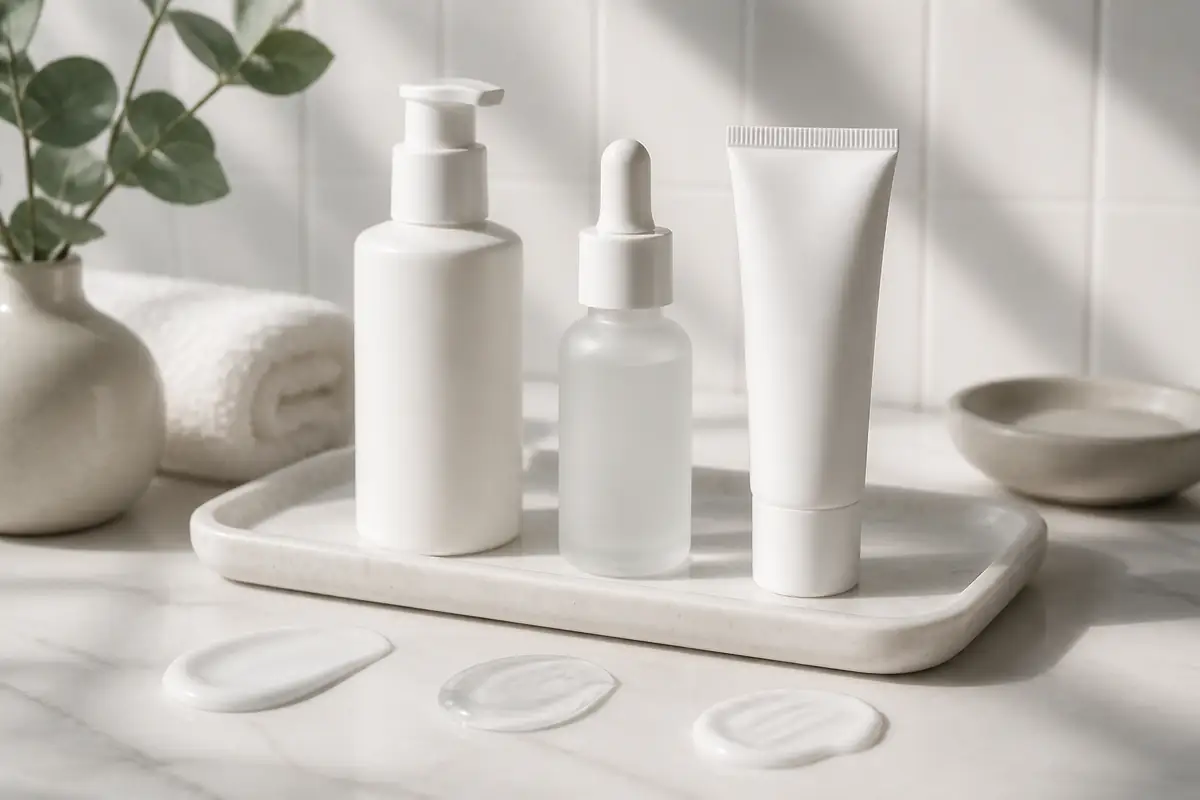
A pump can standardise dose and reduce repeated contact; a dropper gives visual control but exposes the neck each time; a tube is portable; a jar may suit thick cream but requires careful use. Opaque or air-restricting packaging can be useful for some formulas, but the maker should support any stability claim.
Check whether the dispenser reaches the product and whether one full pump matches directions. A small bottle that releases an unnecessarily large dose can have worse cost per use than its price per millilitre suggests. Close promptly and follow storage instructions.
Fragrance and supporting actives change the choice
A niacinamide headline does not reveal fragrance, exfoliating acids, retinoid-like ingredients, vitamin C derivatives or botanical extracts elsewhere in the formula. Review known personal triggers and the complete routine. A fragrance-free claim does not promise universal tolerance.
If the formula combines several active ingredients, introduce it as one new variable and avoid adding other new products simultaneously. Our fragrance-free versus unscented guide clarifies a commonly misunderstood distinction.
Patch testing reduces uncertainty but has limits
Follow manufacturer directions and avoid broken or already inflamed skin. A small-area trial may reveal some immediate incompatibility, but it cannot guarantee tolerance after repeated full-face use. Keep the rest of the routine stable and record application timing.
Do not push through painful burning, swelling or a worsening rash to finish a test. Pause the niacinamide product and ask a pharmacist or clinician about a painful, swollen or worsening reaction instead of increasing exposure to establish whether it is the cause. The patch-testing guide explains why a home check is risk reduction, not a diagnosis.
Routine layering should protect the sunscreen step
In the morning, check whether the directed amount settles beneath the actual sunscreen quantity without pilling. Do not mix separate cosmetics in the hand unless their makers explicitly instruct it, and do not reduce sun protection to make a serum look elegant.
If several watery and gel layers roll up, simplify the routine, allow settling or choose a moisturiser that combines functions. Cosmetic elegance matters because an unpleasant product often becomes an unused product.
GB product information is a basic legitimacy check
Official guidance says cosmetic packaging should identify what the product does, precautions, quantity, Responsible Person, batch information, date or opening period where applicable, origin for imports and ingredients. Information should be in English and readable.
Missing or minimal information is a warning, particularly with marketplace imports. Use our shop verification guide and retain packaging. A professional-looking bottle is not evidence that the GB obligations were met.
Calculate cost per usable application
Start with price divided by volume, then estimate applications from the directed dose rather than one tiny promotional drop. Add delivery and any separate moisturiser needed to make the serum usable. Compare the same format and routine function.
A larger bottle is not a bargain if it cannot be finished within its period after opening or if the formula causes pilling. Record the opening date. Cost per use should expose waste and duplication, not encourage overapplication.
Avoid building a niacinamide stack
The ingredient can appear in cleanser, toner, serum, moisturiser, sunscreen and make-up. More appearances do not establish a better result. List every current product and decide whether a new step adds a distinct format or simply repeats a marketing claim.
When discomfort occurs, a complex stack makes attribution difficult. Simplifying before adding can be more informative and cheaper. Do not stop prescribed treatment or alter a clinician-led routine without suitable advice.
Inspect and record the product on arrival
Check seals, batch code, readable label, quantity, ingredient list, Responsible Person details, directions, warnings and opening symbol. Photograph anything missing or inconsistent before use and contact the seller or brand.
Note the opening date and normal appearance, smell and texture. Follow storage conditions. If the product changes unexpectedly, assess it against expiry and maker guidance rather than testing it on irritated skin.
Know when a buying guide is not enough
Persistent acne, rash, swelling, pain, bleeding, infection signs or unexplained skin change needs suitable professional assessment. A cosmetic ingredient guide cannot identify the cause or recommend individual medical treatment.
Take the full packaging and routine list when seeking advice. Stop a suspect new product, but do not abandon prescribed care on the basis of an online cosmetic claim. Safety and diagnosis sit outside a value comparison.
Choose a serum or moisturiser with niacinamide?
You need a flexible, distinct leave-on step
The formula is tolerable, the dose layers well, it does not duplicate other products and its complete cost fits the routine.
Routine consolidation is better value
The base formula supplies the needed finish and hydration while niacinamide remains one supported component rather than the only reason to buy.
Balanced verdict
The best-value niacinamide product is a complete formula that gets used consistently. Choose format, finish, packaging, routine fit and credible claims before concentration. Compare price per realistic application and remove duplicate steps.
Browse the Beauty archive and use our beauty cost-per-use guide for the calculation.
Frequently asked questions
Is a higher niacinamide percentage always better?
No — Concentration is one field within a complete formula and does not guarantee better tolerance, finish or results.
Can niacinamide be used in several routine steps?
It may appear in several products, but duplication is not evidence of added value and can make reactions harder to attribute.
Is niacinamide a treatment for acne?
A cosmetic should not be assumed to diagnose or treat disease. If acne or an unexplained skin problem persists, take the niacinamide ingredient list and routine history to an appropriate healthcare professional rather than treating a cosmetic concentration as a medical prescription.
Is a dropper better than a pump?
Neither universally — Compare dose control, contact, closure, formula suitability and whether the package lets you use the product consistently.
How is cost per use calculated?
Use the paid price, delivery, directed dose, frequency and likely applications, then include any extra product needed to make the format usable.
Methodology and limitations
We reviewed current official GB cosmetic product and claims guidance, then compared niacinamide formats by full formula, concentration evidence, packaging, routine compatibility, label legitimacy, tolerance and cost per directed application. We did not perform clinical or product testing.
Limitations
Formulas, claims, packaging and prices change, and individual response cannot be predicted from an ingredient list. Recheck the current label and seek qualified advice for persistent or serious symptoms.