Fragrance-free vs unscented skincare: why the labels are different
Fragrance-free usually signals that fragrance was not intentionally added for scent; unscented describes what you perceive and may still involve ingredients that mask an odour. Neither claim replaces the full ingredient list or guarantees that every sensitive person will tolerate the formula.
Read function and ingredients, not just the scent claim
If avoiding fragrance is important, start with a product explicitly labelled fragrance-free, then inspect the full INCI list for parfum/aroma, essential oils, botanical extracts and known personal triggers. “Unscented”, “neutral scent”, “clean” and “for sensitive skin” are not interchangeable. A product can smell of its raw materials without added perfume, and a product with little detectable odour can still contain a masking fragrance.
This guide supports shopping decisions; it cannot diagnose fragrance allergy, contact dermatitis or another skin condition. Seek appropriate clinical advice for persistent rash, swelling, blistering or breathing symptoms.
Separate the common label phrases
| Phrase | What it may tell you | What it does not prove | Next check |
|---|---|---|---|
| Fragrance-free | No ingredient added primarily to perfume the product | Zero odour or universal tolerance | Full INCI and brand definition |
| Unscented | Little or no noticeable scent | Absence of masking fragrance | Parfum/aroma and scent-modifying ingredients |
| Sensitive skin | Intended audience | A standard allergy guarantee | Test method and complete formula |
| Hypoallergenic | Reduced-allergy positioning | That reaction is impossible | Evidence and personal allergens |
| Natural fragrance | Claim about source | Lower sensitisation potential | Essential oils and listed allergens |
Run this label check
- Find the full ingredient list before payment.
- Look for parfum, fragrance or aroma terminology.
- Check essential oils and aromatic botanical extracts.
- Identify ingredients you already know you react to.
- Read precautions, Responsible Person and batch information.
- Save the formula because online listings can lag behind reformulation.
- Introduce one product at a time and stop if a reaction develops.
Why a product can smell without added fragrance
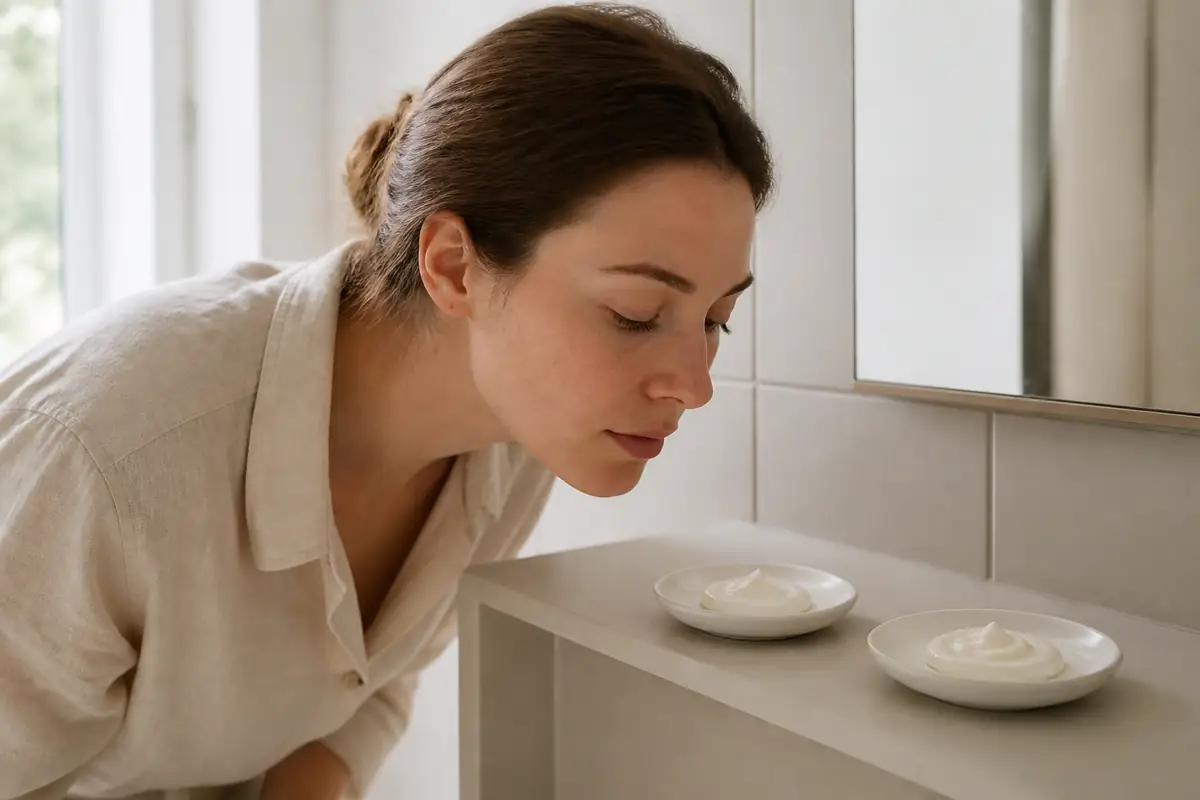
Oils, waxes, surfactants, plant extracts and preservatives have their own odours. A fragrance-free cream may smell faintly fatty, waxy or medicinal because the formula has not been perfumed to disguise those materials. Odour alone cannot reveal whether fragrance ingredients are present.
Conversely, a product marketed as unscented may use a small amount of fragrance to neutralise or cover a base smell. Check the ingredient list rather than relying on a sniff, especially because scent perception differs and fades with repeated exposure.
Use the INCI list, but know its limits
Great Britain cosmetic products need an ingredient list, though it may appear on outer packaging or a leaflet. Fragrance compositions can be represented by terms such as parfum or aroma, with certain fragrance allergens separately named when labelling thresholds and product type require it.
Our ingredient-list guide explains order and naming. The list confirms declared ingredients; it usually does not reveal the percentage or purpose of every one, and a botanical’s function can be more complex than a shopping app category suggests.
Essential oils are fragrance-relevant
Lavender, citrus, mint, eucalyptus and other essential oils may be included for scent, sensory feel or positioning. “Naturally fragranced” does not mean fragrance-free, and natural origin does not make sensitisation impossible. Citrus oils can also raise separate formulation and use questions.
If you avoid perfume because of a diagnosed allergy, use the specific allergen advice given to you rather than a broad “natural” shortcut. A clinician may recommend checking exact ingredient names across leave-on, rinse-off and household products.
Fragrance-free is not the same as minimalist
A fragrance-free product can still contain many emulsifiers, humectants, emollients, preservatives and active ingredients. That is not inherently bad: water-based cosmetics require suitable preservation, and a stable emulsion needs supporting components. The relevant question is whether the complete formula fits your needs.
The ceramide formula guide shows why a highlighted ingredient must be considered within the whole moisturiser. Avoiding fragrance does not resolve irritation caused by excessive exfoliation, incompatible actives or another ingredient.
“For sensitive skin” needs context
Sensitive-skin wording is not a promise of zero reactions. Look for a clear fragrance claim, a full ingredient list and an explanation of any test: number of participants, skin characteristics, product use and measured outcome. “Dermatologist tested” alone does not state the result.
Use the beauty-claims guide to distinguish objective measurements from consumer perception. Prefer modest, specific language over absolute promises such as “non-irritating for everyone”.
Patch testing reduces uncertainty, not all risk
Follow product directions and introduce one new item at a time. A small-area test may reveal an immediate problem but cannot guarantee that repeated or full-face use will remain comfortable. Do not test on broken skin unless advised and do not continue through burning or swelling.
The patch-testing guide provides a practical sequence. Keep the pack and batch details if a reaction occurs; a clinician or manufacturer needs more than the colour of the jar.
Check reformulations every time you repurchase
A familiar product can change formula, packaging or manufacturing site. Compare the current ingredient list instead of relying on an old review or saved shopping-app record. Stock can overlap during a transition, so the online list and delivered pack may differ.
When a specific avoidance matters, confirm the physical label before use and ask the manufacturer about an apparent mismatch. Record opening date using the cosmetics expiry guide; an unusual new odour after months of use is not the same as the intended raw-material smell.
Consider every scented layer in the routine
Cleanser, serum, cream, sunscreen, hair products and laundry detergent can all contribute exposure. Replacing one moisturiser may not solve discomfort if several other fragranced products remain. Simplify methodically rather than swapping five products at once.
For sunscreen, protection and correct application remain central; use the facial sunscreen guide to compare fragrance alongside UV protection, texture and quantity. Do not reduce sunscreen amount merely to reduce perceived scent.
Buy from a traceable seller
Cosmetics for Great Britain should provide key information including a Responsible Person, ingredient list, precautions, volume, batch identification and durability information as applicable. Missing English labelling or an implausibly cheap marketplace product is more serious than a preferred scent claim.
Run the online-shop checklist. For opened cosmetics and hygiene seals, review the cosmetics returns guide before breaking the seal simply to smell the formula.
Account for leave-on, rinse-off and nearby products
Contact time changes the comparison. A cleanser is normally rinsed away, while moisturiser, lip balm and sunscreen remain on the skin for hours. That does not make every leave-on fragranced product unsuitable or every rinse-off product harmless, but it explains why a single “contains fragrance” flag cannot estimate an individual response. Compare where, how much and how often the product is used.
Also consider migration from products that are not sold as facial skincare. Hair conditioner can touch the neck and back; hand cream can reach the eyelids; fragranced laundry products remain on pillowcases and towels. If you are trying to identify a trigger, keep the rest of the environment stable and record timing rather than buying an entire replacement routine. Where symptoms extend beyond mild cosmetic discomfort, ask a qualified professional how broad the avoidance should be.
Compare two products without marketing noise
- Write the avoidance goal: added perfume, named allergen or strong odour.
- Save both complete ingredient lists.
- Check claims, testing context and responsible-person details.
- Compare routine function, texture and packaging.
- Choose one change and introduce it cautiously.
A plain formula that meets the goal is preferable to a premium “clean” story whose fragrance position remains unclear.
Avoiding added scent is a priority
The claim is explicit, the ingredient list supports it and the complete formula suits your routine and known sensitivities.
Odour preference is the main issue
You simply want little noticeable smell and have checked whether masking fragrance or other personal triggers are present.
Balanced verdict
Fragrance-free and unscented answer different questions: formulation intent versus perceived smell. Neither is a medical guarantee, and neither lets you skip the ingredient list.
Define what you are avoiding, verify the delivered formula and change one product at a time. Transparent labelling and tolerable routine fit matter more than soothing package language.
Check current official information:
GOV.UK consumer cosmetics guidanceGOV.UK cosmetic labelling requirementsNHS contact dermatitis information
Frequently asked questions
Does fragrance-free mean a product has no smell?
No. Raw materials can have an odour even when perfume was not added for scent.
Can an unscented product contain fragrance?
It may contain ingredients used to mask the base smell. Check the full ingredient list and the brand’s definition.
Are essential oils fragrance-free?
No when they are used for aromatic effect, and natural origin does not eliminate sensitisation risk.
Is fragrance-free always better for sensitive skin?
It removes one common variable but does not guarantee tolerance of the rest of the formula.
What does parfum mean in an ingredient list?
It is a labelling term for a perfume composition; certain fragrance allergens may also be listed separately where required.
Can I rely on an old ingredient list?
No. Products are reformulated. Check the current delivered packaging before use when an avoidance matters.
How we researched this guide
Recommended Today reviewed current Great Britain cosmetic labelling and consumer guidance plus NHS information on contact dermatitis. We compared claim wording with ingredient evidence, routine context and seller traceability.
Limitations
We did not diagnose allergy, laboratory-test formulas or define every ingredient’s function. Claims and formulas change; recheck the current pack and official sources on publication day. The original image shows two plain creams in unbranded ceramic dishes with no bottle, pack, label, text, logo or price. Links are editorial and non-affiliate.