Mattress firmness explained: support, comfort and trial terms
Firmness describes how a mattress feels at the surface; support describes how it manages your body through the night. Compare both, then read the trial, protector, collection and bed-base rules before treating “100 nights” as risk-free.
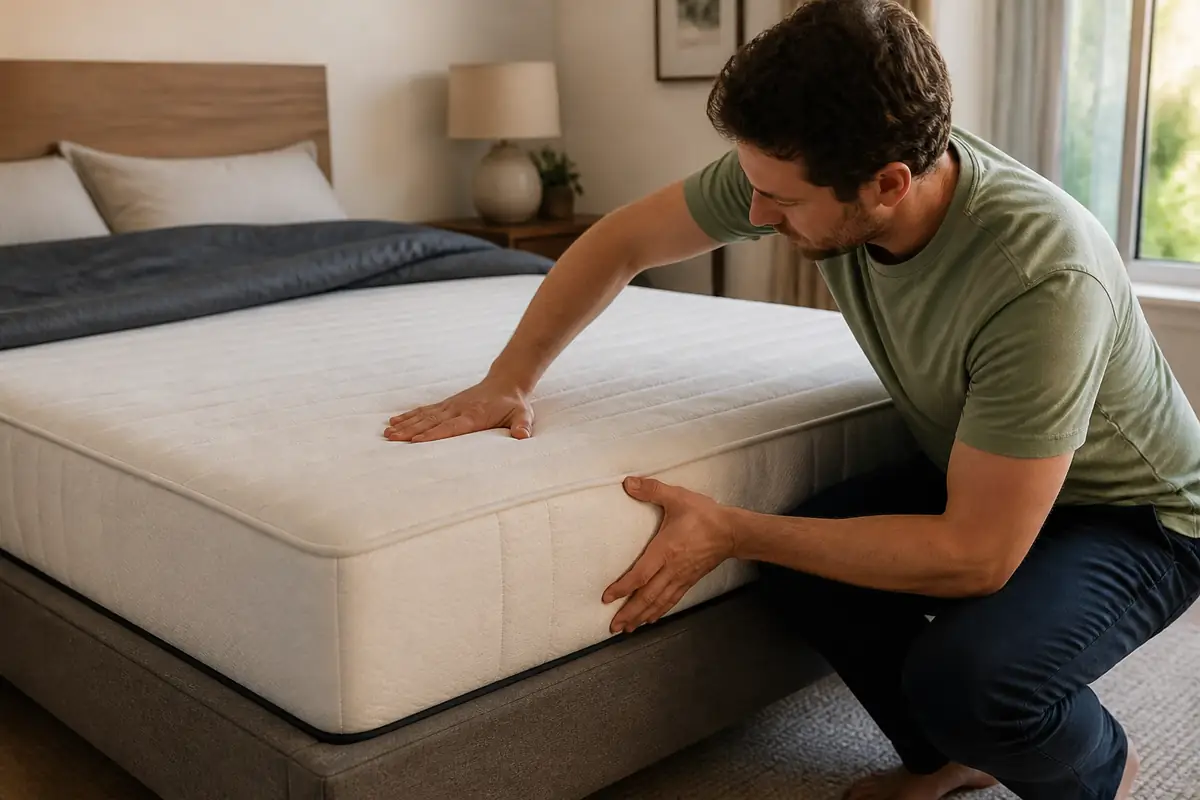
Choose the least extreme feel that keeps you comfortable and stable
Do not assume firmer means more supportive or softer means less durable. Start with body position, pressure comfort, ease of turning, edge use and partner movement. Check the comfort layers and support core, then confirm the exact base, size and sleeper weight assumptions. A home trial is useful only when the return is allowed, affordable and practical for your address.
A mattress cannot be prescribed from a shopping label. Persistent pain, numbness or sleep problems need appropriate clinical advice; a product guide can only help compare construction, fit and contract terms.
Separate firmness, support and pressure comfort
| Question | What it describes | Evidence to seek | Misleading shortcut |
|---|---|---|---|
| How firm? | Initial and settled surface feel | Brand scale, showroom comparison, comfort-layer depth | One universal 1–10 scale |
| How supportive? | How the structure manages load and alignment | Core type, zoning, weight guidance, base compatibility | “Orthopaedic” as proof |
| How pressure-relieving? | How load spreads at shoulders, hips and other contact points | Material response and personal trial | Softest always wins |
| How easy to move? | Resistance when turning or getting up | Surface resilience, sink depth, edge behaviour | More contouring is always better |
| How stable for two? | Movement transfer and usable area | Construction, dimensions and edge support | Marketing glass demonstrations |
A useful showroom or home test
- Use your usual sleeping position for at least several minutes.
- Check shoulder and hip comfort without forcing posture.
- Turn from side to side and sit up without excessive effort.
- Test the edge where you actually sit or sleep.
- Lie together if the mattress is shared.
- Listen for squeaks and feel for partner disturbance.
- Repeat on the bed base type intended at home.
Firmness scales are brand-specific
A “medium-firm” mattress from one range may feel softer than a “medium” from another. Scale numbers are not a regulated cross-brand measurement, and showroom models can soften through repeated use. Compare within a range, then use construction and a real trial to bridge between brands.
Record the exact model, depth and version because manufacturers sometimes sell related names with different fillings or retailer-exclusive specifications. The specification-comparison guide helps prevent a similar name from becoming a false like-for-like comparison.
Body position changes where pressure builds
Side sleepers often notice pressure at shoulder and hip; back sleepers may focus on lumbar support and ease of changing position; front sleepers may dislike deep midsection sink. These are tendencies, not rules. Body proportions, mobility, pillow height and the support core alter the result.
Do not buy from a simple “sleep position equals firmness” chart alone. If two people share a bed, identify the larger conflict: surface feel, motion, temperature, edge use or different preferred positions. A larger size, split construction or adjustable layer may solve more than moving one step on a firmness scale.
Body mass changes the experienced feel
The same mattress compresses differently under different loads. A lighter sleeper may remain mostly in the top layer and perceive firmness; a heavier sleeper may engage deeper layers and need enough material depth to avoid bottoming out. Look for transparent weight guidance for both one sleeper and the total shared load.
Weight limits are not comfort promises, but missing limits make durability harder to assess. Check whether the trial and warranty require a particular base or central support. A strong mattress on an unsuitable frame can feel wrong and develop avoidable wear.
Read construction as a system
Foam mattresses can combine softer comfort foam with a firmer support core. Pocket-sprung designs may use separate springs under layers of foam, wool, fibres or latex. Hybrid is a broad category, not a quality grade. Spring count, foam density and layer thickness mean little unless the unit, mattress size and test context are clear.
Ask which layers are replaceable, turnable or only rotatable. A one-sided mattress may be designed correctly, while a double-sided one spreads wear if turning is manageable. Include handles, weight and the room needed to rotate it.
Zoning can help or miss your body
Zoned cores vary resistance across the length, often aiming to support the centre while allowing shoulder response. That can be useful when zones align with the sleeper; it can be less convincing for a very short or tall person, or when partners have different heights.
Look for a diagram with dimensions rather than a colourful band. If the maker does not state zone locations, do not treat “seven zones” as seven verified benefits. The complete feel matters more than the count.
The bed base is part of the result
A sprung divan can add give; rigid slats or a platform can make the same mattress feel firmer. Slat spacing, centre support and ventilation requirements may affect both performance and warranty. Measure the base and compare it with the manufacturer’s stated maximum gap.
Do not place a new mattress on a bowed, broken or undersized base. Check access, stair turns and package expansion before delivery using the furniture delivery-access guide. A rolled mattress can enter easily but still need enough room to open flat.
Edge support matters for usable width
A weak edge reduces the surface two people can use and can make getting up harder. Sit near the edge, then lie close to it; the two loads are different. A reinforced perimeter may feel firmer than the centre, but a hard border can also create an abrupt transition.
For a smaller room, do not choose a narrow mattress solely to save floor space without considering shared usable width. Measure the frame and bedding as well as the nominal UK size.
Temperature claims need construction evidence
Breathable covers, open-cell foams, springs and natural fibres can influence heat and moisture movement, but “cooling” is not a standard comfort guarantee. Room temperature, protector, duvet, sheets and the sleeper can dominate. A cooling surface sensation may fade after minutes.
Choose bedding and protector together. Our bedding material and texture guide helps separate visual styling from the layers touching the body. A waterproof protector may be required for a trial and can also change feel or sound.
Read every sleep-trial condition
A headline number can hide a minimum settling period, mandatory protector, registration, geographic exclusions, collection fee or exchange-only remedy. Confirm when the clock starts, whether damaged or stained products are excluded, and who arranges removal from an upstairs room.
Some trials allow one comfort exchange rather than a cash refund. A topper may be offered first. Save the offer shown at checkout and use the returns-policy audit. Statutory rights for faulty or misdescribed goods remain separate from a voluntary comfort trial.
Plan collection before unwrapping
A mattress is a large hygiene-sensitive product. Check whether the retailer collects it, requires repacking, asks for photographs or expects donation through an approved route. Do not assume a compressed mattress can be rolled back into its original box.
For practical evidence and collection questions, use the large-item returns guide. Keep the packaging only where safe and useful; never let plastic create a child or pet hazard.
Check safety and seller traceability
Buy from a traceable retailer and inspect the permanent labels and model information delivered. Mattresses sold for domestic use should meet applicable UK product-safety and flammability requirements; a vague marketplace listing with no manufacturer, dimensions or safety information is not a bargain.
Use the online-shop checklist and search current UK safety alerts. Never use a mattress that arrives wet, contaminated, badly torn or with exposed internal components while a fault is assessed.
Calculate value beyond the trial badge
Compare delivered price, base changes, protector, removal of the old mattress and any collection cost. A long warranty is useful only when exclusions, indentation measurement and claim process are readable. Normal softening is not necessarily a defect; the warranty wording should distinguish it from structural failure.
The total-cost guide helps compare the complete setup. Avoid dividing price by an assumed ten-year life that neither the materials nor warranty evidence supports.
Stability and easier movement lead
You feel supported without sharp pressure, can turn comfortably and the construction works with your weight and base.
Surface pressure is the problem
Additional contouring improves comfort without trapping movement, collapsing the edge or creating unwanted heat.
Balanced verdict
Firmness is a personal sensation; support is a performance question. Choose by whole-body comfort, movement, construction and base compatibility rather than an isolated scale number.
A trial reduces uncertainty only when its conditions work in your home. Protect the mattress, save the contract and plan collection before you rely on the return promise.
Check current official information:
GOV.UK returns and refundsGOV.UK distance-selling requirementsUK product safety alerts and recalls
Frequently asked questions
Is a firm mattress always better for back pain?
No. Comfort and support needs vary, and persistent pain needs professional advice rather than a universal firmness rule.
What does medium-firm mean?
It is a manufacturer’s relative description, not a standard measurement shared by all brands.
How long should I try a mattress?
Follow the trial’s minimum and maximum periods. Adaptation can take time, but do not continue through severe discomfort or symptoms needing advice.
Does a topper fix the wrong firmness?
A topper can soften surface feel but cannot correct every support, sagging, size or base problem.
Can I return a mattress after sleeping on it?
Only if the applicable trial or legal remedy permits it and its conditions are met. Read protector, condition and collection rules first.
Will a new base change the feel?
Yes. A sprung, slatted or solid base can alter response and may be specified by the manufacturer.
How we researched this guide
Recommended Today reviewed current UK distance-selling, refund and product-safety guidance. We compared firmness through construction, sleeper interaction, bed base, movement, trial terms and total cost without ranking brands.
Limitations
We did not prescribe a mattress, conduct pressure mapping or test individual models. Comfort, medical needs and contract terms vary; recheck the exact product, base and trial on publication day. The original image shows a fictional plain mattress being assessed in a natural bedroom with no label, logo, text, package or price. Links are editorial and non-affiliate.