Makeup brushes buying guide: fibres, shapes, density and cleaning
A useful brush earns its place by applying a product you own with the control you need. Fibre, bundle shape, density and flexibility matter more than a large set count or professional-sounding name, while cleaning and drying determine whether the tool remains practical.
In this guide
Build a small task-led kit
List the products and techniques used in a normal week, then buy one brush per distinct task where fingers or an existing tool do not work. Prefer secure ferrules, even bundles and shapes that can be cleaned and dried easily; reject padding sets with several near-duplicates.
Brush names are not standardised. One brand’s foundation brush may be another’s buffing or complexion brush, so compare geometry and behaviour rather than labels. For a wider kit audit, use the makeup-bag guide.
Start with products and finish
Powder, liquid, cream and balm textures interact differently with fibres and density. A dense flat or rounded bundle can press and buff a cream product, while a loose flexible brush can diffuse powder lightly. Small firm shapes place colour precisely; longer flexible fibres soften edges.
Technique also matters. Someone who taps on a sheer base needs a different tool from someone who buffs a high-coverage formula. Write the actual task—place concealer beside the nose, diffuse blush, line the lash root—before searching a brush category.
The main geometry decisions
| Feature | More of it tends to do | Check in use |
|---|---|---|
| Density | Holds shape and can build coverage | May absorb product or resist cleaning |
| Fibre length | Longer fibres often flex and diffuse | Control depends on bundle and pressure |
| Flat edge | Places product or follows a line | Sharpness and comfort near the eye |
| Rounded dome | Blends in several directions | Size relative to the target area |
| Angle | Follows brows, cheeks or contours | Edge should remain even after washing |
Photographs can exaggerate or hide scale. Look for total length, fibre length and head width in millimetres. A face brush that looks compact beside a model may cover half another user’s cheek. Product-level dimensions are more useful than claims of perfect precision.
Synthetic and animal hair are not simple quality ranks
Synthetic fibres vary in diameter, taper, crimp, surface and resilience. They can work across liquids, creams and powders, and may be easier to clean consistently, but “synthetic” does not guarantee softness or durability. A poorly finished fibre can feel scratchy regardless of category.
Animal-hair brushes also vary by species, grade, processing and bundle. They raise sourcing, allergy and care questions and are not automatically superior for powder. If a retailer makes welfare or traceability claims, seek specific evidence and scope. “Cruelty-free brush” and “cruelty-free cosmetic formula” are separate claims.
For buyers avoiding animal-derived materials, verify the bristles, adhesive, handle coating and case rather than relying only on a vegan icon. The beauty-claims guide helps test vague terminology.
Ferrule, adhesive and handle construction
The ferrule holds the fibre bundle to the handle. It should sit straight, show no sharp seam and resist movement under gentle pressure. Crimping can add mechanical grip; adhesive quality is difficult to judge remotely. Water repeatedly entering the ferrule can weaken the assembly, so cleaning method matters even on a well-made brush.
A long handle can balance a large face brush but may be awkward close to a mirror or in a small bag. A short travel handle saves space without changing the head, yet cases must let clean brushes dry and prevent crushing. Wood handles should not be soaked; coatings can chip with impact or prolonged moisture.
Build the smallest useful set
- Base: only if you prefer a brush to fingers or sponge for the formula.
- Concealer: choose scale for the target, not a generic name.
- Powder: loose for light diffusion or denser for controlled placement.
- Cheek: head size should fit blush or bronzer area.
- Eye: one placement and one blending shape may cover the routine.
- Brow or liner: prioritise an even edge and stiffness that remains comfortable.
A ten-piece set is poor value when six heads duplicate tasks or do not match products owned. Compare the price of the three or four useful singles with the set, including a case only if it solves storage. Use the cost-per-use framework rather than dividing by the printed brush count.
Softness must be judged with purpose
A brush should not scratch or cause persistent discomfort, but maximum softness is not always control. Very floppy fibres can make precise placement difficult. Reviews describing softness are subjective; repeated reports of sharp fibres, loose ferrules or continual shedding are more useful patterns.
Some initial loose fibres may be manufacturing remnants, but ongoing shedding, uneven edges or a bundle that changes shape after correct washing indicate a problem. Use our review-evidence guide to separate patterns from isolated praise.
Cleaning is part of the specification
Brushes contact skin, cosmetics, hands and surfaces. Clean at a frequency appropriate to product type, use and skin needs, following the maker’s instructions. Do not share used eye or lip brushes without appropriate hygiene controls, and do not assume a cosmetic preservative keeps a dirty tool safe.
Use lukewarm water and suitable cleanser when wet cleaning is allowed, keep water from soaking the ferrule and handle joint, rinse thoroughly and reshape gently. Dry with airflow in a position that does not channel water into the ferrule. Heat can deform fibres or damage adhesive.
Quick-clean sprays may help between colour changes but do not necessarily replace thorough cleaning. Check ingredients, ventilation and compatibility. The cosmetics hygiene and expiry guide supports the wider routine.
Storage must protect clean, dry tools
Open cups provide access but expose fibres to room dust and splashes. Closed cases protect from contact only when brushes are fully dry. Individual guards can preserve some shapes during travel, but tight sleeves on damp fibres trap moisture.
Separate brushes used with strong pigments or eye products when that helps prevent transfer. Clean the storage container too; placing washed tools into a dirty bag defeats part of the process.
Know when a brush is no longer serviceable
A brush does not need replacing because a fixed calendar date arrives. Inspect its function after correct cleaning and drying. A loose ferrule, exposed sharp edge, persistent odour, sticky or cracked handle coating, repeated shedding, irreversible splaying or fibres that remain harsh can make replacement appropriate. Do not keep an uncomfortable tool merely because it was expensive.
Discolouration is not automatically contamination: pigments can stain some fibres. The relevant questions are whether residue is removed according to instructions, the tool dries fully and its performance remains stable. Conversely, a brush that looks clean can still hold product deep in a dense bundle. Work cleanser through the accessible fibres without pulling at the ferrule, and rinse until the maker’s method is complete.
If use repeatedly coincides with irritation, stop using the brush and product while the cause is assessed. Clean tools, check any new cleanser or cosmetic, and seek appropriate professional advice for persistent or concerning symptoms. Buying a softer brush is not a substitute for understanding dermatitis, infection or an unsuitable formula.
Travel changes hygiene and shape protection
Pack only fully dry brushes and separate used tools from clean ones. A rigid case prevents crushing but needs ventilation and cleaning; a fabric roll is compact but can transfer residual product unless washed. Retractable brushes protect fibres during transit, although their sleeves and caps add surfaces that also need cleaning.
Do not rest brushes directly on hotel or shared bathroom counters. A clean washable mat or case creates a defined surface. On return, unpack promptly so unnoticed moisture is not trapped in a closed bag.
Choose singles or a set
Your routine is defined
You can match each head to a real task, avoid duplicates and replace one worn tool without repurchasing a kit.
Most included shapes solve named tasks
The fibres and construction are documented, the price beats useful singles, and the case or format adds practical value.
A pre-purchase checklist
- List products, textures and application areas used weekly.
- Match head size, shape, density and flex to each task.
- Check fibre and animal-derived material disclosure.
- Inspect ferrule, crimp, handle and edge photographs.
- Record dimensions rather than relying on category names.
- Confirm cleaning, drying and storage instructions.
- Compare useful singles with the useful portion of a set.
Balanced verdict
A small set of well-matched, cleanable brushes usually offers better control and value than a large padded kit. Buy geometry for the product and technique, verify material claims, and treat ferrule construction and drying as longevity issues. Replace a tool that remains scratchy, sheds continuously or cannot be cleaned safely.
Continue with the Beauty archive or review cosmetic information with our ingredient-list guide.
Official guidance:
NHS: contact dermatitis ↗GOV.UK Cosmetic Products Enforcement Regulations guidance ↗
Frequently asked questions
How many makeup brushes do I need?
Only enough to cover distinct tasks in your routine. Many people need fewer than a large set contains.
Are synthetic brushes better for liquid makeup?
They can work well, but performance depends on fibre, taper, density and technique rather than category alone.
How often should brushes be washed?
It depends on product, area and use. Follow maker guidance and clean more cautiously for shared, eye or lip use.
Is some shedding normal?
A few loose manufacturing fibres can appear initially; repeated shedding or bundle distortion after correct care is concerning.
Can brushes dry upright?
Avoid a position that lets water run into the ferrule. Reshape and dry with airflow according to instructions.
Methodology and limitations
We assessed brushes by task, fibre, geometry, ferrule, handle, set composition, hygiene, cleaning, storage and value.
Limitations
Softness and control are partly subjective and cannot be confirmed remotely. Check exact materials and return hygiene restrictions.
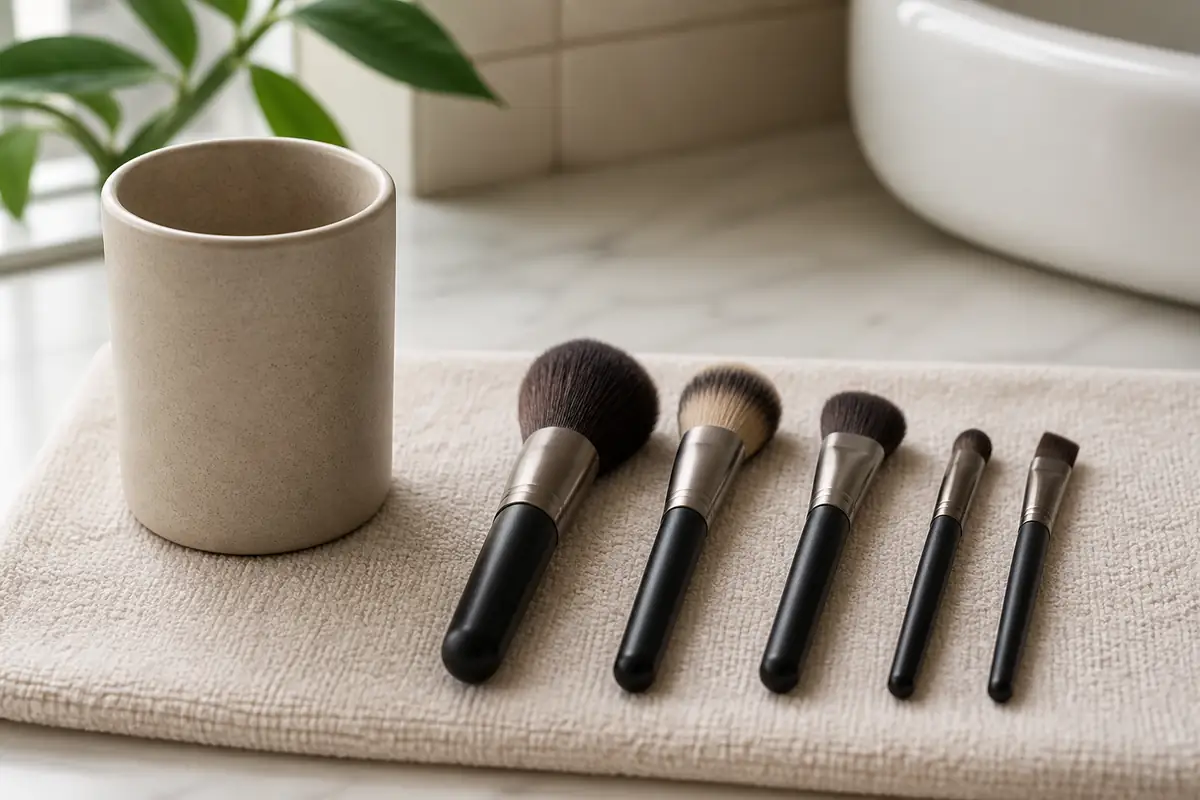
The image is an editorial illustration, not a photograph from a product test. Links are editorial and non-affiliate.