Le Creuset round casserole 20 vs 24 cm UK: capacity and handling
Match the real recipe batch and filled lifting route to the pot, keeping nominal size separate from its complete footprint.
In this guide
The larger casserole needs more than cupboard room
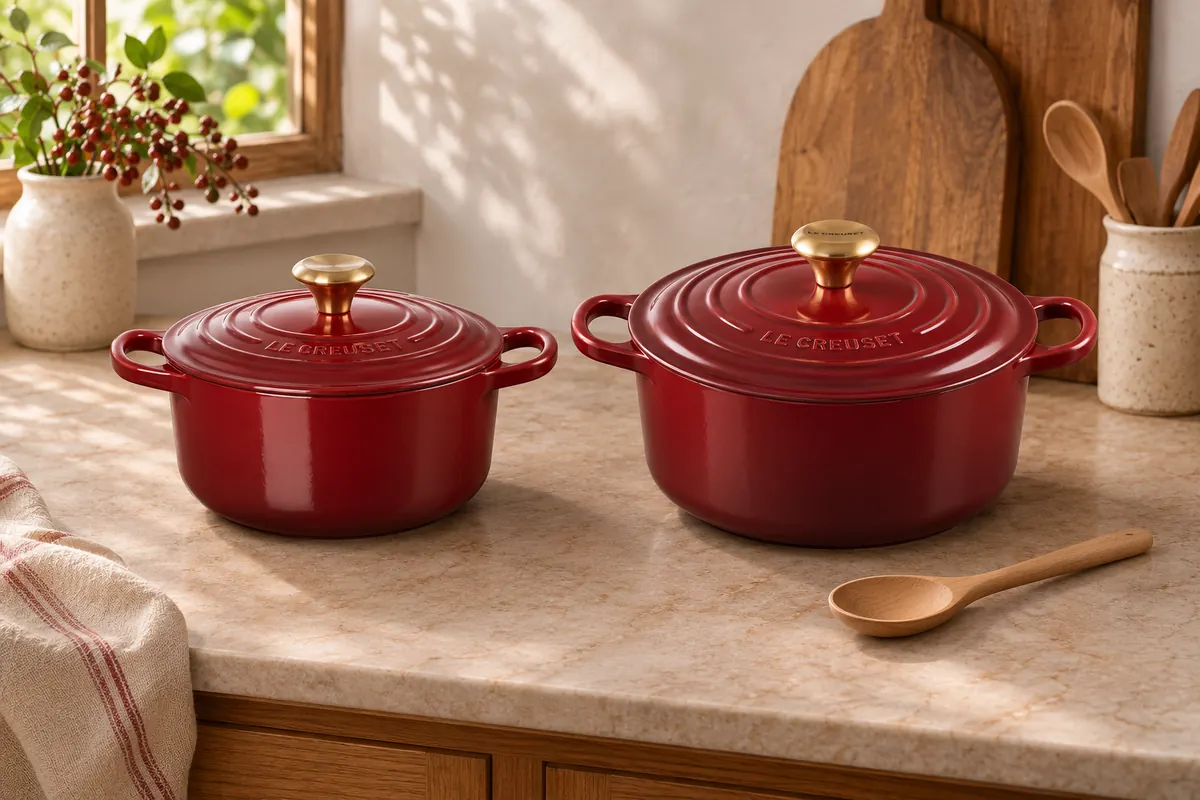
The selected Le Creuset Signature round casserole grows from 2.4 litres at 20 cm to 4.2 litres at 24 cm. That is substantially more capacity, but also a larger footprint and a heavier empty pot. Choose around the quantity actually cooked and the complete lifting route, rather than assuming that a four-centimetre diameter increase is a minor difference.
This comparison uses the garnet enamelled cast-iron round casseroles with Signature knobs on Le Creuset’s UK website, checked on 22 November 2026. Shallow, oval, steel, stoneware and other knob variants need separate checks. They are not equivalent merely because a listing uses the word casserole.
Compare capacity with the outer dimensions
| Planning measurement | 20 cm size | 24 cm size |
|---|---|---|
| Listed capacity | 2.4 L | 4.2 L |
| Handle-to-handle length | 27.3 cm | 32.5 cm |
| Overall height | 14.1 cm | 16.6 cm |
| Listed base diameter | 14.8 cm | 19.2 cm |
| Listed empty weight | 3.09 kg | 4.31 kg |
| Observed garnet UK price | £265 | £335 |
The published measurements are more useful than treating the size name as the complete exterior. Our cookware materials guide also explains why enamelled cast iron should not inherit the care routine for a stainless pan or an uncoated iron skillet.
Separate batch size from a serving label
The 24 cm pot adds 1.8 litres of stated capacity, a 75% increase over the 20 cm figure. That arithmetic compares listed volume; it does not mean every recipe makes 75% more useful portions or that the pot should be filled to its rim.
Start with two or three meals that recur in your kitchen. Record the usual ingredients, the finished amount and whether leftovers are wanted. A thick stew, a batch of soup and a joint of meat place different demands on volume, food shape and space for stirring.
Recipe instructions may require headroom or room around the ingredients. Preserve that allowance instead of turning nominal capacity into a full-to-the-brim target. If an existing pan reliably handles your usual batch, its usable capacity can provide a practical starting point without guessing a universal serving count.
Buying a large pot for a rare gathering may still make sense, but compare that use with the storage and handling cost for the rest of the year. Someone who regularly cooks a small amount may prefer the smaller format; another household may avoid repeated batches by choosing 24 cm.
Test the route from hob to table
The listed empty-weight difference is 1.22 kg before ingredients are added. That is a more concrete ownership consideration than describing both as heavy. Consider lifting the complete pot with its lid and food, not simply moving an empty display sample a short distance.
Trace the route between hob, oven, resting place, table and sink. Tight turns, an awkward oven shelf or a low cupboard can make the same object harder to handle. Leave room for dry oven gloves around both handles rather than measuring only whether the pot physically fits through an opening.
Check the complete kitchen route
- Measure the shelf with the lid fitted and the handles included.
- Allow space to hold both handles securely with appropriate protection.
- Identify a stable heat-resistant resting place before lifting hot cookware.
- Consider the filled weight and whether another person is needed.
- Check sink clearance without assuming that a pot fitting the cupboard is easy to wash.
The small-kitchen buying guide helps weigh that working space against cupboard space. A purchase that can be stored but is awkward to use does not solve the original cooking problem.
Match the base to the cooking zone
The labelled 20 cm and 24 cm sizes are not the flat base diameters. The selected measurements list 14.8 cm and 19.2 cm bases. Check those against the hob manufacturer’s guidance, particularly where induction recognition or the appropriate cooking zone has limits.
Do not use the larger pot’s capacity to assume that every burner can heat it appropriately. Conversely, a small pot on an unsuitable zone may not be recognised as expected. The product’s stated compatibility is only one part of matching it to the actual appliance.
Use the cooking instructions supplied with the selected cookware. Le Creuset recommends low to medium heat for these cast-iron products and appropriate hob sizing. This review has not measured warm-up speed, energy consumption or cooking uniformity for the two sizes.
Our pan-size measurement guide illustrates why rim size, base size and exterior clearance answer different questions. Its frying-pan recommendations do not replace the casserole’s own measurements.
Care is part of the size decision
The selected leaf page identifies hand washing. Check the actual instructions before treating broad range-level advice as permission to use a different cleaning method. Enamel is not an instruction to season the cooking surface like an uncoated cast-iron pan.
Allow the pot to cool as directed and avoid a sudden temperature change during cleaning. Use suitable tools and methods rather than scraping aggressively at a stubborn residue. A larger pot can be more difficult to support securely at the sink, so cleaning is part of the handling assessment.
The current care guide also distinguishes damaged enamel from ordinary cosmetic marks. If a cooking surface is chipped, stop using it and follow the manufacturer’s support guidance rather than trying to conceal the problem. A long guarantee is not a promise that every type of damage is covered.
For a household gift, discuss those obligations with the recipient before choosing a size. The housewarming-gift assessment asks whether storage, handling and maintenance will be welcome rather than burdensome.
Compare the same colour, knob and seller
The checked garnet offers were £265 for 20 cm and £335 for 24 cm, a £70 difference. Those figures describe the selected UK products, including the named knob variant. They are not minimum prices across every colour, outlet listing or retailer.
Both selections showed add-to-basket controls when checked. This does not reserve stock or establish the arrival date for an individual address. A different colour may be on promotion while these references remain at the listed prices, so compare the precise package rather than a range headline.
A free-gift threshold should not decide the pot size. Extra cookware or accessories added to qualify still cost money and need a purpose. Preserve the exact order description and total with our purchase-record guide, including the seller rather than relying on a brand name alone.
Before cooking, inspect an arrival for damage and retain appropriate packaging while resolving a problem. The returns-policy checklist helps distinguish an unused change-of-mind route from a report about damage or a fault.
Choose the pot that will be used comfortably
Prefer the 20 cm format
Your normal recipes fit its usable capacity, the smaller base suits the hob and lower empty weight improves handling. You accept that larger batches may need another vessel.
Prefer the 24 cm format
Your recurring recipes need the extra capacity, the 32.5 cm handle span fits the working route and you can manage the filled weight. The £70 observed premium has a defined use.
Neither size is automatically better value per meal. The useful choice is the one that accommodates the real batch, cooking zone and safe lifting routine often enough to justify its place in the kitchen.
Le Creuset UK size and care sources
Garnet Signature round 20 cm offer and measurements guideGarnet Signature round 24 cm selection and current specificationOfficial cookware care hub and enamelled cast-iron instructions
Signature round size questions
Does 24 cm provide only a little more capacity?
The listed capacity rises from 2.4 L to 4.2 L, although a recipe still needs its own headroom.
Is the named size the handle-to-handle width?
No. The measurements guide lists 27.3 cm and 32.5 cm handle-to-handle lengths for these sizes.
How much heavier is the larger empty pot?
The published figures differ by 1.22 kg before food is added.
Can I choose by a universal serving count?
Recipe volume, ingredient shape and desired leftovers are more useful than one fixed number of portions.
Does this include every round casserole finish?
The comparison uses garnet enamelled cast iron with Signature knobs, so other materials or variants require separate checks.
How the two casserole sizes were assessed
We checked the UK size selections, published measurement table and official care guidance on 22 November 2026. The capacity and weight differences are calculations from those published figures; the original image retains the specified brand marks.
Cooking-test limitations
No recipes, filled-weight lifting trials or energy tests were performed. Individual hob compatibility, safe handling and recipe headroom remain household-specific decisions.