Cookware Materials Explained: Steel, Cast Iron, Aluminium and Non-Stick
Which pan material suits which cooking, how coatings wear, and what "18/10", "tri-ply" and "hard anodised" actually describe. No jargon, no hype.
In this guide
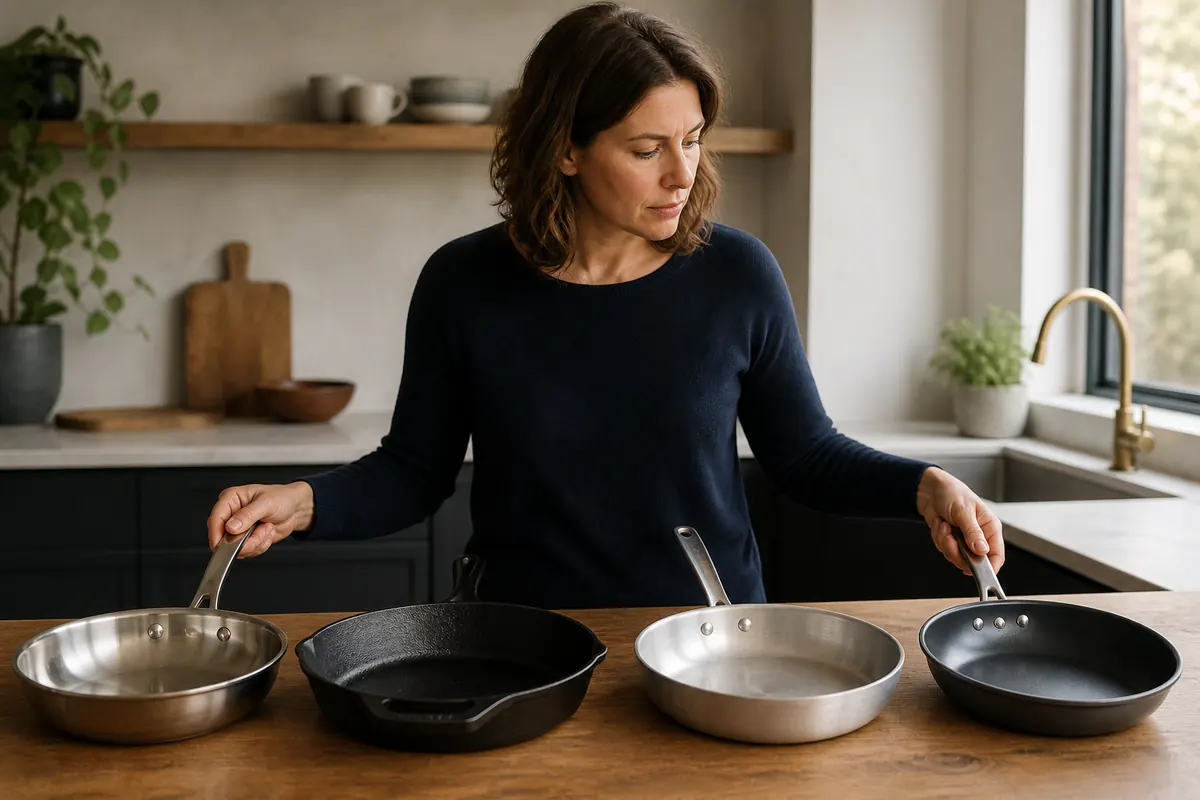
Quick verdict: there is no universally best cookware material. Stainless steel is the dependable generalist, cast iron rewards heat retention and patience, aluminium responds quickly, and non-stick is a useful but consumable surface. Choose by the food you cook, the hob you own, the weight you can handle and the care you will actually provide.
| Material | Best at | Main compromise | Check before buying |
|---|---|---|---|
| Stainless steel | Browning, sauces and everyday durability | Food can stick without heat and fat control | Base construction, handle attachment and induction compatibility |
| Cast iron | Heat retention, searing and oven use | Heavy, slow to respond and needs drying | Total filled weight, seasoning and handle comfort |
| Aluminium | Fast, even response at lower weight | Surface and construction quality vary | Coating or cladding, base flatness and hob suitability |
| Non-stick | Eggs, delicate food and low-fat cooking | Coating eventually wears | Care instructions, temperature limits and replacement plan |
Cookware is sold on adjectives — professional, premium, restaurant-grade — attached to a small number of materials whose behaviour has been understood for a century. Once you know what each material does with heat, the marketing becomes noise and the choice becomes a matter of matching a pan to the cooking you actually do.
This guide explains the materials and the terms printed on the box. It ranks nothing and names no brands.
Heat conduction vs heat retention
Two different properties, constantly confused, and between them they explain nearly every difference in how pans behave.
Conduction is how quickly heat moves through the material and spreads across the base. High conduction means fast response and even heating: turn the hob down and the pan follows. Copper and aluminium conduct well; stainless steel conducts poorly.
Retention is how much heat the pan stores, which depends mostly on mass. A heavy pan holds enough energy that dropping food into it does not collapse the temperature — the property that gives a good sear and steady frying. Cast iron retains superbly and conducts slowly, which is exactly why it browns well and burns things if you are inattentive.
Neither is better. Sauces and anything needing control want conduction; searing and shallow frying want retention. Most kitchens need one pan of each rather than a matched set of either.
Stainless steel and what the grade numbers mean
The two numbers describe the alloy: roughly 18% chromium and 10% nickel in 18/10, or 18% chromium and essentially no nickel in 18/0. Chromium provides corrosion resistance; nickel adds resistance and a brighter finish, and also makes the steel non-magnetic — which is why 18/10 pans need a magnetic layer added to work on induction, while 18/0 works directly.
Stainless is durable, non-reactive with acidic food, dishwasher-tolerant and effectively permanent. Its weakness is conduction, which is why a bare stainless pan produces hot rings and scorching. Quality stainless cookware is therefore always clad, with aluminium or copper doing the heat work and steel providing the surface.
Food sticks to stainless when the pan is under-heated or the food is moved too early; that is technique rather than a defect, and it is the price of a surface that will outlive the kitchen.
Cast iron, enamelled and bare
Cast iron is mass. It heats slowly and unevenly, then holds temperature better than anything else in a domestic kitchen, which makes it excellent for searing, shallow frying, baking and long braises.
Bare cast iron needs seasoning — a polymerised layer of oil built up through use — which gives a naturally slippery surface and protects against rust. It is reactive with acidic food until well seasoned, dislikes prolonged soaking, and is essentially repairable: a neglected pan can be stripped and re-seasoned indefinitely.
Enamelled cast iron replaces seasoning with a fused glass coating, so it is non-reactive, easy to clean and suitable for acidic braises. The trade-off is fragility: enamel chips if knocked or subjected to thermal shock, and a chipped interior generally ends the pan’s useful life.
Both are heavy, which matters more than buyers expect — a full casserole is a two-handed lift, and weight is a genuine constraint in a small kitchen, as discussed in buying for a small kitchen.
Aluminium and hard anodising
Aluminium conducts heat exceptionally well and is light and cheap, which is why it forms the core of most clad cookware even when you never see it. Raw aluminium is soft and reactive with acidic ingredients, so it is rarely used as a bare cooking surface.
Hard anodising is an electrochemical process that thickens and hardens the aluminium’s natural oxide layer, producing a dark, much harder, non-reactive surface. It is a treatment of the metal itself rather than an applied coating, so it cannot flake — though many hard-anodised pans also carry a separate non-stick coating on top, which can.
The practical result is a light, responsive, durable pan. The limitation is that hard-anodised surfaces are generally not dishwasher-friendly, and the treatment does not make the base magnetic, so induction models need a bonded disc.
Non-stick coatings: types, wear life and care
Non-stick is a consumable surface applied to a metal pan, and treating it as a wear part rather than a permanent feature explains everything about how to buy and use it.
The common families are fluoropolymer coatings, typically PTFE-based, and ceramic coatings derived from silica. Fluoropolymer coatings are slicker at the outset and have a defined maximum service temperature published by the manufacturer, above which they degrade — which is why heating an empty non-stick pan hard is the single most damaging thing you can do to it. Ceramic coatings tolerate higher temperatures but tend to lose slipperiness sooner with use.
Coating life depends on heat, utensils and cleaning rather than on time: metal tools, abrasive scourers, dishwasher cycles and high dry heat all shorten it. Because the surface is consumable, non-stick is the clearest case in the kitchen for the arithmetic in cost per use — a cheaper pan replaced periodically can beat an expensive one used carelessly.
Carbon steel and copper
Carbon steel behaves like a lighter, thinner cast iron: it seasons the same way, tolerates high heat, responds faster because there is less mass, and is the traditional material for woks and professional frying pans. It rusts if left wet, and it will warp if thin and thermally shocked.
Copper is the best conductor in common use, giving unmatched responsiveness for sugar work and delicate sauces. It is reactive, so cooking surfaces are lined with tin or stainless steel, and the lining is the wear part — tin linings can be renewed by a specialist. Copper is heavy, expensive and needs polishing to stay bright, which makes it a specialist choice rather than a general one.
Cladding and layer counts: tri-ply and beyond
“Tri-ply” means three bonded layers, conventionally stainless steel on the outside, an aluminium core in the middle and stainless on the cooking surface. Five-ply and seven-ply add further alternating layers, usually to combine aluminium’s conductivity with copper’s or to increase total core thickness.
Two questions matter more than the number. How thick is the conductive core, since a thin core in a five-layer pan will underperform a thick one in three? And is the cladding full, running up the walls, or only a disc bonded to the base? Disc-bottomed pans heat the base evenly but leave the walls poorly heated, which shows up when reducing a sauce or cooking anything shallow.
Weight is again the honest proxy, for the reasons set out in how to judge product quality online: metal has mass, and a pan that feels light for its size has less of it somewhere.
Hob compatibility, especially induction
Induction heats by inducing a current in the pan itself, so the base must be ferromagnetic. Cast iron, carbon steel and magnetic stainless work directly; aluminium and copper require a bonded magnetic disc, which manufacturers add specifically for this purpose.
The reliable check is a fridge magnet: if it grips the base firmly rather than falling away, the pan will work. Two further details are worth knowing — a base smaller than the hob zone may not trigger it, and a warped base will heat unevenly on induction in a way it would not on gas, so flatness matters more than on other hobs.
Gas and radiant electric hobs accept anything, but with less control at the low end, and hob type is one of the constraints worth fixing before shopping, as in how to choose kitchen appliances.
Matching material to what you actually cook
Choose by task rather than by set. Eggs, pancakes and delicate fish want non-stick, accepted as a periodically replaced item. Searing, shallow frying and anything that benefits from a crust wants cast iron or carbon steel. Sauces, reductions and anything requiring control want clad stainless. Long braises want enamelled cast iron or a heavy clad casserole. Boiling water wants whatever is cheapest and lightest.
Most households are well served by three or four pans chosen this way, which will outlast several matched sets bought on appearance. How long each should reasonably last is covered in how long should things actually last.
Which material suits your kitchen?
Cookware check before checkout
- Match the material to the cooking task and hob type.
- Check base construction, usable oven temperature and handle design.
- Lift the pan at its expected working weight, not only when empty.
- Treat non-stick coating life separately from the life of the pan body.
You cook several different ways
Use stainless steel or cast iron for high-heat work and keep one modest non-stick pan for delicate food. This avoids paying for a large matching set whose weakest material dictates every task. Build the shortlist with our product comparison framework.
Simplicity matters more than specialisation
A small stainless-steel set is the least restrictive starting point when weight is manageable. Confirm hob compatibility, usable oven temperature and the care instructions before ordering.
Our verdict
Buy cookware by task, not by matching appearance. A small, deliberate mix usually gives better control and value than a large boxed set. Construction, weight and handle comfort matter as much as the metal named in the listing, while non-stick should be budgeted as a replaceable surface rather than a lifetime purchase.
Check current UK safety information:
Food-contact materials regulations ↗FSA guidance on BPA and UK implications ↗
Frequently asked questions
What does 18/10 mean?
Approximate percentages of chromium and nickel in the steel — about 18% chromium for corrosion resistance and about 10% nickel for further resistance and a brighter finish. 18/0 has effectively no nickel, which makes it magnetic and induction-ready but slightly more prone to staining.
Is stainless steel a good heat conductor?
No, which is why quality stainless pans are clad. Steel alone produces hot spots, so aluminium or copper is bonded inside or beneath it to spread heat while the steel provides a durable, non-reactive surface.
How long does non-stick last?
It is a wear surface, so life depends on heat, utensils and cleaning rather than on time. Overheating an empty pan, metal utensils, abrasive scourers and dishwasher cycles all shorten it — and manufacturers publish a maximum recommended temperature for that reason.
Will any pan work on induction?
Only ferromagnetic ones. Cast iron, carbon steel and magnetic stainless work directly; aluminium and copper need a bonded magnetic disc. Test with a fridge magnet.
Do more cladding layers mean a better pan?
Not by themselves. Core thickness and whether the cladding runs up the walls matter more than the layer count.
How we write this guide
This article is research-led. It draws on established metallurgical and materials properties — relative thermal conductivity, heat capacity and mass, alloy composition conventions for stainless steel, the electrochemical nature of anodising, and the ferromagnetic requirement of induction hobs — together with manufacturers’ published care and temperature guidance for coated cookware.
We have cooked with nothing for this piece. It names no brands, contains no rankings, and gives no temperatures, coating lifespans or prices: those vary by product and are published by manufacturers for the specific item you are considering. Where we describe how coatings wear, we describe mechanisms common across coating families rather than claims about any product.
Recommended Today may earn commission from links to retailers. Commission does not influence our editorial content or the order of any recommendation. This guide is reviewed at least every 18 months. Next scheduled review: February 2028.