Choosing a jewellery box: compartments, lining, tarnish and portability
The best jewellery box is organised around the collection, not the furniture. Count rings, chains, earrings, watches and larger pieces, then choose separation, lining and closure that reduce tangles, abrasion, moisture and forgotten storage.
In this guide
Buy for separation and access before decorative capacity
Choose compartments that let the pieces worn most often be lifted without moving three others. Soft contact surfaces, individual chain anchors, correctly sized ring rolls and a clean-closing lid matter more than a large quoted capacity that assumes every item is tiny.
A jewellery box protects only when the interior suits the contents. Chains can knot in a shared tray; rigid watch cushions can strain a small bracelet; deep undivided drawers can turn brooches into a pile. Material claims such as “velvet” or “anti-tarnish” also need scrutiny: they may describe appearance without explaining fibre, testing or lifespan.
Inventory the collection by shape and frequency
| Piece | Useful storage | Avoid |
|---|---|---|
| Fine chains | Individual hooks with a lower pocket or separate narrow channels | Several loose chains in one compartment. |
| Rings | Evenly spaced padded rolls that grip without force | Gaps so tight that broad bands rub or will not seat. |
| Earrings | Pairs together on a removable card, holes or small cells | Deep wells where backs become hidden. |
| Watches | Compressible cushions sized to the closed bracelet | Hard oversized pillows that keep clasps under tension. |
| Brooches and bangles | Shallow open compartments with enough footprint | Stacking heavy pieces over delicate surfaces. |
Lay the collection on a clean towel and count pieces by type. Mark everyday, occasional and sentimental items. Allow a modest empty margin, but do not buy a cabinet for a speculative future collection. The same disciplined capacity check appears in our jewellery travel-case guide.
Prefer usable dimensions to compartment counts
“Twenty compartments” tells little if the cells are too small for the collection. Compare internal length, width and depth, noting that dividers and padded walls reduce usable space. Measure the largest bangle, watch and pendant, plus the closed circumference of watch bracelets if cushions are supplied.
Shallow drawers keep items visible; deeper drawers suit boxes and larger costume jewellery only when dividers stop movement. Removable trays can reveal a lower layer but become inconvenient if daily pieces live underneath. A box should open fully in its intended location without striking a shelf or mirror.
Inspect every contact material
- Lining: should feel smooth, lie flat and avoid loose fibres that catch fine claws or chain links.
- Dividers: need covered edges and enough stiffness to remain upright without pressing into pieces.
- Adhesive: strong odour, seepage or lifting fabric suggests poor finishing; allow a new box to air before use.
- Hinges: should keep the lid controlled and away from stored items through its full travel.
- Mirror: adds convenience but also weight and a hard surface; it must be securely retained.
A plush appearance is not proof of conservation performance. Claims such as anti-tarnish should identify what creates the effect, how long it is expected to last and whether replacement inserts are needed. For valuable or historically important pieces, use the jeweller’s or a conservator’s storage advice rather than a generic box claim.
Understand tarnish without overpromising a box
Silver and copper alloys can tarnish through reaction with airborne pollutants, and moisture can accelerate corrosion. Government of Canada conservation guidance recommends clean, dry, enclosed storage made from suitable stable materials for metal objects. Domestic jewellery is not a museum collection, but the principle is useful: reduce pollutants, dust and damp rather than expecting a lining to reverse chemistry.
Store pieces clean and dry, keep the box away from bathrooms and radiators, and do not place damp jewellery inside after washing or exercise. Avoid casually polishing plated or delicate surfaces, because abrasive polishing removes material. Follow the maker’s care instructions. Our second-hand designer guide explains why material and condition evidence matter before valuable accessories enter the collection.
Decide whether security means privacy or protection
A small key lock can discourage casual opening but does not turn a lightweight box into a safe. Hinges, timber, acrylic windows and carrying handles remain points of entry. If theft protection is the goal, consider separately rated secure storage and insurance requirements.
For a household with children, the priority may be keeping tiny pieces and pins inaccessible. A high shelf and controlled key can help, but a freestanding box can still be pulled down. Magnetic closures are quick for daily use; mechanical catches provide clearer feedback that the lid is shut.
Choose portability only when it will be used
A handle is valuable if the box moves between rooms, but it must attach to a structure strong enough for the loaded weight. Test the latch before lifting. A large home box is usually poor luggage: pieces can leave their compartments when the case rotates and the rigid shell consumes space.
For travel, select a dedicated small case with positive closure and separation. Keep irreplaceable jewellery with you rather than in checked luggage where carrier rules permit, and document valuable items for insurance. Our travel-size guide uses the same principle of packing for restrictions and real use rather than miniature appearance.
Plan daily access and periodic maintenance
Put frequently worn pieces in the top layer with room for the hand to lift them. Reserve lower drawers for larger occasional items and label categories discreetly if the layout is not obvious. Organisation that requires several trays to be removed every morning will soon be abandoned, even if it looks impressive when first arranged.
Empty one section at a time for cleaning. Follow the box maker’s directions, use a soft dry method where appropriate and avoid saturating glued lining or timber. Inspect hinges, catches, mirror retention and divider covers before returning jewellery. Any residue, strong odour, loose fibre or corrosion inside the box deserves investigation rather than being hidden under another tray.
Photograph the layout for insurance and memory, without sharing the image publicly or storing location details insecurely. The box is also an inventory prompt: identify pieces needing professional repair, isolate broken chains that could snag others and return unworn items to their documented boxes when those offer better protection.
Do not store every material together by default
Soft gemstones, pearls, plated finishes and rigid watch cases can have different care needs. Individual pouches or cells prevent harder edges from scratching softer surfaces. Avoid elastic bands, household foam or strongly scented inserts unless the maker confirms suitability. When a valuable item arrives with specific storage guidance, that instruction outranks a general furniture description.
Do not force a necklace, watch or ring into a fitted slot simply to preserve a tidy layout. Compression can strain clasps and settings, while repeated removal from an undersized roll increases handling. Leave the compartment empty and use an appropriate separate pouch until a better insert is available.
Colour also affects usability. A pale lining can make dark pieces easy to find but may show transfer; a dark lining can hide fine chains in low light. Choose contrast for the collection and inspect colourfastness information rather than treating lining shade only as decoration.
Assess a jewellery box as a gift
A box is a personal storage tool, so do not infer the recipient’s collection value or style. Neutral materials, adaptable dividers and a gift receipt are safer than monogramming before confirming size and taste. If the gift includes precious-metal jewellery, UK hallmarking rules may apply above specified exemption weights; the hallmark concerns the metal item, not the box.
Check dimensions and delivery protection, especially for glass, mirrors or lacquered surfaces. Our gift-choice guide and gift-returns guide help balance surprise with a practical exchange route.
Which format suits the collection?
The collection is edited and frequently worn
A shallow layout can separate every piece, the box fits a dry secure location and portability is not the main job.
Shapes and quantities vary
Trays can be reconfigured, each drawer remains visible and the structure supports the loaded weight without sticking.
Balanced verdict
Choose a jewellery box by the pieces it must separate and the routine it must support. Smooth lining, usable dimensions and sensible closure outweigh decorative bulk. No domestic box eliminates tarnish or provides safe-level security, but thoughtful storage can reduce tangles, abrasion, dust and avoidable handling.
Continue with our personalised-gift checklist, gift-wrapping guide, second-hand designer guide and the Style & Gifts archive.
Check current official sources:
GOV.UK hallmarking consumer guidance ↗Canadian Conservation Institute metal-storage guidance ↗
Frequently asked questions
Does a jewellery box stop silver tarnishing?
Not completely. A suitable closed box may reduce exposure to dust and pollutants, but material, humidity and airborne compounds still matter.
Is velvet the best lining?
Not automatically. Check that any lining is smooth, colourfast, securely fitted and unlikely to catch settings; a vague “velvet” description may not state fibre or performance.
Should necklaces hang or lie flat?
Either can work if each chain remains separate and supported. Hanging needs enough drop and a lower pocket so pendants do not strike the case.
Is a lockable jewellery box secure?
A small lock mainly provides privacy. It is not equivalent to a tested safe or a storage arrangement required by an insurer.
How large should a jewellery box be?
Measure the largest pieces, count each type and add modest spare capacity. Internal dimensions and layout matter more than the external size.
Methodology and limitations
We assessed jewellery boxes through collection mapping, usable dimensions, separation, contact materials, tarnish risk, closure, portability and gifting.
Limitations
Jewellery materials and finishes require different care. Follow the item maker, jeweller, insurer or professional conservator where their guidance is more specific.
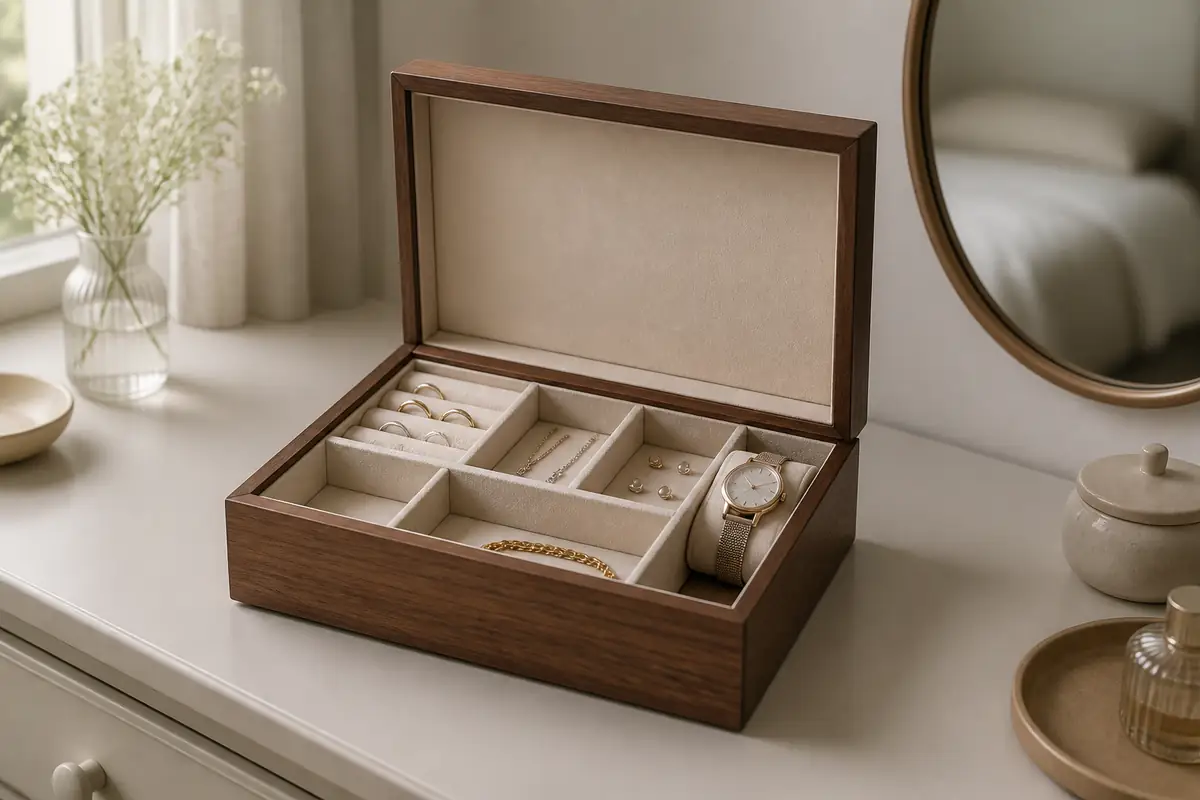
The image is an editorial illustration, not a photograph from a product test. Links are editorial and non-affiliate.