How to choose a jewellery travel case: compartments, tarnish and security
A useful travel case separates the pieces you actually take, prevents chains from crossing and fits inside the baggage allowance. Padding and closure matter; decorative bulk and vague “anti-tarnish” claims do not guarantee protection.
In this guide
Choose the layout around your smallest travel collection
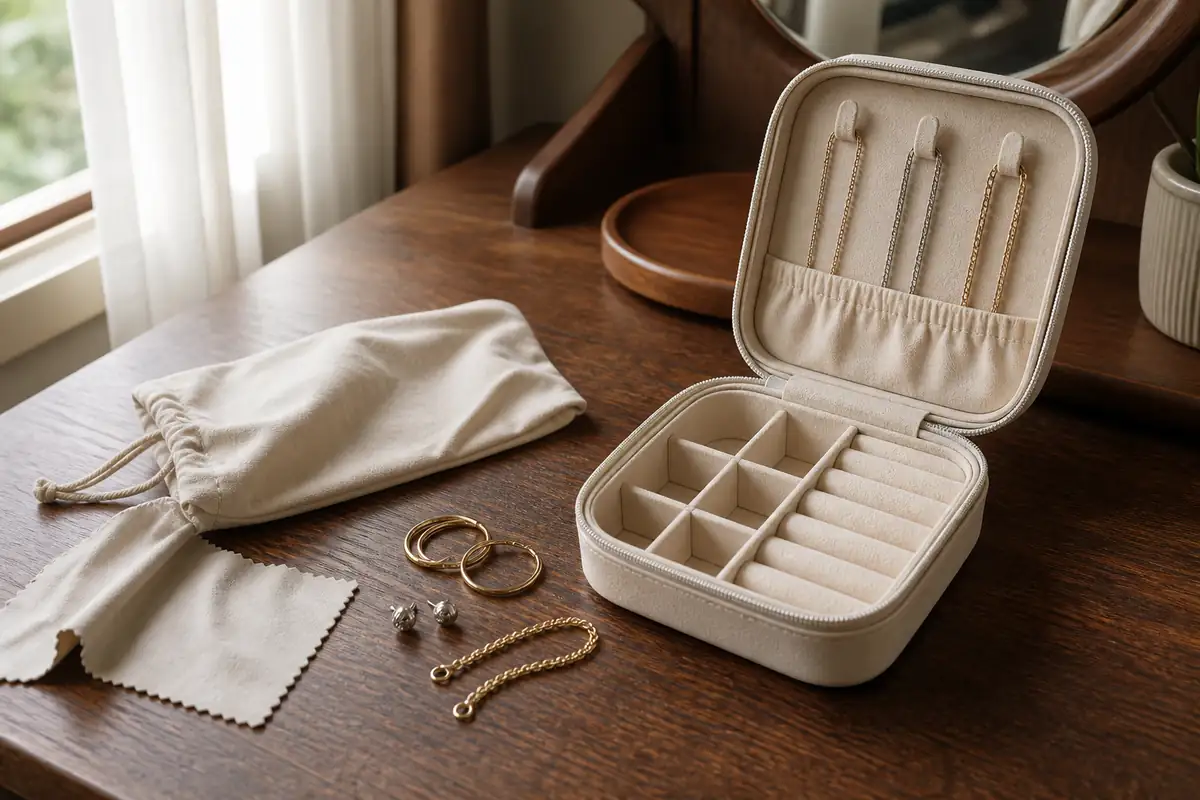
For most trips, a compact zipped case with covered necklace anchors, firm ring rolls, two or three divided compartments and a soft lining is enough. Buy a larger organiser only when it prevents genuinely valuable or fragile pieces from touching. The safest strategy is still to travel with fewer items and keep irreplaceable jewellery at home.
A travel case can reduce scratching, tangling and loss inside a bag, but it is not a safe, insurance policy or chemical guarantee. The right choice begins with an inventory and travel method rather than the number of compartments shown in a photograph.
Match case structure to jewellery type
| Piece | Useful storage feature | Common failure |
|---|---|---|
| Fine chains | Separate anchors with an elasticated pocket or covered channel below. | Several chains share one hook, cross in transit and knot around pendants. |
| Stud earrings | Paired holes in a removable card or small lidded compartment. | Loose backs disappear into a deep open section. |
| Hoops and drops | Enough vertical clearance and a rigid divider. | The lid presses posts, bends wires or rubs plated surfaces. |
| Rings | Firm, evenly spaced rolls that grip different band widths. | Shallow rolls release fine rings when the case is turned. |
| Watches or cuffs | A padded open bay sized to the actual diameter. | A compact box forces metal against a zip or hinge. |
| Mixed materials | Separate lined cells and removable soft pouches. | Hard stones, chains and softer metals move together. |
Make an inventory before measuring the case
Lay out a realistic three- or seven-day selection, not the whole jewellery drawer. Record the largest rigid piece, longest chain, number of earring pairs and whether any item needs to remain on its own. Photograph the collection for personal reference, but do not upload valuable-item details to an unknown seller or public review.
Then measure the closed case space available inside the intended hand luggage or personal item. The Civil Aviation Authority notes that cabin-bag dimensions and allowances vary by airline and aircraft. A jewellery case that forces a handbag outside the permitted allowance can create a costly gate decision. Check the exact airline, not a generic luggage blog.
Use the shortlisting method to compare at most three layouts against the inventory. A case should earn its space by reducing a known risk.
Necklace control needs two points, not one hook
A top hook alone lets the lower chain and pendant swing. Look for a second restraint: an elastic pocket, covered channel or individual pouch. Check the distance between hook and pocket against the necklace when loosely folded. A marketing image may show chains pulled unnaturally tight or leave the lid open, hiding what happens when the case closes.
Very fine chains can still knot around themselves. Threading each through a small plain pouch or using separate soft sleeves can be safer than sharing a built-in panel. Do not store a delicate chain under pressure from a watch or rigid cuff.
Dividers must stay in place when the box turns
- Press lightly on removable dividers. They should not collapse into the next cell under ordinary handling.
- Inspect the lid clearance. An item should not be crushed when the zip follows its normal path.
- Check the hinge gap. Fine chains and earring posts should not reach an exposed mechanism.
- Look behind ring rolls. The insert should be fixed or removable by design, not loosely glued.
- Test the zip route visually. Metal teeth and sliders should remain away from jewellery when the case is full.
Dimensions stated online should describe the closed external case and, ideally, useful internal space. If measurements are unclear, use our product-dimensions framework before accepting a lifestyle photograph as scale evidence.
Materials: soft contact, firm shell, honest claims
A rigid or semi-rigid outer shell protects against compression better than an unstructured pouch. Inside, smooth fabric and covered edges reduce abrasion. “Velvet” may describe a pile finish rather than fibre content; “leather” and “vegan leather” need precise material descriptions if durability or care matters.
Be cautious with “anti-tarnish”. Tarnish depends on metal, plating, humidity, pollutants, cosmetics and time. A seller should explain what material or test supports the claim and how long the effect is expected to last. A treated lining does not make damp jewellery safe to seal away, and it does not stop two pieces rubbing.
Let jewellery dry after wear, keep lotions and perfume separate, and follow the maker’s care advice. Do not place unwrapped polishing compounds inside a case; residues intended for one metal may be unsuitable for another.
Hallmarks identify precious-metal content, not travel durability
UK hallmarking guidance says items described as gold, silver, platinum or palladium generally require a recognised hallmark above specified weight exemptions. The hallmark protects the metal-content description. It does not prove that a stone setting, clasp, plating or travel case will withstand compression.
Save clear photographs, the seller’s description and any valuation or receipt appropriate to the item. If buying jewellery online before a trip, check the seller with our online-shop legitimacy guide and understand who is responsible on a marketplace.
Security is mostly behaviour
A tiny padlock on a soft zip provides limited resistance and can advertise that the contents matter. Keep the case within controlled hand luggage where permitted, avoid displaying valuable pieces in public packing areas, and follow accommodation safe guidance. Photographing every item beside travel documents can create a sensitive data bundle; store records securely and separately.
Insurance definitions, single-item limits, unattended-baggage exclusions and evidence requirements differ. A case marketed as “secure” does not change the policy. For an irreplaceable heirloom, the best travel case may be no case at all because the item stays home.
Zip, snap or roll?
A zip-around box gives structure and an obvious closed state, but the slider must not contact contents. A press-stud pouch is light and quick, though a single compartment allows movement. A jewellery roll creates separated flat pockets and packs efficiently around clothing, but bulky pieces can form pressure points. A hard miniature case protects against compression while consuming more fixed volume.
Read recent critical reviews for the exact model. Useful evidence describes failed stitching, loose dividers, ring-roll grip or zip contact after travel. Star averages and unboxing praise are weaker; apply our review-checking method.
Which travel organiser should you choose?
You carry a small mixed set
You need firm ring storage, separate earring and chain positions, and enough shell structure to sit inside hand luggage without dominating it.
Flat packing matters more
Your pieces are mainly chains and earrings, you can separate them into secure pockets, and there are no bulky cuffs or watches creating pressure points.
Balanced verdict
A compact, well-divided case is the most useful default, but layout beats finish. Reject any organiser that makes chains share a hook, allows dividers to lift or lets a zip touch metal. A larger box is worthwhile only when the actual collection needs the extra separation. For valuable or sentimental pieces, reduce what travels, keep evidence separately and confirm insurance rather than relying on a decorative lock.
Before checkout, compare total price with our drip-pricing guide, review the UK return rules, and browse more Style & Gifts guidance or the shop directory.
Check current official guidance:
UK hallmarking consumer guide ↗Hallmarking requirements summary ↗CAA baggage allowance guidance ↗CAA packing restrictions ↗
Frequently asked questions
Does an anti-tarnish lining stop all tarnish?
No. Ask what supports the claim and still keep jewellery clean, dry and separated according to its care advice.
Should jewellery go in hand luggage?
Check the airline, airport, insurance and destination rules. Keep valuable items under your control where permitted rather than assuming checked baggage is covered.
Is a jewellery roll safer than a hard case?
It depends on the pieces and surrounding packing. Rolls save space; rigid cases resist compression. Both need effective separation.
Can one necklace hook hold several chains?
It can, but chains are more likely to cross and knot. Individual anchors and lower restraints are safer.
Does a hallmark prove jewellery is valuable?
It verifies precious-metal content subject to the hallmarking rules; it is not a valuation or guarantee of stones, workmanship or condition.
Methodology and limitations
We compared common travel-case layouts by inventory fit, separation, compression, closure and travel footprint. We checked current UK hallmarking and Civil Aviation Authority baggage guidance on 29 August 2026. We did not transport jewellery or test a named case.
Limitations
Materials, dimensions, airline rules, insurance terms and jewellery care needs vary. Product photographs may not show internal clearance. Recheck the exact case measurements, item values, baggage allowance and policy before purchase and travel.
The image is an editorial illustration, not a photograph from a product test. Links are editorial and non-affiliate.