iPhone 17e vs Google Pixel 10a: Which Mid-Price Phone Suits You?
Pixel 10a costs £100 less and offers a 120Hz display, ultrawide camera and seven-year update promise. iPhone 17e starts at 256GB, is smaller and suits buyers invested in Apple’s ecosystem.
In this guide
Pixel 10a is the value choice; iPhone 17e is the ecosystem choice.
Choose the Pixel 10a if £499 is your limit, a brighter 60–120Hz screen, ultrawide camera and seven documented years of updates matter. Choose the £599 iPhone 17e if 256GB base storage, a more compact 170g body, Face ID, MagSafe and tight integration with Apple hardware are worth the premium.
This comparison is not a hands-on camera or battery test. It uses official UK prices, specifications, support statements and ownership trade-offs. Manufacturer battery and brightness figures use different methods, so they should guide questions rather than be treated as directly measured winners.
Before buying, read our Argos mobile-phone review, software-support guide, battery-claims guide and screen-specification explainer.
UK prices and storage compared
| Official configuration | iPhone 17e | Google Pixel 10a |
|---|---|---|
| Starting price | £599 SIM-free | £499 SIM-free |
| Starting storage | 256GB | 128GB |
| Higher storage | 512GB at £799 | 256GB available; verify current price at checkout |
| Charger in comparison | USB-C charging; power adapter sold separately | USB-C charging; compatible PPS adapter sold separately |
Price snapshot: Apple Store and Google Store UK checked 19 August 2026. Both manufacturers still displayed an active UK buying route: iPhone 17e from £599 with 256GB, and Pixel 10a from £499 with 128GB. The £100 starting gap is not a like-for-like storage comparison. Promotions, finance and trade-in estimates are conditional and must be checked again in the basket.
If 128GB is enough, Pixel’s lower entry price is a genuine advantage. If a large offline photo, video, game or podcast library makes 256GB necessary, compare the Pixel 256GB checkout directly with the £599 iPhone. Neither phone accepts a microSD card, so storage cannot be expanded later.
Specifications that change the decision
| Feature | iPhone 17e | Pixel 10a |
|---|---|---|
| Body | 146.7×71.5×7.8mm; 170g; IP68 | 153.9×73×9mm; 183g; IP68 |
| Display | 6.1in OLED, 2532×1170, 60Hz; 800 nits typical, 1,200 HDR peak | 160mm pOLED, 1080×2424, 60–120Hz; up to 2,000 HDR and 3,000 peak |
| Processor | Apple A19, six-core CPU, four-core GPU | Google Tensor G4, 8GB RAM |
| Rear cameras | 48MP Fusion wide; 1x and sensor-derived 2x options | 48MP wide plus 13MP 120-degree ultrawide; Super Res Zoom to 8x |
| Front camera | 12MP TrueDepth | 13MP ultrawide |
| Wireless charging | MagSafe up to 15W | Qi-certified wireless charging |
The Pixel’s screen is the obvious specification win: adaptive 60–120Hz can make scrolling and animation feel smoother, while its published brightness ceiling is higher. The iPhone is shorter, thinner and 13g lighter. Buyers with smaller hands should compare case-on dimensions, because a protective case changes both reach and weight.
Display: smoothness versus compactness
Pixel 10a’s 120Hz ceiling matters during scrolling, animation and compatible games. Its peak-brightness claim may help outdoors, although peak figures describe restricted conditions rather than the whole screen indefinitely. The iPhone 17e remains a 60Hz display, which is conspicuous at £599 when many mid-range Android phones now exceed it.
The iPhone panel is still sharp, OLED and HDR capable. Its advantage is the smaller body around it, not refresh rate. People sensitive to motion smoothness should view a 60Hz and 120Hz phone side by side before ordering. People prioritising one-handed reach may prefer the iPhone even with the slower panel.
Cameras: one strong lens or a wider toolkit?
Apple supplies one 48MP rear camera. It supports high-resolution capture and a 2x option derived from the main sensor, but there is no rear ultrawide. Google combines a 48MP wide with a 13MP ultrawide, which is useful for interiors, groups and buildings when stepping backwards is impossible.
That does not prove the Pixel makes better photographs. Processing, motion handling, skin tone, video, focus and app behaviour matter more than megapixels. Google’s “best smartphone camera under £500” marketing rests on a stated third-party test context; it is not evidence for every subject or against the £599 iPhone.
Compare unedited full-resolution samples of the subjects you shoot. Parents should examine indoor motion; travellers should assess ultrawide detail and stabilisation; video creators should check audio, frame rates and storage consumption. Our shortlisting guide explains how to weight use cases before features.
Battery and charging claims
Apple states up to 26 hours of video playback and 21 hours streamed. Google states more than 30 hours under its mixed-use test, a typical 5,100mAh battery and up to 50% charge in about 30 minutes with a compatible 45W USB-C PPS charger or higher. These are not the same test, so “30” cannot be compared directly with “26”.
The iPhone supports up to 50% in 30 minutes with a 20W or higher adapter and adds magnetic MagSafe alignment at up to 15W. Pixel supports Qi wireless charging without the newer Pixelsnap system listed on the Pixel 10. Add the correct charger to total cost if none is already owned.
Real endurance depends on mobile signal, brightness, camera, navigation, gaming and background apps. Compare controlled independent testing after publication and check whether it resembles your workload. Battery longevity also depends on heat and charge cycles; neither headline predicts condition after four years.
Software support, security and AI
Google explicitly promises seven years of OS, security and Pixel Drop updates for Pixel 10a, starting when it first became available through the US Google Store. Its UK security compliance statement also defines at least seven years of support. This is unusually clear evidence for long ownership.
Apple does not publish the same simple fixed-year promise on the iPhone 17e sales page. Its historical support is strong, but history is not a contractual end date. Buy for current iOS 26 features and the present app ecosystem, not an invented number of future releases.
Both promote AI features. Availability can depend on language, region, account, connectivity and future service policy. Treat AI as changeable software, not the foundation of a seven-year purchase. Local authentication differs: iPhone uses Face ID; Pixel offers fingerprint and face unlock. Test accessibility with masks, glasses, gloves and the way the phone is mounted.
Repair, warranty and resale
Google’s official hardware information lists a two-year warranty for relevant Pixel phones in the UK and provides mail-in and walk-in repair routes, subject to model, condition and location. It recommends backing up because repair can erase data. Accidental and cosmetic damage are not normally covered by the limited warranty.
Apple provides its voluntary one-year limited warranty alongside UK statutory rights and offers Apple Store and authorised service routes. Warranty duration alone does not replace consumer law against the retailer. Compare screen and battery service prices, local availability, turnaround, insurance excess and case cost.
iPhones often have a deep second-hand market, but resale varies with storage, battery health and condition. Pixel’s lower purchase price can reduce the cash exposed to depreciation. Use our total-cost framework: purchase plus accessories and repairs minus realistic resale, divided by expected years.
Which phone fits which buyer?
Direct buying checklist
- Match storage, connectivity and colour before comparing.
- Add delivery, trade-in conditions and included accessories.
- Check software-support commitments on official manufacturer pages.
- Treat launch promotions as temporary until verified at checkout.
You want compact Apple ownership
You use iMessage, FaceTime, Apple Watch, AirDrop or iCloud; 256GB is valuable; and MagSafe, Face ID and the smaller 170g body outweigh the 60Hz display and single rear lens.
You want more hardware value at £499
A 120Hz display, ultrawide camera, explicit seven-year updates and lower 128GB entry price matter more than Apple integration.
Switching ecosystems adds friction: password managers, photo libraries, paid apps, watches, trackers, messaging and family controls may not transfer cleanly. Inventory these before treating the phone prices as the entire decision. Our refurbished-versus-used guide is also worth considering if the budget is firm.
Final verdict
Pixel 10a is the stronger specification-per-pound choice for most platform-neutral buyers. It is £100 cheaper at entry, has the smoother, brighter-specification display, an ultrawide camera and a defined seven-year support period. The iPhone 17e earns its premium through 256GB starting storage, compact build, MagSafe and the value of Apple integration—not display technology.
Compare the storage you actually need, then add case, charger, insurance and any ecosystem switching cost. Check current offers through the shop directory, but never subtract an unconfirmed maximum trade-in from the headline price.
Check current official information:
Apple iPhone 17e specifications ↗Apple UK prices ↗Pixel 10a specifications ↗Pixel update policy ↗
Frequently asked questions
Is Pixel 10a cheaper than iPhone 17e?
Yes at entry: £499 for 128GB versus £599 for 256GB on 19 August 2026. Compare 256GB prices if 128GB is insufficient.
Which has the better display?
Pixel has the stronger published specification with 60–120Hz and higher peak brightness. iPhone’s advantage is a smaller overall body.
Which is better for cameras?
Pixel offers wide and ultrawide rear cameras; iPhone has one 48MP wide camera. Output preference needs controlled sample comparison, not lens count alone.
Which receives updates for longer?
Google explicitly promises seven years for Pixel 10a. Apple does not state an equivalent fixed period on its current sales page, so avoid inventing one.
Do either include a power adapter?
Plan on reusing or buying a compatible USB-C adapter. Confirm box contents and charging standards before purchase.
How we compared these phones
We checked official Apple and Google UK specifications, live buying pages, prices, support statements and repair information on 19 August 2026. We compared declared features and ownership implications; we did not handle, photograph, benchmark or battery-test either phone.
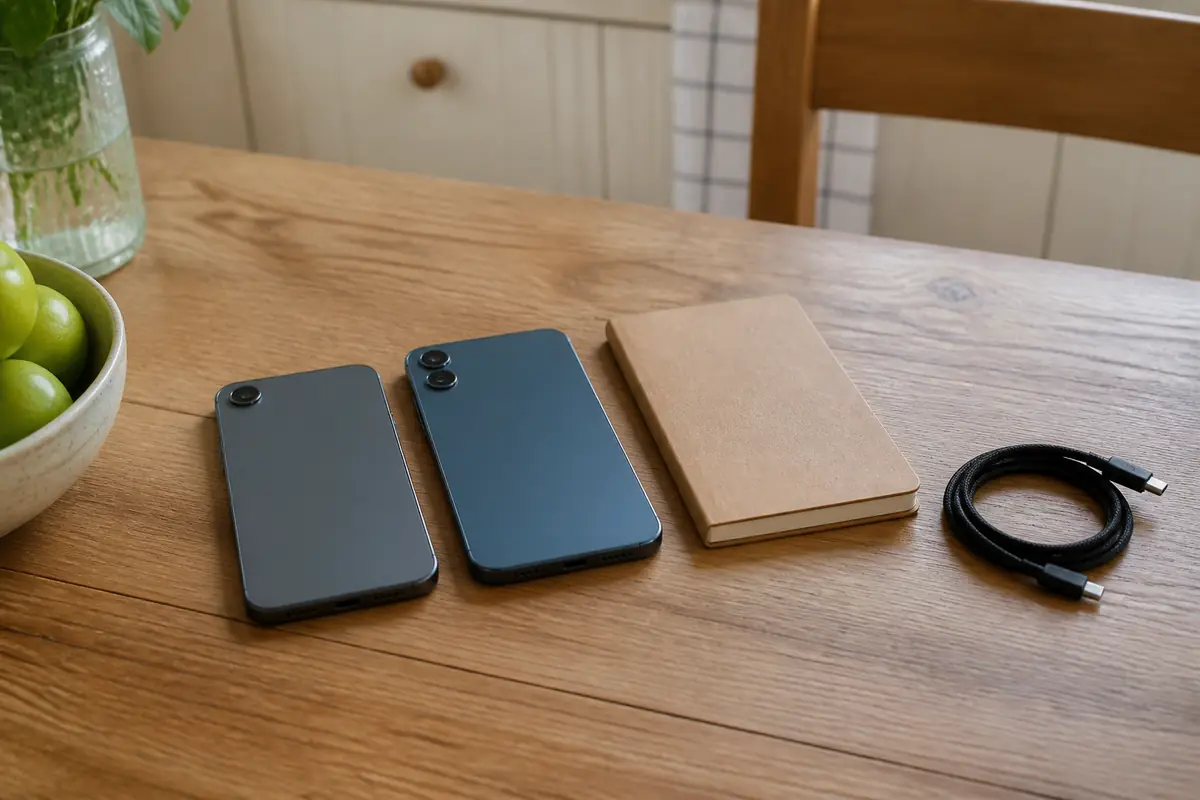
The image is an editorial illustration, not a photograph from a product test. Links are editorial and non-affiliate. We excluded expired promotions from the verdict and did not deduct conditional trade-in values from either headline price.
Prices, stock, software features and terms change. Confirm the exact storage, model, network compatibility, basket and support information before buying.