Home fragrance diffuser refill and spill guide: compatibility, cleanup and pet exposure
A refill is a chemical product, not simply scented water. Preserve its label, use a stable tray, keep it away from children and animals, and follow product-specific first-aid directions if liquid reaches skin, eyes or a mouth.
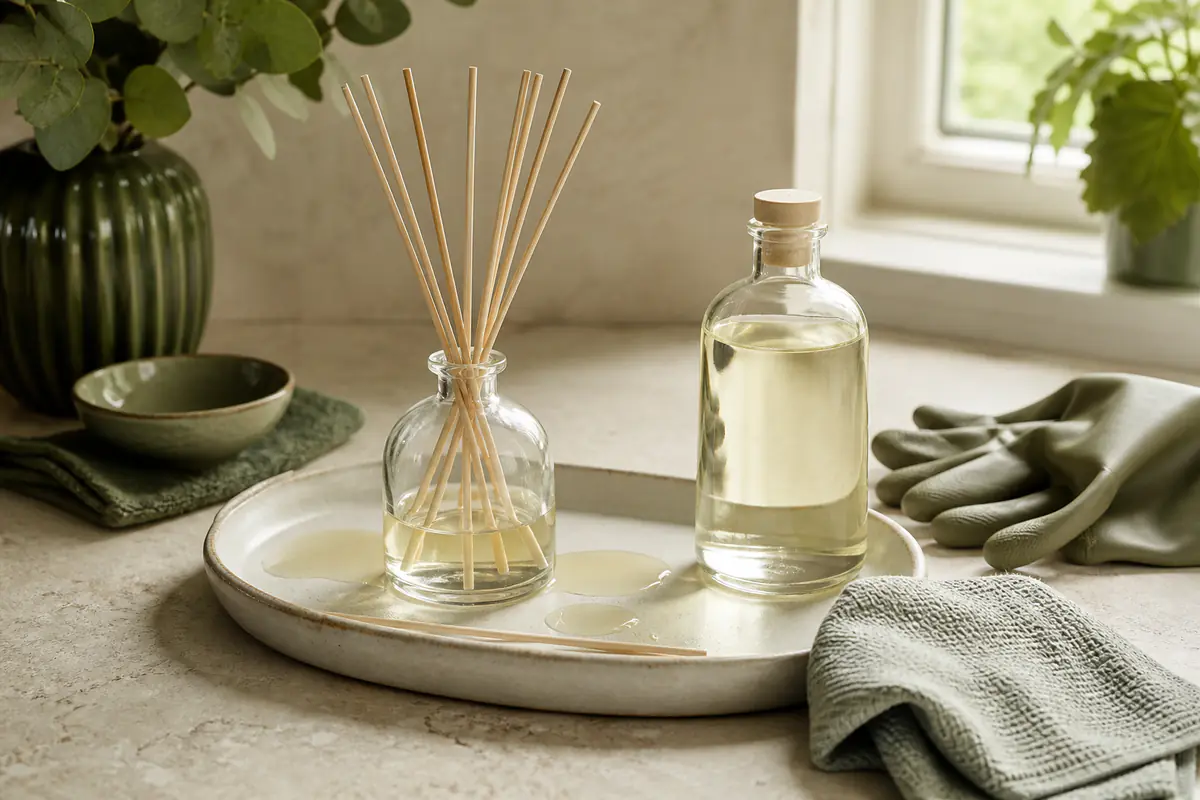
In this guide
Control the liquid before chasing stronger scent
Use only a refill intended for the vessel and reeds, work over a non-porous tray, protect skin as directed and retain the labelled container. Do not mix leftovers, decant into a drinks bottle or use stronger oils around a pet. If harmful exposure is possible, follow NHS or veterinary advice promptly.
Use our home fragrance diffuser buying guide for the initial product decision and the reed diffuser placement guide for everyday location. This page covers refilling, spills and exposure after purchase.
| Situation | Immediate priority | Evidence to keep | Do not |
|---|---|---|---|
| Routine refill | Read label and verify compatibility | Product name, batch and instructions | Mix unknown liquids or overfill |
| Surface spill | Protect people and contain as labelled | Surface, product and affected area photos | Rub liquid into unfinished material |
| Skin or eye exposure | Use product first aid and urgent guidance | Container and ingredient/safety information | Delay advice to test a home remedy |
| Pet contact | Remove access and contact a vet promptly | Oil type, concentration and route | Wait for symptoms or induce vomiting |
Prepare a controlled refill station
- Original labelled refill container.
- Compatible clean diffuser vessel.
- Correct new reeds if specified.
- Stable non-porous tray with raised edge.
- Protective gloves stated by the label.
- Absorbent disposable material.
- Good ventilation and clear light.
- Children and animals outside the area.
Treat the refill as a separate product decision
Read the refill label, safety warnings, intended use, volume and compatibility before opening it. A liquid being sold beside a diffuser does not prove it suits every vessel, stopper, reed material or previous fragrance. Use the maker’s combination where specified and do not assume essential oil, perfume oil and prepared reed-diffuser fluid are interchangeable.
Keep the original container and batch information. Never transfer leftover liquid into a drinks bottle, food jar or unlabelled decorative vessel. If the diffuser itself lacks stable geometry, damage-free glass or a suitable neck, replacing it may be safer than extending its life. The buying guide covers vessel stability and total refill cost.
Do not mix old and new liquids casually
Different bases, dyes and fragrance mixtures can behave unpredictably, smell unpleasant or leave residues. Old liquid may have oxidised, thickened or collected dust. If the instructions allow reuse, empty and clean the vessel exactly as directed and let it dry fully. Otherwise use a new compatible container rather than improvising a solvent wash.
Do not pour unwanted fragrance down a sink or outside. Follow the label and local waste guidance. Keep mixtures out of household cleaning bottles, because future users may mistake their purpose. If the product lacks disposal information, ask the manufacturer or local authority with the exact container and composition rather than guessing.
Set up for a spill before opening
Choose a stable, well-lit, ventilated area with a non-porous tray large enough to hold the vessel and refill. Remove textiles, papers, varnished ornaments and electronics. Keep a cloth or absorbent material ready, but do not use a valued towel that may spread oil to a washing load.
Place children and animals in another room and close the refill immediately after pouring. Work slowly and below eye level. A funnel should be used only if the product instructions permit and it is dedicated to this purpose; a food funnel creates contamination risk. Do not fill to the rim because reeds displace liquid.
Protect the surface and furniture finish
Fragrance liquid can mark paint, varnish, stone, plastic, fabric and wood. A coaster that only fits the base may not contain a tip-over spill; use a raised, non-porous tray in routine placement. Test any cleaning step on an inconspicuous area and follow the furniture or surface maker’s care instructions.
When a spill occurs, stop the source, keep others away and blot or lift liquid as the product instructions indicate. Avoid aggressive scrubbing that drives oil into grain or spreads the affected area. Photograph the product and damage before using cleaners if a claim may follow. The fault evidence photography guide helps build a neutral record.
Follow the label for skin and eye contact
Fragrance and essential-oil products vary, so the container’s safety information is the first reference. Remove contaminated clothing or jewellery where directed and prevent transfer to the face. If irritation, breathing difficulty or a chemical injury is possible, seek appropriate medical help rather than testing another substance on the skin.
NHS guidance says suspected harmful swallowing, touching or inhalation requires prompt medical advice and directs uncertain cases to NHS 111; severe symptoms require emergency action. For chemical burns, NHS instructions emphasise urgent treatment and extensive cool or lukewarm running water. Take the labelled container or safety information for clinicians, without delaying care.
Manage pet exposure conservatively
PDSA advises keeping cats away from rooms using reed, plug-in or nebulising essential-oil diffusers and ventilating before allowing them back. It recommends contacting a vet immediately if a cat may have contacted or eaten an essential-oil product, even without symptoms. This is more cautious than waiting to see whether the animal appears unwell.
Remove access without putting yourself at risk, prevent licking of contaminated fur or paws where safe, and contact the vet with product, oil, concentration, route, time and estimated amount. Do not induce vomiting or apply another oil unless a veterinary professional instructs it. Keep the package for identification.
Choose reeds and strength without overexposure
Use the number and type of reeds specified by the product. More reeds or frequent flipping can increase evaporation and exposure as well as scent. If the room feels overpowering, reduce use according to the instructions, improve ventilation appropriately or remove the product rather than placing it closer to a face or sleeping area.
Our fragrance-strength guide explains that perceived intensity depends on room, airflow and person. Do not treat nose fatigue as proof that no fragrance remains, and do not add undiluted oil to force a stronger result. Headache, irritation or breathing symptoms are reasons to stop exposure and seek advice where needed.
Prevent tipping and accidental drinking
Keep the vessel out of reach, away from table edges and off shelves that vibrate. Long reeds can invite pulling by children or pets and can brush curtains. A narrow, top-heavy vessel remains risky even on a coaster. Choose a position where it cannot be mistaken for a drink or toiletry.
Use the placement guide to assess sunlight, heat, airflow and surfaces. Do not place a diffuser above food preparation, beside medicines or near open flame. Although a reed diffuser has no flame in normal use, many fragrance liquids and their vapours still require label-led storage away from heat.
Decide when the vessel should be retired
Retire a vessel with chips, cracks, a loose decorative sleeve, an unstable base or residue that cannot be removed by the approved method. Do not hide a crack with adhesive or reuse decorative glass for food. Old reeds that are clogged, dusty or incompatible can produce poor performance; replace only as the maker directs.
If the product was supplied unsafe, leaked in transit or failed under normal use, preserve the item and listing before disposal. Follow the faulty-goods guide and check official product safety alerts. Do not keep a leaking product operating merely to create more evidence.
Store refills as household chemicals
Keep refills upright in their original closed containers, away from heat, ignition, food, medicines, children and pets. Follow temperature and sunlight instructions. Record the opening date if useful, but do not cover hazard information with a handwritten label.
Before buying a large refill, check realistic usage, shelf guidance and whether the scent remains suitable. A bulk bottle can reduce cost per millilitre while increasing stored chemical volume and spill consequence. The better value is a compatible quantity that can be used safely before its condition deteriorates.
Balance atmosphere with exposure and upkeep
A diffuser is optional décor, not essential indoor-air equipment. If it creates repeated irritation, pet-management difficulty, surface damage or waste, reduce or stop use. Unscented space and ventilation may be the better choice. Do not use fragrance to conceal damp, smoke, drainage or electrical odours that require investigation.
For a flame-based alternative, our scented-candle care guide addresses a different risk profile. Neither format should be treated as harmless because it is familiar. Read the product, control access and choose the lowest-maintenance route that achieves the intended atmosphere.
Refill the vessel or retire it?
Compatibility and containment are clear
The vessel is stable and undamaged, the refill is intended for it, the label is complete and a safe location remains available.
Damage or exposure cannot be controlled
Glass is compromised, liquid identity is unclear, pets or children can reach it, or the product repeatedly causes irritation or spills.
Balanced verdict
A careful refill keeps product identity, containment and exposure control intact. Do not mix unknown liquids, protect surfaces, retain the label and treat human or animal exposure promptly.
Use the linked buying, placement, fragrance, evidence and consumer guides for the decisions around the spill itself.
Official checks:
NHS poisoning guidance ↗
NHS chemical burn guidance ↗
PDSA cats and essential oils guidance ↗
UK product safety alerts and recalls ↗
Frequently asked questions
Can I put any fragrance oil in a reed diffuser?
No safe general assumption should be made. Use a refill intended for the vessel and reeds and follow its label; do not improvise with unknown oils.
Can I mix two diffuser refills?
Avoid mixing unless the manufacturer explicitly permits it. Different liquids can be incompatible and the resulting safety information becomes unclear.
What should I do if diffuser liquid reaches an eye?
Follow the product label and obtain urgent medical guidance. NHS chemical-injury guidance emphasises prompt action and extensive water irrigation for chemical burns.
Are reed diffusers safe around cats?
PDSA advises keeping cats away from rooms using essential-oil diffusers and contacting a vet immediately after suspected contact or ingestion.
Can diffuser liquid go down the sink?
Do not assume it can. Follow the product disposal instructions or ask the manufacturer or local authority about the exact liquid.
Methodology and limitations
We reviewed current NHS poisoning and chemical-injury guidance, current PDSA veterinary guidance on cats and essential oils, and UK product-safety information on 2 September 2026. We separated compatibility, refill preparation, surface spills, human exposure, pet exposure, storage and retirement. We did not test a specific fragrance product.
Limitations
Ingredients, concentrations, labels, surfaces and health or veterinary risks vary. The product label and urgent professional advice take priority. This is general household risk guidance, not medical, veterinary or chemical-treatment advice.