Hair dryer buying guide: airflow, heat, attachments and handling weight
A hair dryer should provide controllable airflow at a heat level and weight you can manage. Wattage, motor labels and marketing terms are secondary to the real routine, attachment fit and safe ownership.
In this guide
Choose control and handling before maximum heat
Prioritise separate airflow and temperature settings, a useful cool option, secure attachments and a weight you can hold through the longest section of your routine. Buy from an identifiable UK seller, inspect the plug and cable, keep the appliance away from water and stop using it after damage, overheating or unusual noise.
Use the Boots beauty retailer review for one established buying route, the genuine-shop guide for seller checks and the warranty evidence guide after purchase.
| Need | Prioritise | Test or verify | Avoid assuming |
|---|---|---|---|
| Fast rough drying | Strong controllable airflow | Setting layout and sustained comfort | Highest wattage is always fastest |
| Defined curls | Secure diffuser with suitable bowl and prongs | Fit, reach and low-speed control | Any bundled diffuser suits every curl |
| Smooth finish | Concentrator plus balanced heat and airflow | Nozzle security and manageable distance | Maximum heat creates the best finish |
| Limited grip or shoulder endurance | Lower handling weight and balanced body | Dryer, cable and attachment together | A compact body is necessarily light |
Shortlist checklist
- Independent heat and airflow controls.
- Cool setting that is easy to hold or select.
- Attachment needed by the actual routine.
- Weight including cable and attachment.
- Handle balance and switch placement.
- Removable or accessible filter.
- UK three-pin plug and identifiable seller.
- Warranty, recall and spare-part route.
Translate the routine into controls
Write down hair length, density, texture, usual starting dampness and the result sought. Rough drying thick hair, diffusing curls and directing a smooth blow-dry require different airflow patterns. Count how often attachments change and how long the dryer is held above shoulder height. This turns a generic appliance search into a handling and control problem.
Prioritise settings that can be changed without looking or losing grip. Separate heat and speed controls create more useful combinations than one linked high-medium-low switch. A cool option can help finish a section without adding heat, but check whether it is a momentary button or a selectable setting and whether your hand can maintain it comfortably.
Do not use wattage as a performance score
Wattage describes electrical input, not directly the airflow, temperature control, noise, motor durability or drying time on your hair. Two dryers with similar wattage can move air differently through their fan, heater and nozzle. A large headline number cannot reveal whether the lowest heat is gentle enough or the highest speed is controllable.
Compare manufacturer airflow data only when the test units and conditions match. Otherwise, use wattage to understand electrical demand and product category, not to rank results. The expert-test comparison guide helps prevent unlike figures from entering the same score column.
Choose heat you can reduce
Heat can speed evaporation, but more is not automatically better for scalp comfort, hair condition or control. Look for a useful low and medium heat alongside the high setting. Follow the product and hair-care instructions, keep the inlet unobstructed and maintain distance rather than holding the nozzle against hair or skin.
If the dryer becomes abnormally hot, smells of burning, crackles, sparks, repeatedly cuts out or trips protection, switch it off, unplug safely and stop using it. Do not defeat a thermal cut-out or cover the air inlet. An automatic pause may indicate blockage or overheating rather than a feature to ignore.
Match the attachment to the technique
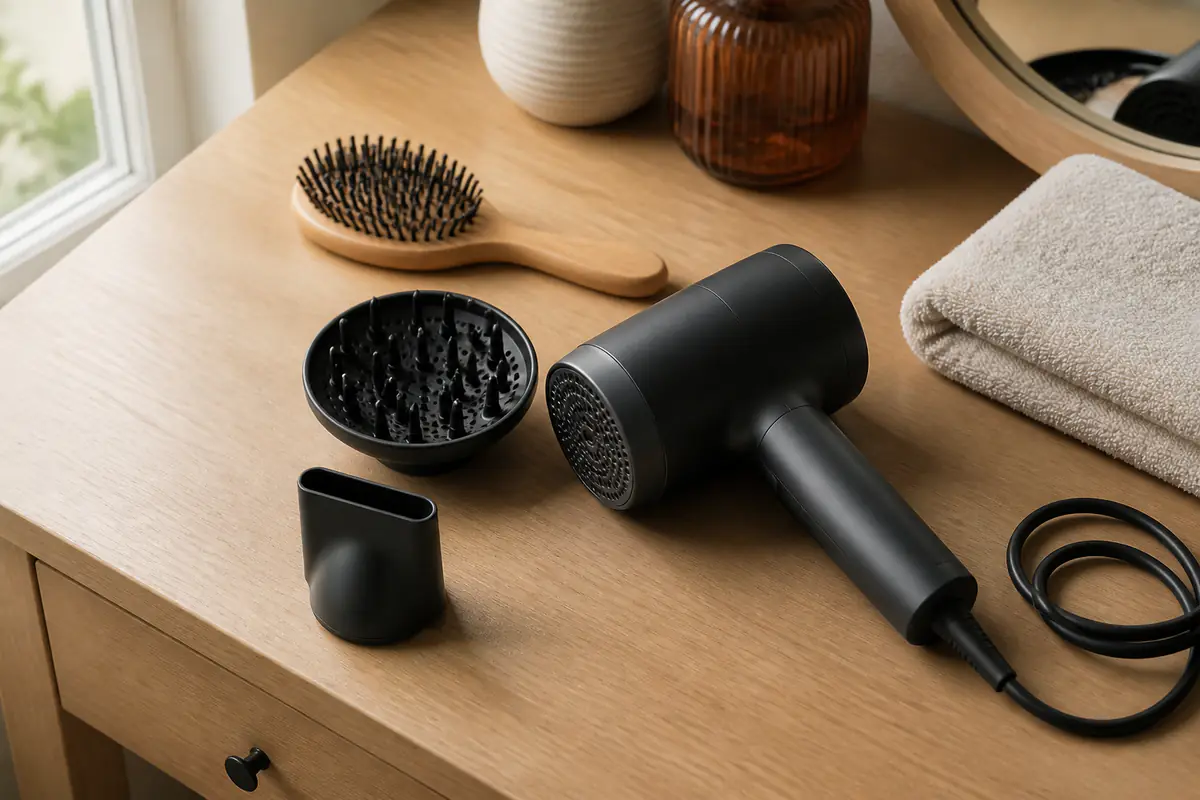
A concentrator narrows airflow for sectioned directing; a diffuser spreads flow and supports curls. Check that the included attachment locks securely, remains manageable when warm and does not fall during angle changes. Bowl depth, prong shape and opening pattern affect how a diffuser meets different hair lengths, but no geometry guarantees a particular result.
Count only attachments you will use. A bundle of combs and nozzles has little value if storage is awkward or replacements are unavailable. Proprietary magnetic fittings can be convenient but may limit compatible spares. Use the beauty travel-size guide to keep portability separate from full-size performance.
Assess weight, balance and cable together
Published weight may exclude the cable or attachment, so confirm what is measured. A short compact body can still feel wrist-heavy if the motor mass sits far from the grip. Consider the longest continuous section of the routine, not a ten-second shop lift. Switch position, handle diameter and surface texture also affect fatigue.
The cable adds drag and can catch on a dressing table. Check length for the intended socket without planning an extension lead through a bathroom or wet area. The dryer should rest securely between sections without blocking its inlet. People with pain, weakness or limited reach should prioritise an easy return policy and seek appropriate occupational advice where needed.
Treat ionic and motor labels cautiously
Ionic, ceramic, tourmaline, brushless, digital and salon-grade claims are not standardised consumer outcomes. Ask what measurable difference the manufacturer states, under which conditions and whether it changes weight, noise, filter care or warranty. Do not infer healthier hair, permanent frizz removal or professional durability from one label.
A motor design can influence size, control and lifespan, but the finished appliance and support matter. Compare settings, weight, attachment fit, parts and warranty before paying a large premium. The review reading guide helps separate repeated reports of switch or attachment problems from subjective styling results.
Buy and use it as a mains appliance
Choose an identifiable seller and a product intended for the UK supply with a proper UK three-pin plug and instructions. Current OPSS safety reports show that hair dryers can be stopped at the border or recalled for serious electrical risks, so an attractive listing is not safety certification. Save model and seller evidence and check official recalls.
Keep the dryer away from baths, showers, basins and wet hands; follow the exact manufacturer instructions and household electrical-safety guidance. Do not use it while bathing or where it may fall into water. Inspect plug, flex and body regularly. Never wrap the cable tightly around a hot appliance or carry it by the lead.
Maintain the filter and storage route
A blocked inlet restricts airflow and can increase heat. Follow the maker’s method and frequency for removing lint and hair only when the dryer is unplugged and cool. Do not insert tools through the grille or operate without a required filter cover. Keep sprays and loose towels away from the inlet while drying.
Store the appliance cool and dry, with a loose cable coil and attachments protected from crushing. Keep the manual and model record. If the filter cover, nozzle, diffuser or cable needs replacement, use an official compatible part. A home cable repair or taped cracked housing is not an acceptable route for a high-power appliance.
Inspect on arrival and register ownership
Before first use, match the model, UK plug, controls and attachments to the listing and manual. Check for cracks, loose parts, exposed conductors or shipping damage. If anything is wrong, do not power it to gather more evidence. Photograph the condition and contact the seller through an official channel.
Register the appliance where the manufacturer offers a recall service, without confusing registration with extra legal rights. Save the receipt, serial privately and warranty terms. Our faulty goods guide explains the evidence path when an appliance is unsafe, misdescribed or fails prematurely.
Choose a full-size or compact dryer?
Control and sustained airflow matter most
You can manage its weight and storage and the settings and attachments match the regular routine.
Portability and shorter sessions dominate
The smaller model still has safe UK compatibility, useful controls and adequate attachment support.
Balanced verdict
A controllable, balanced dryer with one useful attachment is better than a hotter bundle you cannot manage. Match airflow and heat to the routine, include cable and attachment in handling, and treat seller and electrical evidence as essential.
Use the linked styling-tool, seller, warranty, specification, attachment, review and faulty-goods guides.
Official checks:
OPSS consumer product safety guidance ↗
UK electrical product safety alerts and recalls ↗
Electrical Safety First home guidance ↗
Register My Appliance recall registration service ↗
Frequently asked questions
Can a hair dryer’s input wattage predict how quickly it dries my hair?
Not by itself — Fan, heater, nozzle, controls, workload and technique affect drying; wattage is electrical input rather than a result score.
Do I need a diffuser?
Only if the spread airflow and bowl or prong design support your curl-drying method. Check secure fit and usable low-speed control.
What weight should I choose?
Choose a dryer you can hold through the longest section of your routine, including cable and attachment. Balance matters as well as grams.
Can I use a hair dryer near a bath or sink?
Keep mains appliances away from water and follow the manufacturer and current electrical-safety guidance. Never use one while bathing.
When should I stop using a dryer?
Stop after cable or housing damage, burning smell, sparking, unusual noise, repeated overheating, tripping or a relevant recall.
Methodology and limitations
We reviewed current OPSS consumer safety and electrical-product alert material, Electrical Safety First home guidance and appliance registration advice on 2 September 2026. We assessed controls, attachments, handling, seller, maintenance and ownership. We did not test or style with individual dryers.
Limitations
Performance depends on hair, technique and exact model. Product specifications, prices, spare parts and recalls change. This guide is not medical advice and does not replace manufacturer or electrical-safety instructions. Noise, temperature and airflow figures are comparable only when the stated test method and units match. A retailer demonstration cannot reproduce every grip, reach, hair or home-electrical condition, so preserve return eligibility until the controls and handling have been assessed. Recheck recalls and the exact UK model before purchase.