Hair dryer value: useful airflow, attachment fit, motor claims and ownership cost
A higher price is worthwhile only when the dryer reduces effort for the actual hair and routine. Airflow control, attachments, balance and cleaning matter more than prestige language.
In this guide
Pay for a repeatable routine, not an impressive wattage
Choose controls and attachments that work at the required distance, speed and heat without adding fatigue or cleaning friction. Start with our hair dryer buying guide, then calculate the ownership trade-off.
Use the specification guide, review-reading guide and ownership-cost guide to test marketing claims.
| Feature | Evidence | Common trap | Value test |
|---|---|---|---|
| Airflow | Control range and real drying pattern | Wattage used as airflow proxy | Does it shorten the routine? |
| Heat | Distinct stable settings and cool control | Maximum heat presented as speed | Can the user stay lower? |
| Attachment | Secure fit and useful geometry | Large bundle of near-duplicates | Count regularly used pieces |
| Ownership | Filter, cable, balance, warranty | Premium finish without serviceability | Price the complete routine |
Record the real drying routine
- Hair length, density, texture and usual starting moisture.
- Drying method, brush use and section size.
- Comfortable heat, speed and distance.
- Diffuser, concentrator or no attachment.
- Hand position, weight balance and session length.
- Filter access and cleaning frequency.
- Cable reach, storage and household noise constraints.
- Warranty, support and replacement attachment route.
Define the result worth paying for
Value can mean shorter drying, lower fatigue, better diffuser control, a narrower concentrator, easier storage or a tool that several household members can operate. Choose two or three outcomes and rank them before comparing models. Do not treat salon positioning as a measurable result.
A premium that saves little time and adds an awkward attachment system is not value. Conversely, better balance or a secure diffuser can matter daily even when wattage is ordinary. Compare the finished routine from towel-dried hair to storage, not the motor in isolation.
Do not convert wattage into drying performance
Electrical input does not directly describe air volume, velocity, temperature distribution or control. Two dryers with similar wattage can feel different because of fan, heater, nozzle and feedback design. Avoid claiming a higher figure dries faster or a lower figure is automatically gentler.
Look for controlled comparisons on similar hair and starting moisture, with settings disclosed. Record whether time saving comes from higher heat, stronger airflow or more efficient sectioning. The useful performance is the lowest comfortable combination that produces the wanted result.
Value airflow range, not only maximum force
Strong airflow can move water quickly but can disturb curls, fine hair or precise brush work. Check whether lower settings remain stable and whether controls can be changed without altering grip. A model with a broad usable range can serve more routines than one impressive maximum.
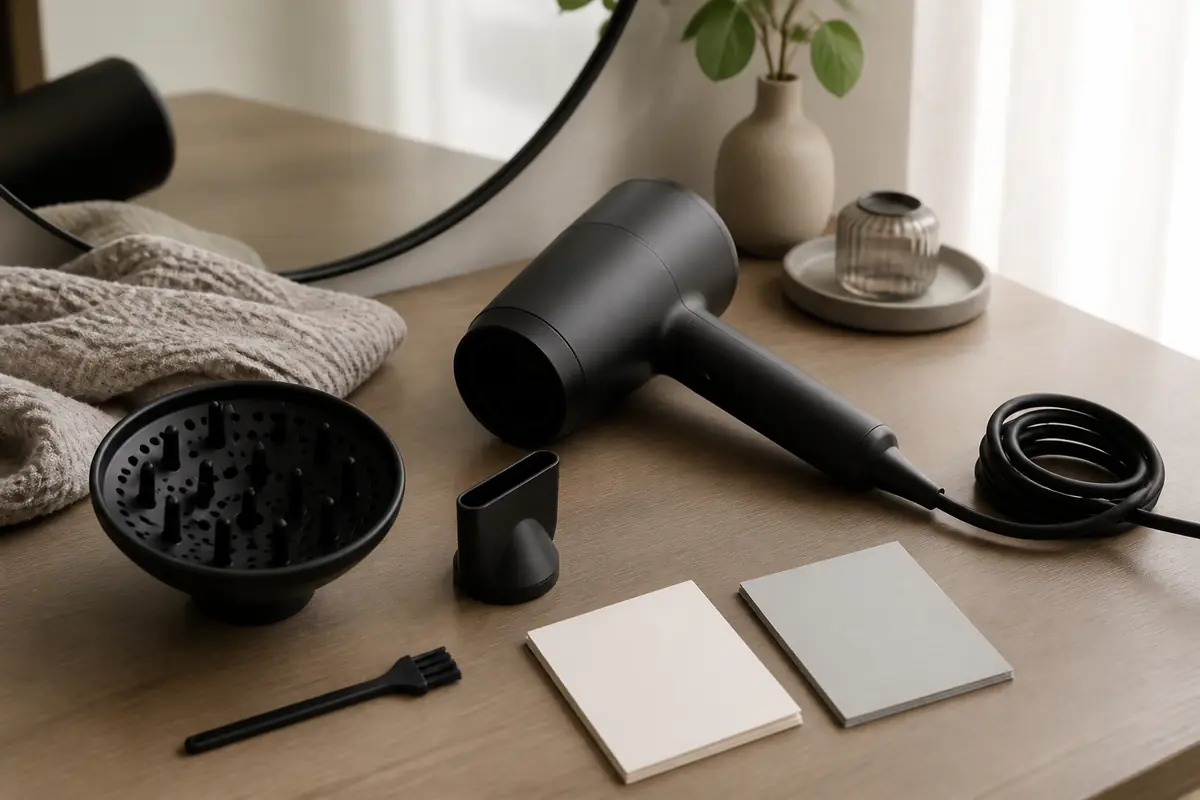
Diffusing needs even flow through the bowl and prongs; concentrated styling needs a controlled jet that does not loosen the nozzle. Test attachment orientation and whether it stays secure as the housing warms. Count only modes the user can distinguish and will use.
Treat heat controls as a damage-management tool
More heat can reduce time but can also make it harder to work comfortably and consistently. Check separation between heat and speed controls, the behaviour of the cool control and whether settings are easy to identify by touch without looking into the airflow.
Do not make medical or universal hair-damage claims from a feature name. Use the manufacturer directions, maintain distance and keep the inlet clear. Our straightener safety guide reinforces the wider principle that temperature control and technique matter more than a maximum figure.
Audit attachment usefulness one piece at a time
List the diffuser, concentrator, smoothing tool, comb or flyaway attachment and the exact job each performs. Check dimensions, magnetic or friction fit, rotation, heat tolerance and storage. A five-piece bundle is poor value when four pieces duplicate technique or do not suit the user.
Replacement availability matters because a cracked nozzle can remove the feature that justified the premium. Search the exact model and part before purchase. Do not assume attachments from a related family fit safely merely because the barrel diameter looks similar.
Calculate fatigue through balance and grip
Total weight is incomplete without centre of gravity, handle angle, head length, control position and cable pull. A compact heavy head can tire the wrist differently from a longer balanced body. Consider the actual drying position, including overhead reach and brush use.
Use independent reviews only when the reviewer discloses routine and session length. Our linked review guide helps separate a brief unboxing reaction from repeated use. If possible, handle a display model without powering it and rehearse attachment changes and storage.
Check filter access and airflow maintenance
Lint and hair at the inlet can restrict airflow and raise operating stress. Confirm whether the filter cover is removable, how it opens and the manufacturer’s permitted cleaning method. A decorative grille that is difficult to access can turn routine care into neglect.
Record cleaning reminders based on visible accumulation and instructions, not a made-up universal interval. Unplug and cool the dryer first. Never insert tools through the grille unless the manual explicitly permits it. A washable component must be completely dry before refitting where instructions require.
Interpret motor and ion claims carefully
Terms such as digital, brushless, professional, ionic and intelligent can describe real engineering features, but the words alone do not quantify airflow, lifespan, frizz outcome or repairability. Demand model-specific evidence and identify which result the claim is supposed to improve.
Do not infer a service life from motor type without a comparable test and warranty. Ion-related cosmetic outcomes vary with hair, environment and technique. Mark an unmeasured claim as context, not as a price premium. The warranty guide helps verify support rather than projecting durability from language.
Include noise and shared-space cost
Sound level and character affect early-morning use, shared homes and users sensitive to high-pitched noise. Manufacturer figures, when supplied, need test distance and setting. A single decibel number at maximum may not describe the routine.
Compare on the settings actually used and include session duration. Do not hold a running dryer close to the ear for comparison. If quiet use is important, prioritise return options that permit a lawful assessment without assuming a used hygiene-related product can always be returned.
Price energy through minutes and settings
Running cost depends on power draw, setting and duration. Estimate energy from rated input as an upper context, then use realistic minutes per session and frequency. A more powerful dryer can cost less per routine if it genuinely reduces time, but only measured use can establish that.
Do not invent a saving from a motor label. Compare expected annual use and treat small differences honestly. The purchase price, attachments, replacement parts and likelihood of continued use usually matter alongside electricity. Value is the complete routine, not a dramatic daily fraction.
Verify safety, support and recall evidence
Check the plug, cable, housing and inlet before each use. Keep the appliance away from water and follow Electrical Safety First and manufacturer guidance. Register or preserve model details so a safety notice can be matched to the exact product.
Save the model, seller, order and warranty evidence. Use our manual guide before purchase and check the UK product-safety database for alerts. Stop using a dryer with cable damage, burning smell, arcing, unusual heat or intermittent operation and seek qualified advice.
Test storage and travel assumptions
A folding handle, compact body or travel label adds value only when the cable, plug and attachments fit the intended bag without stress. Check voltage and frequency requirements for the destination; a plug adapter changes shape, not electrical compatibility. Do not operate a UK-only dryer on an incompatible supply.
At home, store the cooled dryer where the cable is not tightly wrapped around the body and attachments are not crushed. Include the space needed for a diffuser and the time spent finding loose pieces. A smaller dryer with an awkward proprietary bundle can require more storage than a simple full-size model.
Pay for a premium dryer or a simpler model?
The routine improvement is specific and repeatable
Balance, airflow range, attachment fit and maintenance clearly reduce time or effort for regular use.
Core controls already meet the routine
Extra modes and attachments do not improve the result, comfort or support route.
Balanced verdict
Hair dryer value is useful airflow delivered through a manageable routine. Wattage, motor labels and large bundles matter only when they improve control, comfort, care or support.
Use the linked hair dryer, specifications, reviews, ownership-cost, straightener, warranty and manual guides.
Official checks:
Electrical Safety First product-safety guidance ↗
UK product safety alerts and recalls ↗
GOV.UK electrical waste responsibilities ↗
Frequently asked questions
How much does wattage tell me about the useful drying time bought for the price?
Not by itself — Airflow, heat, nozzle, controls, hair and technique determine the complete routine.
Are ionic dryers always better?
No universal result follows from the label. Compare model-specific evidence and the user’s actual hair and technique.
How many attachments add value?
Only the pieces used regularly, fitting securely and available as replacements should count.
Can a premium motor guarantee longer life?
No — Motor language is not a lifespan guarantee; check test evidence, warranty and support.
How should running cost be compared?
Use realistic power setting, minutes and frequency, then include purchase price, parts and likely continued use.
Methodology and limitations
We assessed hair dryer value through routine outcome, airflow, heat, attachments, balance, filter care, motor claims, noise, energy, safety and support. The hair-dryer value research records 2 September 2026 for its Electrical Safety First, GOV.UK product-safety and electrical-waste references. We did not measure airflow, temperature, noise or power on a named dryer.
Limitations
Models, specifications, attachments, prices, support and safety notices change. Hair response and comfort are individual, and marketing terms are not standardised performance tests. Before valuing a particular dryer, verify its model-specific manual, trader, warranty cover and current safety information.