Hair dryer ownership guide: filter cleaning, cable care and energy
A hair dryer’s useful life depends on clear airflow, an undamaged lead, sensible heat and the exact manual. Blocked inlets or poor storage can turn inconvenience into a safety stop.
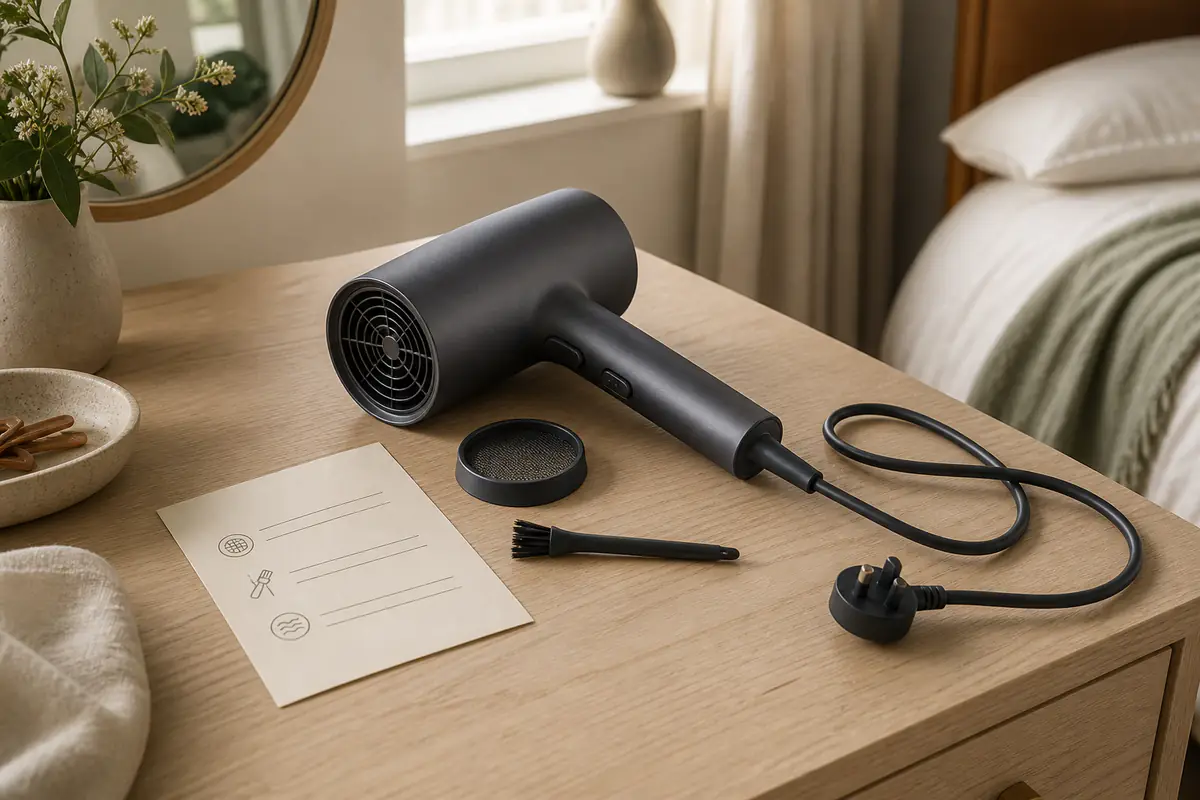
In this guide
Protect airflow first and never normalise cable damage
Unplug and cool the dryer before permitted cleaning, keep openings clear, store the lead loosely and stop after sparking, unusual smell, cracks or heat damage. Choose the right format with our hair dryer buying guide.
For the purchase-value calculation, use the hair dryer value guide. This ownership guide is about repeatable care and fault decisions, not salon technique or a claim that one wattage suits every routine.
| Check | Normal evidence | Stop-use sign | Action |
|---|---|---|---|
| Air inlet | Clean, clear and securely fitted | Blocked, cracked or scorching | Unplug and follow manual |
| Lead and plug | Flexible insulation, firm pins | Cuts, heat, looseness or exposed wire | Stop and seek proper repair |
| Operation | Expected sound and airflow | Sparks, smoke, odd smell or cycling | Switch off and disconnect |
| Routine | Lowest effective heat and time | Repeated overheating or very long drying | Review method and condition |
Create a safe care routine
- Exact model, manual and permitted filter-removal method.
- Normal airflow, sound and heat behaviour when new.
- Cooling surface and dry storage location.
- Filter inspection and cleaning interval.
- Lead, plug, strain relief and housing check.
- Attachments actually used and their secure-fit condition.
- Typical setting and elapsed drying time.
- Registration, receipt, recall check and fault record.
Read the filter instructions for the exact model
Some dryers have a removable rear grille or filter; others permit only surface cleaning. Find the manufacturer’s instructions before twisting, prising or washing any part. Record the part orientation so it is fully dry and securely refitted before the next use.
Our manual-before-buying guide explains how to locate care rules early. Do not infer a cleaning method from a similar-looking dryer or online clip: hidden clips, coatings and electrical clearances differ.
Unplug, cool and move away from water
Finish use, switch off, unplug and allow the dryer to cool on a stable heat-resistant surface. Maintenance belongs in a dry area with dry hands, not beside a filled sink or bath. Electrical Safety First says hair dryers must not be used in the bathroom or near a sink full of water.
Do not pull the plug by the cable, and do not leave the hot appliance on bedding, carpet or another soft flammable surface. The cooling step is part of ownership, not dead time to be shortened by putting the dryer straight into a drawer.
Inspect the air inlet before performance drops
Hair, dust and lint can accumulate at the inlet and restrict cooling air. Check the grille in good light at the interval in the manual and sooner if the normal sound, airflow or casing temperature changes. Keep the opening clear during use and avoid placing it against fabric.
A blocked inlet can make a dryer cycle, smell hot or take longer. Do not compensate with a hotter setting or prolonged operation. Switch off, disconnect and follow only the permitted cleaning process once the appliance has cooled.
Clean without driving debris inside
Use the tool and direction allowed by the manufacturer, commonly a dry soft brush or cloth on an accessible grille. Work gently so lint is lifted away rather than pushed into the housing. If a removable filter may be washed, follow the specified drying time exactly.
Never run the dryer with a required guard or filter removed. Do not insert metal objects, spray cleaner into the opening or use a vacuum nozzle unless the manual expressly permits it. Internal mains work belongs with an appropriately qualified repair route.
Reassemble and make a short dry-area check
Confirm every removable piece is dry, correctly aligned and locked. Inspect for gaps, cracked tabs or a grille that can contact the fan. Make a brief operational check in a suitable dry location before starting a full routine.
If the sound, vibration, airflow or smell is abnormal after cleaning, stop immediately. Repeating the cycle to see whether it clears can worsen a loose part or concealed obstruction. Preserve the cleaning date and observations for support.
Store the lead in a relaxed loop
Electrical Safety First advises against wrapping the cable around the dryer. Tight turns at the handle or plug repeatedly load the conductors and strain relief. Let the lead cool, form a broad loose loop and store it where a drawer cannot pinch it.
Avoid hanging the appliance by its cable or using the cable as a carrying handle. If the dryer has a hanging loop, confirm the manual permits its use and ensure the dryer is cool, dry and beyond accidental pulling.
Inspect plug, lead and strain relief
Before connection, look for cuts, flattened areas, discoloration, exposed insulation, loose plug pins or a lead that moves unusually at the handle. Check the socket area for burn marks or heat. Do not tape over damage and continue using it.
A replaceable plug does not make the entire cable a user-serviceable part. Stop use and contact the retailer, manufacturer or an appropriately competent repairer. Keep the exact fault location and photographs with the ownership record.
Keep cable and hot surfaces apart during use
Route the lead so it cannot touch the hot outlet, be trapped under furniture or cross a walking route. Leave enough slack for normal movement without pulling at the handle. Keep the plug and cable dry and away from heated styling tools.
If several styling tools share the area, use a deliberate sequence rather than a tangle of hot leads. Do not overload adaptors or extension arrangements. The safe solution may be a different socket location, not a longer drying lead.
Choose the lowest effective heat and airflow combination
Start from hair type, moisture level, attachment and intended finish. Higher rated power is not the same as constant consumption, and maximum heat is not automatically fastest when it causes repeated pauses or discomfort. Use the settings supported by the manual and technique appropriate to the user.
Record the setting and approximate elapsed time for a normal routine. This creates a useful baseline: a growing drying time can prompt a filter, attachment or technique check. It is not proof of motor failure or a precise energy benchmark.
Estimate energy from measured use, not the label alone
The rating plate shows maximum electrical characteristics, not necessarily the average draw across every setting. If a precise household estimate matters, use a suitable measurement method with the appliance operated normally and apply the current tariff. Do not handle plugs or meters in a wet styling area.
The total cost of ownership guide shows how to keep assumptions visible. Small reductions in unnecessary running time may matter more than choosing by nominal wattage when the lower-powered dryer takes substantially longer.
Use attachments only when secure and appropriate
A concentrator, diffuser or smoothing attachment changes airflow and clearance. Fit only compatible parts in the orientation the manufacturer describes, and check for cracks, distortion or a loose connection before heating. Allow attachments to cool before removal.
Do not block the outlet with hair, a brush or an improvised reducer. If an attachment repeatedly falls off, stop using it and verify the exact part number. A generic fit is not established by similar diameter.
Create a stop-use rule for abnormal behaviour
Stop after sparks, smoke, burning smell, repeated unexpected cut-outs, cracking, rattling, damaged casing or a hot plug or socket. Switch off, unplug when safe and move away from combustible materials without touching a dangerously hot surface.
Electrical Safety First specifically advises unplugging after odd smell, sparking, cracks or damage and contacting the retailer or manufacturer. Do not reset repeatedly, strike the housing or open the mains enclosure to search for a quick fix.
Keep dated evidence for intermittent faults
Write down the setting, elapsed time, attachment, sound, smell and whether the air inlet was clear. Photograph external damage and the model identifier without including personal information. A concise pattern helps support distinguish normal thermal protection from a defect.
Use our warranty registration and evidence guide to preserve the receipt, case number and promised remedy. Do not send the dryer before recording the cable and housing condition unless a safety instruction requires immediate return.
Register and check recalls
Register the exact model with the manufacturer where a route exists so safety messages can reach the owner. Also check the official UK product-safety alert service when the model, seller or symptoms raise concern; broad social posts are not enough to identify an affected batch.
Follow our UK product-recall action guide: match model and batch carefully, stop when instructed, preserve evidence and use the stated remedy. Never keep using a recalled dryer to meet a cost-per-use target.
Review the routine when ownership burden grows
If cleaning becomes unusually frequent, attachments no longer remain secure or drying time rises after appropriate care, compare the service route and remaining support with replacement. Do not invent a universal lifespan: use condition, documented symptoms and available remedy.
The earlier value calculation should be updated with real time, energy and maintenance evidence. A modest dryer that remains safe and fits the routine can be better value than an elaborate model whose accessories and care are routinely avoided.
Retire and dispose without creating a new risk
Remove the dryer from the styling area so another person does not use a known-fault item. Keep recall or warranty identifiers attached until the remedy is closed, and do not cut a mains lead as a casual method of marking it unusable.
Use an appropriate electrical-waste or retailer take-back route. Before replacement, review the old failure and the product specifications guide so the next purchase addresses airflow, weight, control and attachment needs rather than simply choosing a higher number.
Maintain the dryer or stop using it?
Condition and behaviour remain normal
The filter, lead, plug, housing and attachments are sound and the expected routine is stable.
Safety evidence has changed
Damage, sparking, unusual smell, abnormal heat or repeated cut-outs make continued use uncertain.
Balanced verdict
Good hair-dryer ownership is a clear airflow path, a relaxed cable and a firm stop-use rule. Permitted filter care, realistic setting choice, dated fault evidence and recall registration protect more value than chasing maximum heat or wattage.
Use the linked hair-dryer buying and value guides, manual, ownership-cost, warranty, recall and specification guides.
Official checks:
Electrical Safety First hair-dryer guidance ↗
GOV.UK electrical product safety alerts and recalls ↗
GOV.UK electrical-waste responsibilities ↗
Frequently asked questions
How often should a hair-dryer filter be cleaned?
Follow the exact model manual and inspect sooner when lint, airflow, sound or temperature changes.
Can I wash the rear filter?
Only if the manufacturer permits it; it must be completely dry and correctly refitted before use.
Should the lead be wrapped around the dryer?
No — Electrical Safety First advises against it; store the cooled lead in a broad relaxed loop.
Does lower wattage always use less energy?
Not necessarily — Actual setting and drying time determine use, so the label alone is not a routine cost.
When should I stop using the dryer?
Stop after damage, sparking, odd smell, abnormal heat, smoke or other behaviour the safety guidance flags.
Methodology and limitations
We assessed hair-dryer ownership through official safety guidance, exact-manual care, airflow, cable and plug condition, attachments, setting discipline, energy estimation, fault evidence, recalls and disposal. Current Electrical Safety First and GOV.UK resources were checked on 2 September 2026. We did not test a named dryer or provide salon technique.
Limitations
Models, filters, settings, attachments, support and recall notices vary. Energy use depends on the individual routine. This is not an electrical inspection, repair manual or hair-care diagnosis. Follow the exact manufacturer instructions and stop after safety warning signs.