Fragrance samples and discovery sets: sizes, testing, value and waste
A discovery set can reduce the risk of buying the wrong full bottle, but only when the samples are genuine, large enough for repeated wear and relevant to the fragrances you might buy. Compare concentration, usable volume, voucher terms and total delivered cost.
In this guide
Buy enough evidence, not the largest sample collection
Choose a small set of precisely identified fragrances that can each be worn on separate days, then record comfort, development and realistic use. A voucher has value only when its expiry, eligible bottles and minimum spend fit a purchase you would otherwise make.
Check the sample’s exact product name and concentration against the full bottle you are considering. Use our UK cosmetics label guide to inspect the pack, estimate the amount you will finish with the beauty cost-per-use guide, and use our recipient-first gift checklist when buying for someone else.
| Question | Useful evidence | Weak shortcut | Decision |
|---|---|---|---|
| Which vial sizes and fragrance concentrations does the discovery set contain? | Full name, flanker, concentration and stated volume for every vial | Brand family or bottle colour alone | Reject unidentified or ambiguous samples |
| Can it be tested properly? | Enough sprays for separate wears within the stated period | A single first impression | Prefer fewer useful vials to novelty volume |
| Does a voucher add value? | Amount, expiry, eligible size, channel and minimum spend | “Redeemable” without conditions | Count only a voucher you can realistically use |
| Is the route reversible? | Seller, seal, hygiene condition and live return terms | Assuming samples are ordinary returnable goods | Read conditions before breaking any seal |
Build a controlled fragrance test
- Photograph the vial labels and order record.
- Check the full fragrance name and concentration.
- Test one fragrance at a time in a familiar routine.
- Use a blotter first when skin suitability is uncertain.
- Wear on different days and avoid mixing test areas.
- Record opening, dry-down, comfort and context.
- Keep samples cool, dark, upright and securely closed.
- Delay a full bottle until the shortlist survives repeated wear.
Begin with a question the set can answer
A brand-wide set can answer which style within one house suits you; a mixed retailer edit can explore a fragrance family; a single official sample can confirm one planned bottle. Exploring a house, comparing scent families and confirming a single bottle call for different sample selections. Write the decision before selecting the set.
If the buyer already knows the exact fragrance but not the concentration, a broad collection creates distraction. If the buyer does not know whether fresh, woody or amber styles appeal, several closely related flankers may provide little range. Relevance matters more than sample count.
Record the complete identity of every sample
Copy the brand, full fragrance name, flanker, concentration and vial volume. Eau de Toilette, Eau de Parfum, Parfum, Intense and Elixir can share recognisable naming while behaving differently. An image of a full bottle is not enough to identify the liquid supplied.
Check whether the sample is made, filled or authorised by the brand, retailer or another named seller. Decanted products introduce a different chain of custody and labelling question. Do not infer authenticity from a professionally printed card or marketplace photograph alone.
Vial design affects usable testing
A spray vial approximates full-bottle application better than an open dabber, but pumps can vary and small tubes retain residue. The stated millilitres are more comparable than an advertised number of sprays because spray output differs.
Check that caps, pumps and glass arrive intact. Photograph leakage before handling further. A very small sample may support a blotter check yet not repeated full-day wear; count it accordingly rather than treating every vial as an equal trial.
Test on blotter before skin when appropriate
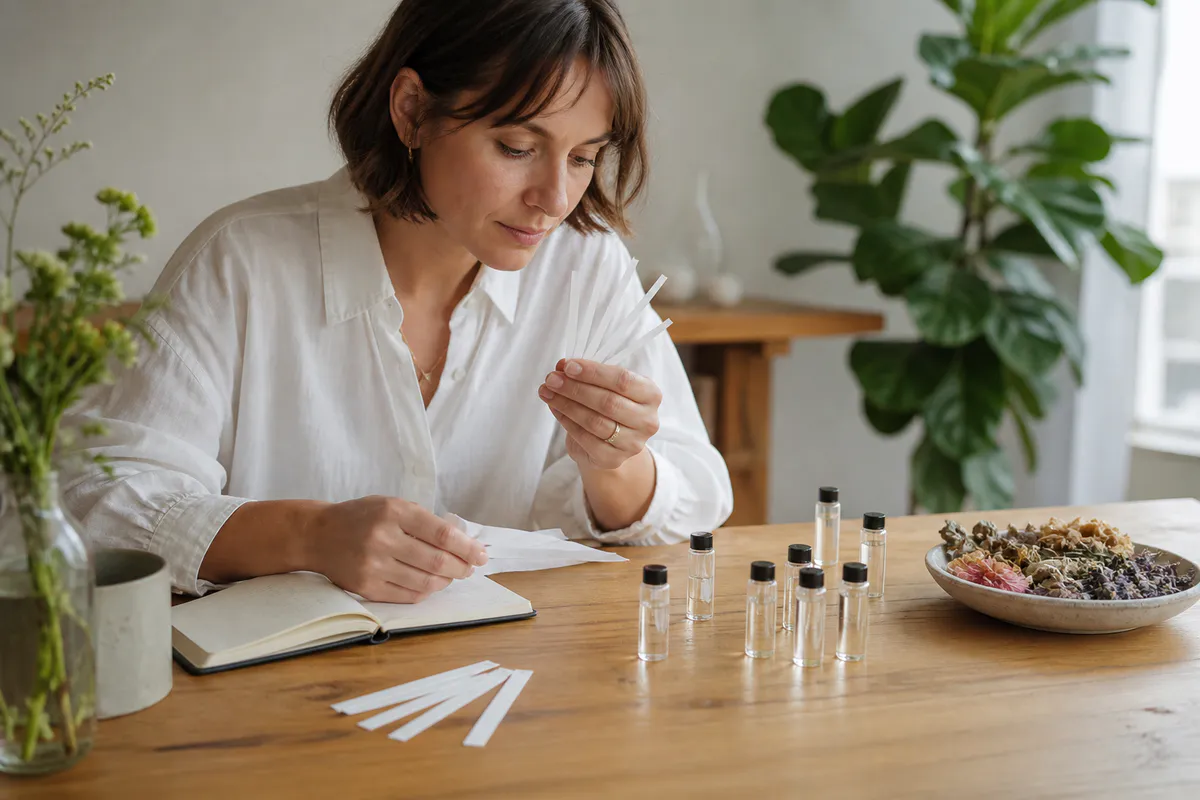
A paper blotter can separate initial candidates without putting several formulas on the body. Label each strip immediately, keep spacing between them and revisit after the volatile opening has changed. Do not wave many fresh strips together and expect distinct notes.
Blotter performance does not predict skin development, projection or comfort. Once a candidate is plausible and the ingredients are suitable for your circumstances, use a conservative skin test following the product directions. Stop for irritation rather than normalising discomfort.
Wear one candidate through an ordinary day
A shop opening can be attractive while the dry-down becomes tiring, too quiet or unsuitable for the setting. Test in the weather, clothing and routine where the fragrance would be used. Avoid a major event as the first full wear.
Record time applied, approximate amount, weather, activity, perceived changes and any skin response. Ask others only when their proximity is appropriate; compliments and dislike are subjective and do not measure safe exposure or objective quality.
Avoid sensory fatigue and false comparison
Testing many fragrances in succession makes distinctions harder. Space trials, ventilate and return to a neutral environment. Coffee beans are not a reset button for the olfactory system; time and reduced exposure are more dependable.
Use separate days for finalists and the same general application routine. Do not compare one fragrance on skin after exercise with another on paper in a shop. The point is not laboratory precision but removing obvious context differences from a personal decision.
Calculate sample value without pretending it is a bottle
Divide the delivered set price by total stated millilitres only after identifying every vial, but treat the result as context rather than a simple bargain score. Small-scale filling, presentation and discovery have value; the real return is avoided full-bottle waste.
A cheap set of irrelevant scents is poor value, while a focused set can be worthwhile even at a higher price per millilitre. Use realistic test wears and whether one sample changed the purchase decision. Packaging volume and sample count alone reward clutter.
Voucher terms can change the whole calculation
Record the voucher amount, expiry, redemption channel, eligible fragrances and sizes, minimum spend, account requirement and whether it combines with promotions. A voucher restricted to a large bottle is not equivalent to cash when a smaller size is appropriate.
Treat the set price and later bottle purchase as separate decisions. A short expiry can create pressure to redeem before testing is complete. If no candidate survives, letting the voucher lapse may cost less than buying an unwanted bottle to “recover” it.
Retailer samples and brand sets solve different risks
A brand set can compare a coherent range with clearer official identification. A retailer set can span brands and families, which may improve discovery but make voucher rules or sample sources more complex. Check the contracting seller and fulfilment route.
Our profiles of The Perfume Shop and The Fragrance Shop explain their distinct sampling, membership and return evidence. The direct specialist comparison keeps current service facts separate from permanent scent preference.
Return rights narrow after hygiene seals are broken
Read the live policy before opening. Cosmetic samples, personalised selections and sealed goods may have different change-of-mind conditions, while faulty, leaking, incorrect or misdescribed goods remain a separate issue. Preference is not automatically a fault.
Inspect the parcel, vial identity and damage first. Our UK cosmetics returns guide distinguishes voluntary policy, cancellation and remedies. Keep photographs, confirmation and packaging until any problem is resolved.
Storage protects a very small volume
Keep vials upright, tightly closed and away from heat, direct light, cars and humid windowsills. Small headspace and imperfect closures can make evaporation or leakage more noticeable. Transport in a protective pouch that does not crush the pump.
Record the opening date and use the set within the stated guidance. Our cosmetics expiry guide explains why period-after-opening, batch and visible change are different evidence. Do not combine remnants into an unlabelled vial.
A discovery set can be a better gift than a guessed bottle
For someone who enjoys choosing, an official set with clear identities and a flexible voucher can preserve agency. Confirm allergies, household sensitivities and whether the recipient wants fragrance before presenting it as universally safe or personal.
Avoid treating a voucher as generous when it requires a large additional spend. Include the receipt and conditions discreetly. If the recipient has named one exact fragrance, a broad set may be less thoughtful than the correct small bottle or an invitation to test together.
Reduce waste after the decision
Do not keep spraying rejected samples merely to finish them on skin that dislikes them. Ask whether a friend can safely use an identified sample, whether the retailer has a route, or dispose of it according to local guidance. Never pour concentrated fragrance into drains without checking.
Keep the finalist for travel or comparison only if it remains clearly labelled and stable. Avoid accumulating sets faster than they can be tested. Browse Beauty for related evidence-led guides rather than turning discovery into a collection target.
Move to a full bottle only after repeat evidence
Choose size from realistic frequency, existing bottles and storage life. A lower unit price on 100ml is not value when 30ml would be used comfortably. Recheck the exact concentration because the sample and bottle must match.
Compare current authorised sellers on the same day and calculate the delivered total. Preserve seals until identity and condition are checked. A successful discovery process ends with either a confident appropriate size or no purchase; both are valid outcomes.
Choose a discovery set or one targeted sample?
Several relevant candidates need repeated comparison
Every vial is identified, volume supports real wear, the set spans the right question and any voucher has workable conditions without forcing a bottle.
The uncertainty is narrow
You already know the brand, fragrance or family and only need to confirm one concentration, skin response or full-day dry-down before buying.
Balanced verdict
A useful discovery set buys better evidence, not merely more miniature objects. Prefer clearly identified samples that can be worn separately, price vouchers conservatively and treat no full-bottle purchase as a successful result when none survives.
For claim checking, use our beauty marketing guide; keep a dated record of seller, concentration, volume and voucher terms.
Official checks:
NHS contact dermatitis information ↗
GOV.UK Cosmetic Products Enforcement Regulations guidance ↗
Citizens Advice cancellation guidance ↗
Frequently asked questions
How large should a fragrance sample be?
It should contain enough for the number of separate wears needed to answer the question. Compare stated millilitres rather than assuming a spray count is standard.
Are dabber and spray samples equivalent?
No — Application and evaporation differ. A spray may approximate a retail atomiser more closely, but the exact pump and dose still vary.
Is a redeemable voucher the same as cash?
No — Expiry, eligible fragrances, bottle size, minimum spend and sales channel can restrict its practical value.
Can opened fragrance samples be returned?
Change-of-mind conditions can be restricted once seals are broken. Inspect first and read the live policy; faults, leakage and incorrect supply are separate.
How many fragrances should be tested in one day?
There is no universal number, but fewer, spaced tests are easier to interpret. Finalists are best worn separately on ordinary days.
Methodology and limitations
We assessed discovery sets through identity, concentration, vial design, usable test volume, skin and blotter method, sensory fatigue, unit cost, voucher conditions, seller, returns, storage, gifts and waste, supported by official UK health, cosmetics and consumer guidance. We did not smell or laboratory-test a set.
Limitations
Fragrance preference, skin response, projection and longevity are personal. Sets, vouchers, sellers, prices and returns change. Check the exact vial identities and live terms, and seek medical advice for significant reactions.