Foundation matching online: undertone, depth, finish and return limits
A convincing screen swatch is not a shade match. Narrow foundation by depth and undertone, then check finish, coverage, formula, photographs, sample options and the retailer’s hygiene policy before opening a full-size product.
In this guide
Match depth first, undertone second and formula third
Use a current shade you know, compare several swatch sources in neutral light and shortlist neighbouring depths rather than trusting one digital matcher. A correct colour can still look wrong if the finish, coverage or oxidation differs. Confirm sample availability and the return rules for sealed and opened cosmetics before paying.
This is a decision guide for cosmetic foundation, skin tint and tinted base bought online in the UK. It does not diagnose skin conditions, prescribe ingredients or promise that a formula will be tolerated. Ingredient sensitivities and persistent reactions need advice from an appropriate healthcare professional.
Start with the result, not the shade name
Write down where the base will be worn, how much coverage is useful, the preferred finish and how long it needs to remain comfortable. A light tint for daylight and a fuller base for flash photography create different shortlists even when the colour family is identical. Decide whether sunscreen, fragrance, alcohol, silicones or particular allergens affect the choice, but assess the complete ingredient list rather than labelling one ingredient automatically good or bad.
Shade names such as ivory, sand, honey and caramel are marketing labels, not shared measurements. The same name can represent different depths and undertones between ranges, or after a reformulation. Treat every range as a new chart. Our product-shortlisting method helps separate requirements from attractive extras before comparison begins.
| Decision | Evidence to use | Common mistake | Safer action |
|---|---|---|---|
| Depth | Jaw-to-neck swatches in neutral daylight | Matching the centre of the face or wrist | Compare adjacent shades after drying |
| Undertone | How colour sits beside neck and chest | Relying only on vein colour | Test neutral, warm and cool neighbours |
| Finish | Formula description and varied wear images | Assuming colour alone decides naturalness | Account for skin preparation and powder |
| Coverage | Sheer, medium or full with buildability evidence | Using a heavy layer to correct a poor match | Choose coverage for the real use case |
| Return risk | Exact retailer policy and seal condition | Assuming an opened cosmetic is returnable | Use a sample or preserve the seal |
Build a foundation evidence note
- Current product, exact shade and whether it still matches.
- Approximate depth and suspected undertone, with uncertainty recorded.
- Finish and coverage wanted in real lighting.
- Skin-preparation products normally worn underneath.
- Ingredient restrictions based on known experience or professional advice.
- Sample, mini or in-store swatch availability.
- Retailer’s sealed, opened, faulty and misdescribed return routes.
Separate shade depth from undertone
Depth describes how light or deep the colour appears. Undertone describes the more persistent colour direction beneath it, often grouped as warm, cool, neutral, olive or variations between them. These labels are not perfectly standardised. A range’s “neutral” may lean peach, yellow, red or olive when placed beside another range.
First find two or three plausible depths. Then compare undertones within those depths. If a shade appears grey or ashy, it may be too light, the undertone may conflict, or both. If it turns conspicuously orange, it may be too deep, too warm or changing as it dries. Do not correct every mismatch with bronzer or concealer; that adds cost and makes the base harder to repeat.
Match the transition between face and neck
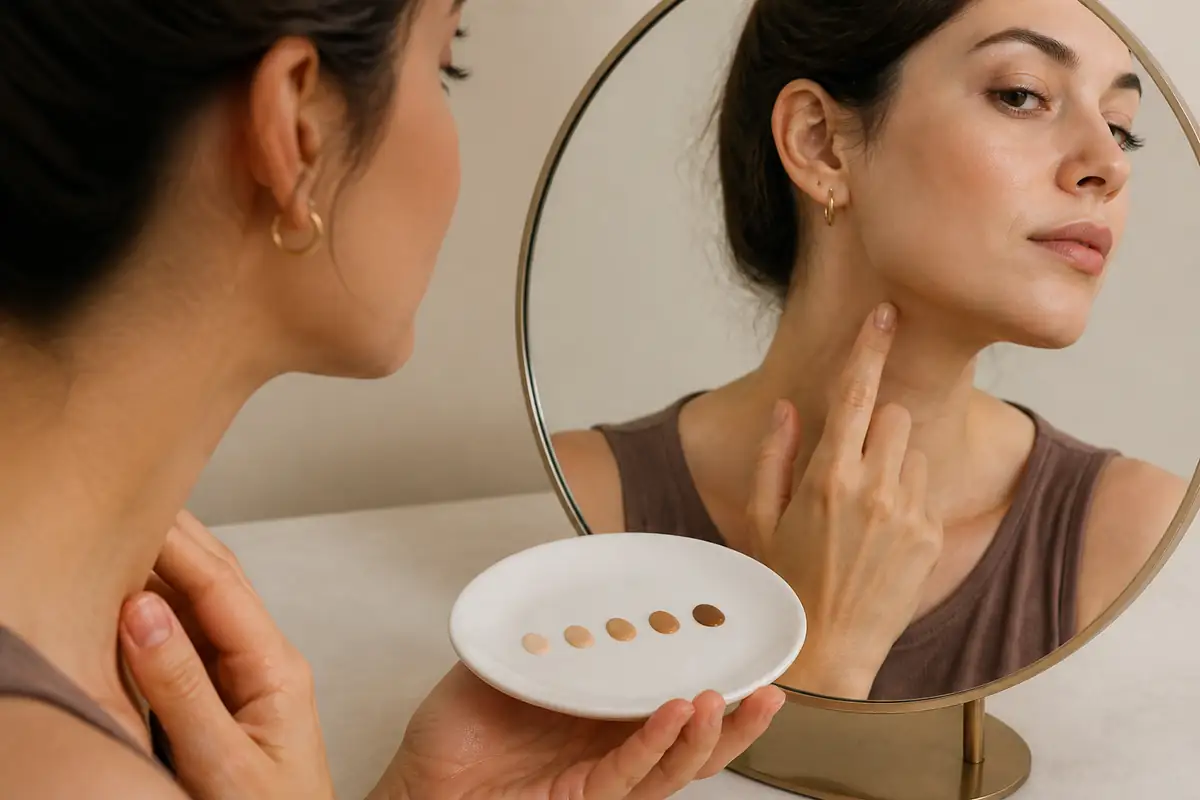
Faces can be redder, darker or lighter than necks because of sun exposure, irritation and skincare. The wrist is convenient but usually not the most useful destination colour. A small swatch along the jaw towards the neck shows whether the face can blend into surrounding skin without creating a mask-like boundary.
Consider the upper chest when it will be visible, but do not chase perfect uniformity across naturally different areas. The goal is a coherent transition. Compare bare skin and the dried swatch in indirect daylight; strong bathroom bulbs, direct sun and camera processing can all distort colour.
Use online photographs as a set, not proof
Look for swatches on several people, close-ups after application and photographs in more than one lighting condition. Brand photographs can help explain the intended range, while independent images may show different cameras, preparation and exposure. Neither proves how the formula will look on you. Screen calibration and brightness add another layer of uncertainty.
A digital shade finder is useful when it identifies its inputs and offers neighbouring options. It is weaker when it converts one selfie into a single confident answer without explaining lighting or camera assumptions. Our guide to research without hands-on testing explains how to combine incomplete sources without turning them into certainty.
Compare with a current reference shade carefully
A foundation that matches now is a valuable anchor. Record its brand, full product name, shade and how it behaves after drying. Cross-range comparison tools can suggest a starting point, but formulas differ in opacity, undertone, naming and colour change. Check whether either product has been reformulated since the comparison was submitted.
If the reference is slightly wrong, say how: too peach, too yellow, too deep, too pale or suitable only in summer. That directional information is often more useful than a bare shade code. Keep seasonal changes separate from assumptions about undertone.
Allow the swatch to dry before judging
Some formulas deepen or shift as volatile ingredients evaporate, pigments settle or the product interacts with skincare. Online users often call any change “oxidation”, although several processes may be involved. The practical response is the same: compare freshly applied and fully dried colour under the same light.
Use a normal application amount. An unusually thick swatch can exaggerate pigment and finish. If sampling in a shop, note the time and inspect again before committing. Do not use a shared tester directly on the face; follow the retailer’s hygiene procedure.
Finish and coverage can alter the perceived match
A luminous sheer tint allows more natural skin colour to show through; a matte full-coverage base creates a more opaque field. Powder, primer, moisturiser and application tool can change reflectance and apparent depth. A shade that looks acceptable when sheer may become obvious when built to full coverage.
Compare the formula you intend to wear, not just a swatch from another product in the same shade family. Check whether “buildable” means it layers evenly in the manufacturer’s instructions. If your routine already has several layers, assess compatibility and total finish rather than buying another corrective product automatically.
Read the complete product information
For cosmetics sold in Great Britain, official guidance says packaging should provide information including precautions, quantity, the Responsible Person, traceability details, durability information where applicable and ingredients. Online listings should let you identify the exact item you will receive. Missing or poorly translated information, an unclear purpose or no identifiable responsible business are reasons to stop.
Check the ingredient list on the current retailer and brand pages because formulas change. “Dermatologist tested”, “non-comedogenic”, “clean” and similar wording does not tell you the study design or guarantee individual tolerance. Our fragrance-free versus unscented guide shows why adjacent claims need their own evidence, while the broader genuine-shop checklist helps evaluate the seller as well as the bottle.
Plan a low-risk trial
A sealed sample, sachet, mini or store-made sample can reduce waste and cost if supplied hygienically and legally. Confirm whether the sample is the same formula and current shade. Test it according to the product instructions and avoid introducing several unfamiliar skincare or make-up products at once, which makes the cause of a problem difficult to identify.
Stop using a product if a concerning reaction occurs and seek appropriate advice when needed. A cosmetic review cannot predict personal tolerance. Check current product-safety alerts if the seller, labelling or formula raises concern.
Understand return limits before breaking a seal
UK distance-selling cancellation rights have exceptions. GOV.UK states that sealed goods unsuitable for return for health or hygiene reasons may be exempt once unsealed. Retailer goodwill policies differ: some accept lightly tested beauty products, while others require them unopened. Read the product-specific policy rather than relying on a general banner.
Personal change-of-mind restrictions do not remove rights where goods are faulty, not as described or not fit for their stated purpose. Keep the order confirmation, listing, batch details and photographs if there is a genuine fault or description problem. The returns-policy audit shows what to save before opening.
Inspect the delivery before use
Check that the shade, product name and size match the order. Look for leakage, a broken tamper feature, damaged pump, unusual separation contrary to instructions or missing mandatory information. Photograph damage before cleaning it up and contact the seller through a traceable channel.
Do not keep using a questionable item simply because the shade looks right. The UK cosmetics returns guide separates change-of-mind, hygiene and fault scenarios in more detail.
Buy the full size now when
- A current reference narrows depth and undertone convincingly.
- The exact formula, finish and coverage suit the use case.
- Ingredients and mandatory product information are clear.
- A sample or reliable dried swatch reduces uncertainty.
Sample or pause when
- Only one processed image supports the match.
- Shade-finder outputs conflict without explanation.
- The full-size item becomes non-returnable when opened.
- The seller, labelling or formula history is unclear.
Balanced verdict
Online foundation matching is controlled uncertainty, not a one-click colour calculation. The strongest shortlist combines a known reference, adjacent shade depths, undertone comparison, dried swatches, formula evidence and a realistic view of the return policy.
When those signals disagree, a sample or in-person swatch is usually better value than ordering several full-size bottles. A precise shade name cannot compensate for the wrong finish, unsuitable formula or an opened item that cannot be returned.
Check current official information:
GOV.UK consumer guidance on cosmeticsGOV.UK returns and refundsGOV.UK cosmetic safety alerts and recalls
Frequently asked questions
Should foundation match my face or neck?
Use the jaw-to-neck transition and consider the visible chest. The aim is a coherent blend, not forcing naturally different areas into one exact colour.
Can wrist veins identify undertone?
They are an unreliable shortcut on their own. Compare neighbouring undertones beside the neck and let the actual formula dry.
Why does foundation look darker later?
Drying, volatile ingredients, skincare interaction and pigment behaviour can change appearance. Compare fresh and dried swatches under the same neutral light.
Are online shade matchers accurate?
They can narrow options, especially from a known reference, but camera, lighting, screen and formula differences prevent a guaranteed match.
Can I return opened foundation in the UK?
It depends on the circumstances and policy. Hygiene-sealed goods may lose change-of-mind cancellation rights once opened, while faulty or misdescribed goods are a separate matter.
Is a sample always the same as the full-size product?
Confirm the exact formula, shade and batch context. Samples can reduce risk but old, unofficial or differently formulated samples are weak evidence.
How we researched this guide
Recommended Today reviewed current UK cosmetics, product-safety, distance-selling and refund guidance, then mapped an online shade decision across depth, undertone, finish, coverage, product information, sampling and return risk.
Limitations
We did not wear-test individual foundations or diagnose skin. Shade ranges, formulas, policies and availability change, and images vary by screen. Recheck the exact listing, ingredients and terms before purchase. The image is an editorial illustration, not a photograph from a product test.