Hair dryers explained: power, heat control, attachments and weight
A high wattage does not prove fast, gentle or even drying. Airflow design, heat range, controls, attachment geometry, balance and technique work together. Choose for hair length, density, texture, mobility and routine, then check cleaning and electrical-safety instructions.
In this guide
Prioritise controllable airflow and comfortable handling
Look for independently selectable heat and speed, a cool setting, a removable filter and the attachment needed for the actual styling method. Compare weight with the cord and nozzle fitted, and check where that weight sits in the hand. Use the lowest effective heat and keep air moving.
This guide explains ordinary domestic mains hair dryers. It does not assess salon duty cycles, medical scalp conditions or specialist accessibility needs. Manufacturer safety and care instructions always take priority over general technique.
Start with hair and routine, not motor language
Record hair length, density, strand texture, usual moisture level and the finish required. A quick rough dry for short hair has a different brief from controlled smoothing of long dense hair or diffuser drying of curls. Note how long the tool is normally held, which hand positions are comfortable and whether noise affects other people.
Decide whether the dryer must travel, hang, store in a shallow drawer or work with an existing brush routine. A lightweight compact tool may trade attachment security or acoustic comfort; a larger dryer may be better balanced despite a higher scale weight. Our shortlisting guide helps hold those priorities steady.
| Specification | Useful meaning | Common misread | Better check |
|---|---|---|---|
| Wattage | Electrical input rating | Guaranteed airflow or drying speed | Air performance and controls |
| Heat settings | Available control positions | Exact or stable temperatures | Independent heat/speed layout |
| Cool shot | Lower-heat airflow control | Instantly cold air in every condition | Button comfort and hold method |
| Ionic claim | Named technology or feature | Universal frizz result | Precise evidence and user need |
| Weight | Mass under stated conditions | Balance and wrist comfort | Weight with cord and attachment |
Questions worth answering before purchase
- Can heat and speed be changed independently?
- Can the controls be reached without accidental switching?
- Is the concentrator or diffuser the right size and depth?
- Does the attachment lock securely yet remove safely?
- Is the filter removable and easy to clean?
- What are the total weight, cord length and storage dimensions?
- Where is authorised repair or warranty support available?
Wattage is input, not a drying-speed score
Watts describe electrical power consumption at the rated supply, not directly how much air reaches the hair or how evenly heat is distributed. Motor efficiency, fan, duct shape, heater control, filter condition and nozzle alter the result. Two dryers with similar wattage can feel very different; a higher figure can also place more demand on a travel adaptor or circuit.
Look for measured airflow or drying claims only when the method and comparison are disclosed. Marketing terms such as professional, high-speed or salon performance are not standard tests. In a normal home, controllable output is more useful than a headline maximum that is too hot or forceful to use comfortably.
Heat and speed controls should be genuinely independent
Separate controls allow strong airflow with lower heat for rough drying and a more focused combination for styling. Count usable combinations, not button icons. Some dryers link heat to speed or remember settings; others require holding a cool button. Check whether controls sit where the fingers will knock them and whether indicators are readable without turning the hot outlet towards the face.
A cool setting may help finish a section, but it is not a repair for excessive heat exposure. Start by blotting rather than rubbing wet hair, divide dense hair into manageable sections and keep the dryer moving. Never block the intake or outlet.
Attachments change the airflow job
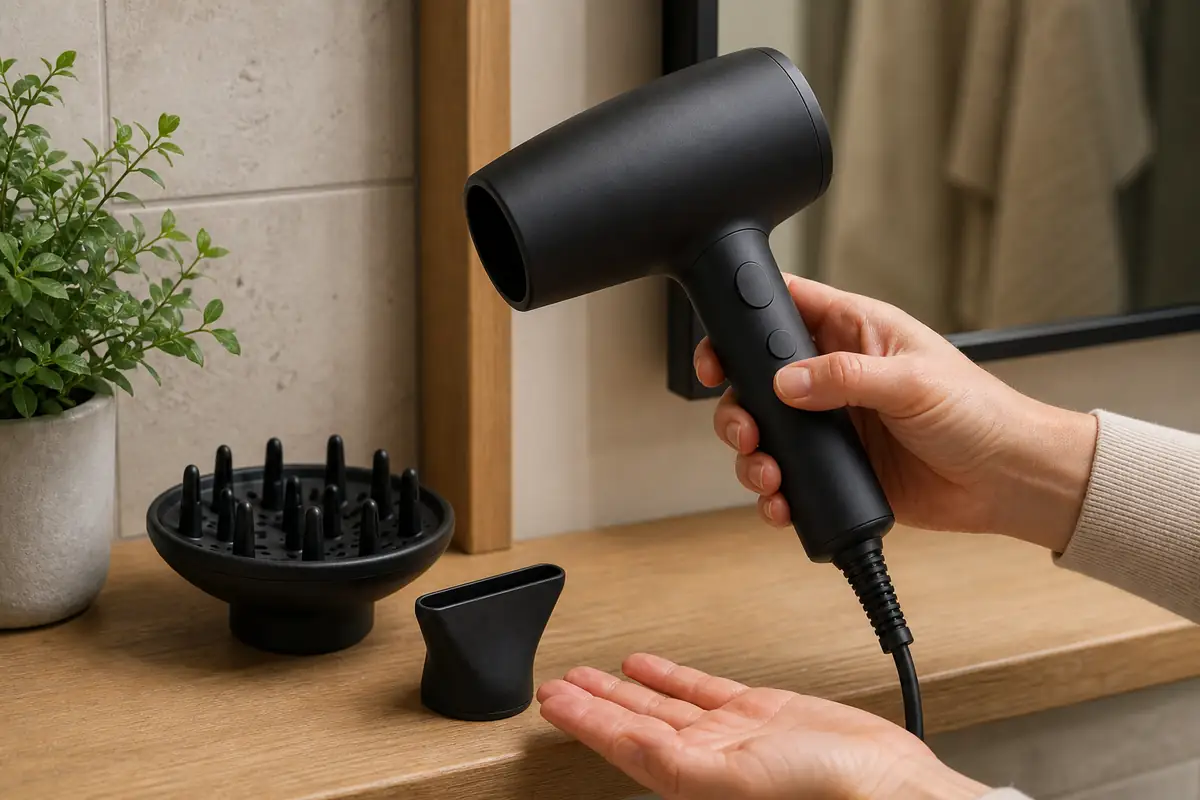
A concentrator narrows the air stream for directional drying with a brush. Compare aperture width, nozzle length, rotation and how securely it fits. An attachment that falls off when warm or becomes difficult to remove is a practical flaw. Keep the outlet far enough from hair and skin according to the instructions.
A diffuser spreads airflow and provides a bowl or prongs to support textured hair. Bowl diameter, depth, hole pattern and prong length matter more than the word diffuser. Check whether the complete section of hair can sit without being crushed. Universal attachments can alter airflow or fit poorly; use only accessories approved as compatible by the manufacturer.
Weight must be judged with leverage
A scale figure does not describe centre of gravity. Weight far from the grip creates more leverage at the wrist, while a balanced motor close to the hand may feel easier. Cord pull, attachment length, handle angle and button pressure also influence fatigue. If possible, hold the dryer in the positions used at the back and crown of the head.
Online, seek a declared weight and ask whether it includes cable and nozzle. Compare handle circumference and dimensions with a tool already comfortable. A folding handle can help storage but introduces a joint that must lock securely. People with limited grip or shoulder movement may value a stand, lighter hose-based design or professional accessibility advice.
Noise needs comparable evidence
Sound level depends on distance, room acoustics, speed and measurement weighting. A single decibel claim without method should not decide the purchase. Tone matters too: a high-pitched whine may feel more intrusive than a lower sound at a similar measured level. Customer comments can flag a pattern but are not controlled tests.
If noise is important, look for a named measurement condition and compare like with like. Shorter drying through suitable airflow can reduce total exposure, but maximum speed is not automatically the quickest for every hair type or technique.
Treat ion and coating claims cautiously
Ionic, ceramic, mineral and conditioning language can describe different components and test methods. Seek a clear explanation of what is present, whether the feature can be switched and which outcome was measured. Humidity, hair condition, products, brush and technique can dominate the visible result.
Do not interpret an ionic claim as a health treatment or damage guarantee. A balanced review should separate a plausible mechanism from evidence on the complete dryer. Our research-without-testing guide explains why undisclosed demonstrations and testimonials are weak proof.
Filter cleaning protects airflow
Lint, dust and hair at the intake restrict air and can increase heat or strain. Check whether the filter cover removes without tools, how often it should be cleaned and whether the manufacturer permits water. Unplug the dryer and let it cool before maintenance; never operate it with missing guards or a wet filter.
Inspect the cord, plug, strain relief, casing and attachments. Stop using the dryer if it is damaged, smells unusual, cuts out repeatedly or has been dropped into water. Do not wrap the cable tightly around a hot body. The electrical-safety checklist covers plugs, recalls and seller evidence.
Bathrooms require strict electrical care
Water and mains electricity are a dangerous combination. Follow the manufacturer’s location, storage and use restrictions, keep the appliance away from baths and basins, and unplug after use. A residual-current device adds protection but does not make unsafe positioning acceptable. Never use with wet hands or where the dryer can fall into water.
Buy from a traceable seller, check the UK plug and rating information, register the product where possible and search current safety alerts. A counterfeit or grey-market unit may lack dependable compliance and support. The genuine online shop guide helps assess the seller before an electrical purchase.
Include ownership and repair in value
Compare purchase price, electricity use in the real routine, filter access, attachment replacement, warranty length and authorised repair. A low-cost dryer can be adequate when controls and safety are clear; a premium one needs evidence that its handling, time or support benefits matter to the user. Avoid paying for a large attachment set when only one suits the technique. Use the total-cost-of-ownership guide to keep energy, parts and replacement separate from the shelf price.
Keep proof of purchase and model information. The warranty versus guarantee guide explains voluntary cover alongside consumer rights. Never attempt internal repair unless appropriately qualified and authorised.
Choose a simpler dryer when
- Independent controls cover the real routine.
- One secure attachment is enough.
- Low weight and easy cleaning matter most.
- Safety information and support are complete.
Consider a premium design when
- Verified balance materially reduces strain.
- A specialist attachment fits the technique.
- Comparable evidence supports an important claim.
- Repair and parts support improve ownership.
Balanced verdict
The best hair dryer is not the one with the largest wattage or longest technology list. It is the model that delivers controllable air through the right attachment while remaining comfortable to hold, easy to clean and safe in the intended room.
Technique and hair condition still influence results. Use the lowest effective heat, keep air moving and stop if the tool or scalp becomes uncomfortably hot.
Check current official information:
GOV.UK product safety guidanceUK product safety alerts and recallsElectrical Safety First hair dryer advice
Frequently asked questions
Does higher wattage dry hair faster?
Not necessarily. Airflow design, heat control, filter condition, hair and technique all influence drying time.
Do I need an ionic hair dryer?
Only if a clear, relevant claim has credible evidence. The label alone does not guarantee a result for every hair type.
What is a diffuser for?
It spreads airflow and can support textured sections. Bowl, prong and airflow design should match the technique.
Is a light dryer always easier to use?
No. Balance, handle, cord and attachment leverage can matter as much as total mass.
How often should the filter be cleaned?
Follow the exact manufacturer interval and method; inspect sooner if airflow falls or visible lint gathers.
Can I use a hair dryer in the bathroom?
Only in strict accordance with electrical-safety and manufacturer instructions, well away from water, and unplugged after use.
How we researched this guide
Recommended Today reviewed UK product-safety and electrical guidance, then compared common dryer specifications by airflow control, heat, attachments, balance, maintenance and ownership support.
Limitations
We did not measure airflow, temperature, sound, drying time or hair outcomes for individual products. Specifications and safety notices change. Recheck official instructions and recalls before purchase. The image is an editorial illustration, not a photograph from a product test.