Dinnerware sets practical guide: dishwashing, chips and storage
Dinnerware lasts through hundreds of small handling decisions. Match the maker’s care instructions, stop pieces knocking in the dishwasher, protect stacked rims and remove chipped or cracked crockery from food use.
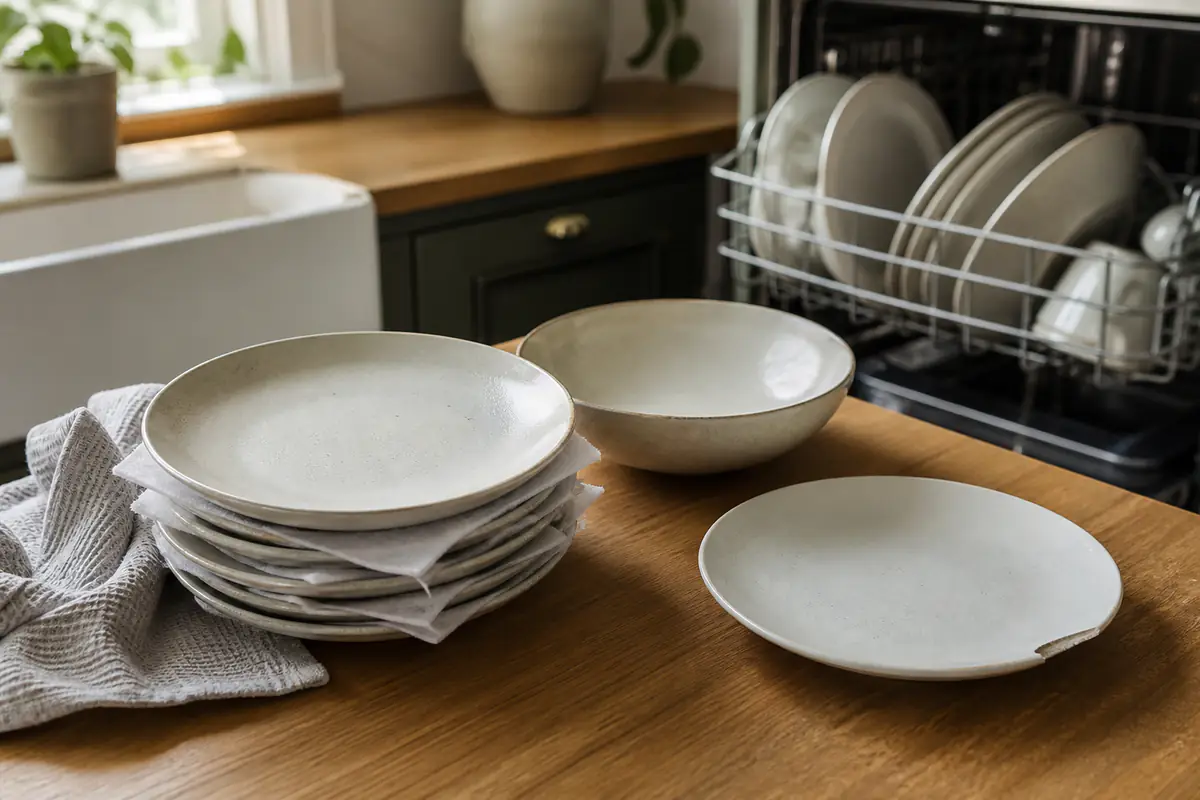
In this guide
Protect rims, glaze and food-contact surfaces
Load pieces without contact, use only permitted dishwasher settings, let hot ceramics cool before handling, separate vulnerable stacks and discard chipped or cracked crockery from food use. Choose useful pieces and materials first with our dinnerware buying guide.
Use the dinnerware value guide for replacement availability and lifetime cost. This guide covers the daily wash, stack, inspection and retirement routine.
| Observation | Likely handling question | Immediate action | Record |
|---|---|---|---|
| Fresh chip | Impact or existing weakness | Remove from food use | Rim and whole-piece photos |
| Glaze crazing | Thermal or material response | Pause food use | Care history and close-up |
| Dishwasher rub marks | Pieces touching or rack fit | Change supported loading | Positions and programme |
| Stack scratches | Base rings or trapped grit | Clean and separate | Affected pieces and pattern |
Keep a practical set record
- Material, range name and exact piece dimensions.
- Dishwasher, microwave, oven and freezer claims.
- Maker’s loading and temperature-change warnings.
- Normal stack height and cupboard clearance.
- Dishwasher rack positions and contact points.
- Chip, crack, crazing, staining and utensil-mark history.
- Replacement availability and purchase evidence.
- Retired, repurposed and recycled piece count.
Keep the care information after unpacking
Photograph base marks and retain the manufacturer’s dishwasher, microwave and thermal instructions. “Dishwasher safe” does not define every detergent, programme or rack position, and decorated pieces can differ from plain ones.
Record the range and colour because replacements can change. Remove retail stickers using a permitted method before food use, without scraping glaze.
Inspect rims and feet before the first wash
Run a visual check, not a finger along a sharp edge. Look for cracks, chips, rough foot rings, glaze gaps and pieces that rock. Photograph defects before washing changes return evidence.
A sharp or unstable new piece should not enter the rotation. Use a separate box and contact the seller with overall and close images.
Load the dishwasher so ceramics cannot knock
Place plates in supported slots with clearance, bowls at a draining angle and mugs where handles cannot hit another item. Do not force oversized dinner plates into a rack that contacts spray arms or seals.
Check our dimensions guide when buying replacements. Dishwasher capacity is limited by geometry as well as place-setting claims.
Keep dissimilar heavy items from fragile pieces
Pans, cutlery handles and thick stoneware can move against lighter ceramics. Follow the dishwasher manual and avoid a load where one item can strike another during spray or rack movement.
Secure small pieces only in supported locations. Never improvise clips or obstruct water paths unless the appliance maker permits it.
Choose programme and detergent from both instructions
Use a dishwasher programme permitted for the dinnerware and suitable for the soil. A harsher or hotter cycle is not automatically more hygienic if it exceeds decoration or glaze guidance.
Dose detergent according to its label and water conditions. Do not mix cleaning products or use abrasive hand treatment to remove a dishwasher mark without identifying it.
Avoid sudden temperature changes
Ceramic materials can respond to thermal shock. Do not move a cold piece directly into extreme heat or cool hot crockery abruptly unless the exact product explicitly supports the transition.
Oven-safe, microwave-safe and freezer-safe are separate claims. Read each boundary and remove any piece with damage.
Unload after heat and moisture are controlled
Allow the cycle and pieces to cool as the manual directs. Hot bowls can retain water in bases and handles, making them slippery. Empty pooled water away from food-contact surfaces.
Dry remaining moisture before stacking. A damp cupboard can create odour and surface problems even when ceramics themselves are non-absorbent.
Hand wash vulnerable decoration cautiously
For pieces excluded from the dishwasher, use the permitted water temperature, cloth or brush and detergent. Protect rims from the sink, tap and other dishes with a stable sequence rather than filling a crowded basin.
Do not use metal scourers or an abrasive paste on glaze unless authorised. Stop if colour, metallic decoration or surface changes.
Separate stacks where base rings rub glaze
A rough foot ring can scratch the plate below during lift and rotation. Clean grit from both surfaces and use food-safe clean separators for valuable or soft-glazed sets.
Limit stack height so the bottom piece and shelf are not overloaded. Lift pieces rather than sliding them sideways.
Store by frequency and handling reach
Put daily plates at a stable accessible height and heavy serving pieces where they can be lifted with two hands. Avoid tall stacks above shoulder height or at the front of shallow shelves.
Measure shelf depth, door clearance and usable hand space. A set that technically fits but cannot be safely removed is a poor household match.
Distinguish utensil marks from glaze damage
Grey marks can be material transferred from cutlery rather than scratches, while true cracks or glaze loss need a different response. Use only the maker’s permitted cleaning method and inspect under neutral light.
Do not polish aggressively to prove the difference. Preserve a repeatable photograph and compare an unaffected piece from the same set.
Retire chipped or cracked crockery from food use
Food Standards Agency guidance advises discarding chipped or cracked crockery because bacteria can grow in cracks. Do not sand, glue or glaze a damaged eating surface for continued food contact.
Handle sharp pieces safely and keep children away. Check local material-recycling rules rather than placing ceramics in glass recycling by assumption.
Document premature failure as a pattern
Record purchase date, batch clues, care method and exact damage position across pieces. One dropped plate differs from several rims chipping under supported dishwasher use.
Use the fault photography guide and keep the original listing evidence. State observations without claiming a manufacturing cause.
Replace selectively before changing the whole set
Check individual-piece availability, dimensions and colour variation. A later production run may not match perfectly but can preserve a functional rotation.
Calculate the useful place settings rather than buying display pieces again. The value guide and total-cost method help compare selective replacement with a new compatible set.
Manage staining without damaging the glaze
Identify whether colour sits on the surface, in an unglazed foot ring or beneath damaged glaze. Use only a cleaner and contact time allowed by the maker, and rinse as directed. Never mix bleach, acids or another cleaning chemical.
Persistent staining can be cosmetic, while a rough, cracked or crazed food-contact surface raises a different question. Photograph the dry piece in neutral light before and after a permitted attempt so repeated abrasion is avoided.
Plan serving and microwave handling separately
A plate that fits the dishwasher may not rotate freely in a microwave, and a bowl safe for reheating may become hot from its contents. Follow the exact microwave claim, avoid metallic decoration unless expressly permitted and use suitable hand protection.
Do not heat an empty piece or use dinnerware under a grill unless the maker specifically allows it. Check temperature before passing a dish to a child or vulnerable person.
Keep special-occasion pieces from becoming unknown stock
Inspect stored sets before an event rather than discovering chips while serving. Wash off cupboard dust by the permitted method and count sound pieces before planning place settings.
Wrap and box only when completely dry, with dividers that do not transfer dye or shed grit. Label the private storage box with the range and count so replacements and retired pieces remain traceable.
Make mixed sets safe and usable rather than perfectly matched
When exact replacements disappear, compare diameter, depth, foot ring, weight, stack shape and dishwasher fit before adding a compatible plain piece. A close colour is less important than stable storage and practical portion use.
Test one replacement through the normal handling and care routine before buying several. Keep materially different care instructions with the set so a household member does not apply the most robust piece’s limits to every plate.
Review the set after a breakage event
After a shelf failure or dropped stack, isolate the area, wear appropriate footwear and collect fragments without bare hands. Inspect nearby pieces for hairline cracks and chips under good light before returning them to service.
Clean the shelf and floor so small shards cannot transfer to textiles or food areas. Record the failed support or handling cause and correct it before rebuilding the same heavy stack.
Keep or retire a marked piece?
The surface is intact and care-compatible
The observation is removable transferred material, with no chip, crack, crazing or food-contact damage.
Food-contact integrity is compromised
A chip, crack, sharp rim, crazing or unstable body makes safe cleaning and use uncertain.
Balanced verdict
Dinnerware durability is a wash, handling and storage system. Keep pieces apart in the dishwasher, avoid unsupported thermal change, protect stacked glaze and remove chipped or cracked crockery from food use.
Use the linked buying, value, dimensions, photography and purchase-evidence guides.
Official checks:
Food Standards Agency crockery safety advice ↗
GOV.UK product labelling law ↗
GOV.UK consumer product-safety guidance ↗
Frequently asked questions
Can chipped dinnerware still be used?
Food Standards Agency guidance advises discarding chipped or cracked crockery from food use.
Does dishwasher safe mean any programme?
No — Follow the exact dinnerware and dishwasher instructions, including temperature, detergent and rack-position limits.
How do I prevent plates scratching in a stack?
Clean base rings and glaze, lift rather than slide, keep stacks manageable and use suitable clean separators where needed.
Are grey cutlery marks cracks?
Not necessarily — They can be transferred metal, but use only a permitted cleaning method and inspect for actual glaze damage.
Can cracked crockery be glued for food use?
Do not rely on a home repair for a damaged food-contact piece. Retire it and follow appropriate local disposal guidance.
Methodology and limitations
We assessed dinnerware ownership through care information, dishwasher geometry, programme choice, thermal change, hand washing, stacking, glaze inspection, chips, fault evidence and replacement. Current FSA and GOV.UK sources were checked on 2 September 2026. We did not test a named set.
Limitations
Materials, glazes, decorations, dishwashers, detergents and local recycling rules differ. Follow exact manufacturer directions. This is not ceramics engineering or specialist food-contact testing advice.