How to choose knitwear that will keep its shape
Shape retention is not determined by fibre content alone. Yarn twist, knit density, structure, garment weight, ribbing, seams, fit and care decide whether shoulders, cuffs, hem and elbows recover after wear.
In this guide
Test recovery and construction before judging softness
Gently stretch a permitted area of body knit and rib, then watch whether it returns promptly without rippling. Inspect shoulder and side seams, compare panel symmetry and choose enough ease to avoid constant strain. Dense, balanced knitting and stable finishing can matter more than a prestigious fibre name.
This guide focuses on jumpers, cardigans and knitted tops for ordinary wear. It does not predict exact lifespan or replace the care label. Deliberately relaxed, draped or open-knit garments may change shape by design; assess them against their intended silhouette.
Translate “keeps its shape” into specific zones
Decide which failures matter: bagged elbows, stretched cuffs, wavy hem, dropped shoulders, growing body length, twisted side seams or a neckline that no longer lies flat. Photograph or measure a favourite garment that fits. That reference reveals desired body width, sleeve length, armhole depth and rib length more reliably than a generic size.
Use the specification comparison method to record garment measurements and the care-label guide to reject items whose maintenance is unrealistic. Shape retention is a use-and-care system, not a promise visible in one catalogue image.
| Construction clue | What to inspect | Possible strength | Remaining risk |
|---|---|---|---|
| Dense plain knit | Even loops and low show-through | Stable body and abrasion resistance | Weight may encourage length growth |
| Rib structure | Elastic return and attachment | Recovery at cuffs and hem | Weak yarn or loose tension can flare |
| Fully fashioned shaping | Orderly increases and decreases | Controlled panel shape | Execution still varies |
| Cut-and-sew seam | Secure overlock and no dropped loops | Efficient stable assembly | Bulk, fraying or twisting if poor |
| Blended yarn | Percentages and intended benefit | Potential recovery or durability | Blend alone proves nothing |
In-store recovery and symmetry check
- Lay or hold the garment square without pulling it straight.
- Compare left and right sleeves, shoulders and side lengths.
- Check whether side seams hang vertically.
- Stretch a small body area gently and release.
- Repeat on cuff and hem ribbing.
- Look for waves, ladders, dropped loops and loose ends.
- Confirm the garment returns to its original outline.
Fibre influences behaviour but does not decide it
Wool fibres can offer useful natural elasticity; cotton can feel substantial yet grow under weight; viscose can drape and may distort when wet; synthetics can add strength and recovery but vary widely. Blends combine properties according to percentage, fibre form, yarn and construction. No rule such as “natural loses shape” or “synthetic always bounces back” survives every garment.
Read exact percentages and component labels. Compare the article on cotton, viscose and polyester by garment for use-specific trade-offs, and the cashmere quality guide for why a luxury fibre name cannot prove recovery.
Yarn twist and ply support the knit architecture
Yarn with adequate cohesion can resist abrasion and hold loops more consistently. Low-twist or heavily brushed yarn may feel soft but release fibre and lose definition. Multiple plies can balance yarn and add strength, but very fine plies may still create a light fabric. Retail pages often omit twist, so inspect stitch clarity, shedding and surface fuzz rather than inventing a specification.
Novelty yarns, bouclé and fluffy finishes intentionally obscure stitch structure. They can be attractive, but make dropped stitches and early abrasion harder to see. Price them for that maintenance risk. Do not pull fibres or perform damaging tests on a product you may return.
Density and garment weight must be balanced
A dense knit can resist snagging and hold form, yet a long heavy cardigan may stretch vertically under its own weight, especially on a hanger. A very loose knit can distort at elbows and seams. Hold a single layer against light, compare evenness across the body and inspect whether weight is supported at shoulders and front bands.
Gauge describes stitch scale, not quality by itself. Fine-gauge knitwear can be stable when tightly and evenly made; chunky knitwear can be loose and vulnerable or robust and balanced. Match density to silhouette and likely friction under coats, bags and desk edges.
Seams, shoulders and necklines carry structural load
Check whether shoulder seams sit where intended and whether any tape or stabilisation is smooth. Fully fashioned panels show planned shaping; cut-and-sew panels should trap loops securely and hang without twisting. Underarm joins need enough flexibility for reach without open holes or hard knots.
Neck ribbing should recover after gentle stretch and lie flat without ripples. Heavy collars and hoods add load. Cardigan button bands should match in length and tension so fronts do not wave. Decorative dropped shoulders can be stable, but excess garment width can concentrate rubbing and make cuffs work harder.
Fit determines how much stress the knit receives
Too-tight knitwear is repeatedly stretched across bust, back, elbows and forearms; very oversized heavy knitwear pulls at shoulders and length. Try the intended base layer, raise arms, sit and bend elbows. Look for strain lines, transparent stretched loops and a hem that rides rather than returning.
Measure garment rather than relying on S, M or L. Online, compare width, length, sleeve and shoulder to a known knit and note whether measurements are relaxed. Our shortlisting guide helps reject listings that provide no usable dimensions or care information.
Care and drying can preserve or destroy recovery
Water, heat, agitation and gravity affect fibres differently. Follow the exact wash temperature, cycle and drying instruction. Support wet knitwear; do not lift it from one shoulder. When flat drying is specified, reshape to measured dimensions on a ventilated surface and turn as needed. A tumble-dry prohibition is not optional.
Fold heavy knitwear and avoid crowded hanging that creates shoulder peaks. Rest garments between wears so fibres and ribbing can recover. Remove pills gently and repair small holes before loops run. Clean before long storage and monitor for moth activity where animal fibres are present.
Judge value by stable wears
Price per wear is only helpful when a garment remains wearable. Include cleaning, de-pilling and repair, then estimate frequency from colour, neckline, warmth and dress code. Use the cost-per-wear framework without promising a number of years.
A slightly firmer, less immediately soft jumper can outperform a plush one that grows or pills rapidly. Conversely, a delicate open knit can be good value when worn intentionally and cared for. There is no universal durability winner; there is alignment between structure and use.
Use arrival-day measurements as a future reference
Before wearing, lay the garment flat without stretching and record chest width, body length, sleeve length and hem width in the same positions used by the retailer. Photograph overall shape, ribbing and seams in neutral light. This record helps distinguish normal relaxation from substantial dimensional change and supports a clear care routine.
Repeat after the first permitted wash only when the garment is fully dry and rested. A small difference can come from measurement placement; use the same surface and landmarks. If change is severe despite following instructions, stop repeatedly reshaping and document the issue before seeking the appropriate retailer remedy.
Separate pilling, felting and growth
Pilling is fibre tangling on the surface, felting is fibre entanglement and shrinkage under moisture, heat and movement, while growth is dimensional extension. They require different prevention and cannot all be fixed with a comb. Diagnose only at the garment level: check the care history, fibre, affected zone and whether loops or seams changed.
Repeated abrasion at a desk or bag strap may pill an otherwise stable jumper. A hot wash can compact animal fibre while a heavy wet viscose knit can lengthen. The remedy is not automatically “buy better”; it is to match material and construction to real treatment.
Prioritise resilient structure when
- The garment will be worn weekly.
- Elbows, cuffs and bag areas face friction.
- Easy recovery and cleaning matter.
- Dense balanced knit suits the silhouette.
Accept deliberate delicacy when
- Open texture or drape is the main purpose.
- Wear will be occasional and controlled.
- Storage and specialist care are realistic.
- The price reflects maintenance and repair risk.
Balanced verdict
Shape retention comes from balanced material, yarn, knit, seams, fit and care. No fibre percentage can guarantee it. Test gentle recovery, inspect symmetry and load-bearing areas, and reject a garment that already needs pulling into shape.
For frequent wear, choose the simplest construction that returns cleanly and can be maintained. Softness and drape are benefits only when the garment still fits after the first weeks of real use.
Check current official information:
GOV.UK textile labellingGOV.UK product labelling and claim accuracyGOV.UK consumer rights and advice routes
Frequently asked questions
Which fibre keeps its shape best?
No fibre wins alone. Yarn, knit structure, garment weight, fit and care are equally important.
Is dense knitwear always more durable?
It can resist snagging, but heavy garments may grow and density does not fix weak yarn or seams.
Should I hang knitted jumpers?
Follow the garment guidance; folding is usually safer for heavy knitwear that can stretch on hangers.
Does elastane guarantee recovery?
No. Percentage, placement, heat exposure, yarn and construction affect how a garment recovers.
Can stretched knitwear be restored?
Careful washing and reshaping may help some fibres, but heat or severe distortion can be irreversible.
Why do side seams twist?
Panel cutting, knitting, yarn torque, finishing and laundering can contribute. Inspect alignment before buying.
How we researched this guide
Recommended Today reviewed current UK textile-labelling and product-claim guidance and compared fibre, yarn, density, structure, seams, fit, care and value evidence.
Limitations
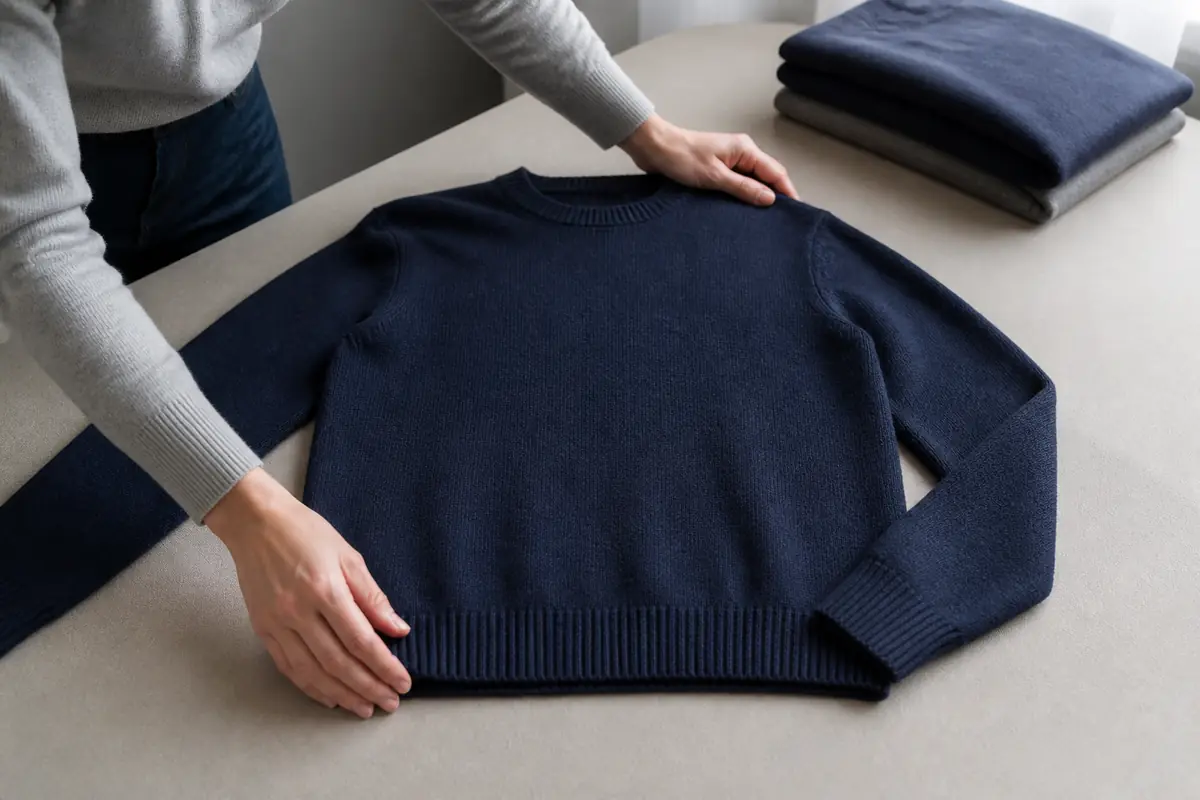
We did not laboratory-test recovery, wash garments or predict lifespan. Knit constructions and care responses vary. Recheck exact composition and care before purchase. The image is an editorial illustration, not a photograph from a product test.