Cotton, viscose or polyester: which fabric suits which garment?
A fibre name does not tell you how a garment will behave. Match fibre composition with fabric weight, knit or weave, construction and care, then test the property that matters for that specific item.
Choose by garment job, not a natural-versus-synthetic slogan
Cotton is often useful for absorbent, washable everyday layers; viscose can provide fluid drape; polyester can offer quick drying, recovery and durability. None is automatically cool, opaque, sustainable, crease-resistant or high quality. A heavy cotton sweatshirt and a fine cotton voile share a fibre but not a function. Treat the percentage label as one input, then inspect structure, density, lining, seams and care.
This guide separates a practical garment-use question from our broader fabric-composition guide. It does not award a universal winner or repeat environmental claims that cannot be verified for the exact product.
Start with the garment’s real job
Write down three requirements before browsing: how the item should hang, how much stretch or recovery it needs, and how it must be washed and dried. A work blouse may need drape and low transparency. A summer T-shirt may prioritise soft absorbency and repeat washing. Travel trousers may need crease recovery and quick drying. “Breathable” alone is too vague to resolve those different jobs.
Then check fibre percentages. UK textile labels should show fibre content, including different components where applicable. A shell and lining can have separate compositions. Read the actual listing and sewn-in label rather than assuming from a product title; the clothing product-page guide covers missing measurements and vague material descriptions.
Five tests worth doing before keeping a garment
- Hold it in normal and back light to judge opacity where it matters.
- Scrunch a discreet area for several seconds and watch crease recovery.
- Move, sit and raise your arms to test drape and cling.
- Check whether cuffs, knees and elbows recover after stretching.
- Read the complete care label and confirm you can dry it as instructed.
Compare likely strengths by garment type
| Garment job | Cotton often suits | Viscose often suits | Polyester often suits |
|---|---|---|---|
| Everyday T-shirt | Soft absorbent jersey; may crease or lose shape | Fluid soft hand; wet care and recovery vary | Quick drying and recovery; odour and feel vary |
| Blouse or dress | Crisper shape in poplin or voile | Fluid drape and movement | Drape with crease resistance, depending on weave |
| Sports or travel layer | Comfortable dry feel but slower to dry when saturated | Soft but not automatically robust under friction | Often quick drying with engineered stretch or wicking |
| Trousers or skirt | Structure in twill; knees may relax | Drape; seams and wet care need scrutiny | Recovery and abrasion resistance; static or shine may occur |
| Knitwear blend | Softness and absorbency | Drape and smooth handle | Shape retention and quicker drying |
“Often” is deliberate. Fibre processing, yarn, density, finish and garment construction can reverse an expectation. Compare the exact items, not just the cells in a general table.
Cotton: useful absorbency, variable structure
Cotton can absorb moisture and feel comfortable against skin, which helps explain its use in T-shirts, shirts, underwear and casual knitwear. Yet moisture held in the fabric can make a saturated cotton garment slow to dry. A fine open knit behaves differently from dense interlock; a brushed sweatshirt behaves differently again.
Pure cotton is not automatically durable or shrink-proof. Yarn quality, fabric density, seam construction, finishing and laundering matter. Some cotton jerseys relax at the neck or knees, while woven cotton can crease sharply. Check whether the item is pre-shrunk only when the maker states it, and still follow the care label. Our first-wear clothing-care guide helps preserve both condition evidence and return options.
Viscose: drape without a universal care profile
Viscose is a manufactured cellulosic fibre often selected for fluid drape and a smooth or soft hand. It can work well in blouses, dresses, skirts and loose trousers where movement matters. But fibre name alone cannot guarantee breathability, opacity or strength. A dense viscose twill and a light viscose challis are different purchases.
Some viscose fabrics can be vulnerable when wet, distort if hung heavily, shrink under unsuitable washing or develop seam strain in a close-fitting garment. The exact care label is decisive. Inspect high-load areas around armholes, side seams, seat and zip. If the listing says dry clean or very mild wash, budget for that reality rather than hoping a normal cycle will be fine.
Polyester: quick drying and recovery, with trade-offs
Polyester can dry quickly, resist creasing and recover shape, which can be valuable for travel clothing, pleats, activewear and frequently washed uniforms. Engineers can alter yarn shape, knit and finish to manage moisture, so one polyester fabric cannot represent all polyester. A coarse cheap lining and a well-designed technical knit may have little in common beyond polymer family.
Potential drawbacks include static, heat retention, shine, pilling or retained odour, depending on fabric and use. Test against skin and under likely layers. A “moisture-wicking” claim should be supported for the product rather than inferred from fibre. Avoid broad environmental conclusions from a recycled percentage alone; the UK CMA expects clear, specific and evidenced fashion claims.
Blends are design choices, not diluted purity
A cotton-polyester blend may combine absorbent handle with quicker drying and improved recovery. A viscose-polyester blend may keep drape while adding stability. Elastane can supply stretch but may complicate heat exposure and end-of-life separation. The value depends on percentages and construction, not whether one fibre is “pure”.
Check the composition of shell, lining, rib, pocketing and trims where provided. A polyester lining can change how a cotton or viscose dress feels in warm weather. A small elastane percentage may transform fit. Use our fabric weight, opacity and drape guide to judge the visible structure that a percentage cannot describe.
Match the fibre to the cut and stress points
Fluid viscose can suit a bias or gathered dress but expose poor seam allowance. Crisp cotton can support a shirt collar but feel bulky in a gathered sleeve. Polyester recovery can support narrow travel trousers, but a dense weave may feel warmer than expected. Inspect whether the cut exploits the fabric rather than fighting it.
At the fitting stage, sit for several minutes, bend the knee and elbow, then check bagging. Look for seam grin where stitches become visible under tension. Check whether a pale fabric turns transparent when stretched. Our clothing-quality guide covers stitching, pattern matching, reinforcement and finishing.
Care cost can outweigh purchase price
Translate symbols into your actual laundry setup. GINETEX notes that the number in a wash tub is the maximum temperature, while bars indicate milder mechanical action. A hand-wash or very-mild-cycle garment is not suitable for every routine. If it cannot be tumble dried, confirm you have space and time to dry it flat or hanging as directed.
Repeated professional cleaning can change cost per wear. A quick-drying polyester item may save time but need odour-focused washing. A cotton garment may tolerate robust washing but take longer to dry. A viscose garment may require reshaping. The care-label guide turns the symbols into a keep-or-return decision.
Use a garment-specific shortlist
- Name the garment job and three non-negotiable properties.
- Check exact fibre percentages for shell and lining.
- Compare weight, weave or knit and opacity.
- Test drape, recovery and stress points while trying on.
- Translate the care label into time, equipment and cost.
- Reject vague claims that replace measurable composition.
- Keep only the item whose complete design serves the job.
Our shortlisting method helps prevent a promotion or attractive colour from overriding a failed practical requirement.
The garment is an everyday skin-contact layer
A suitable cotton construction can be comfortable and familiar, provided shape, drying and care fit your routine.
The cut depends on movement or low creasing
Viscose or polyester may serve better, but inspect density, seams, lining and care rather than choosing by fibre alone.
Balanced verdict
Cotton, viscose and polyester each solve different garment problems, and each can be poorly executed. Cotton often supports washable comfort and structure, viscose fluid drape, and polyester quick drying and recovery. Weight, construction and care determine whether those tendencies appear in the finished item.
Choose the garment first, then the fibre. A well-constructed blend that survives your routine is better value than a theoretically “ideal” fibre in the wrong weight, cut or care regime.
Check current official information:
GOV.UK textile labellingGOV.UK product labelling lawGINETEX care symbolsCMA fashion environmental-claims guidance
Frequently asked questions
Is cotton always more breathable than polyester?
No. Air permeability and moisture behaviour depend on yarn, knit or weave, density and finish. Compare the exact fabrics and intended activity.
Does viscose always shrink?
No universal outcome applies. Some products are designed for washable care and others are not. Follow the exact label and allow for any maker-stated dimensional change.
Is polyester bad for summer?
Not automatically. A light open or engineered polyester can dry quickly, while a dense fabric may feel warm. Test the specific garment and lining.
Are blends lower quality?
No. A blend can deliberately add recovery, stretch, softness or drying speed. Quality depends on design, percentages, construction and performance.
Which fibre is best for travel?
Polyester-rich fabrics often dry and recover quickly, but comfort and odour behaviour vary. A blended or lightweight cotton garment may work if drying facilities are reliable.
Can I trust an “eco fabric” name?
Look for exact fibre percentages, the scope of the claim and supporting evidence. Ambiguous green language should not replace composition and care information.
How we researched this guide
Recommended Today reviewed current GOV.UK textile-labelling rules, CMA guidance for environmental claims in fashion and GINETEX care-symbol explanations. We compared fibre tendencies only as part of a garment system including structure, construction, fit and care.
Limitations
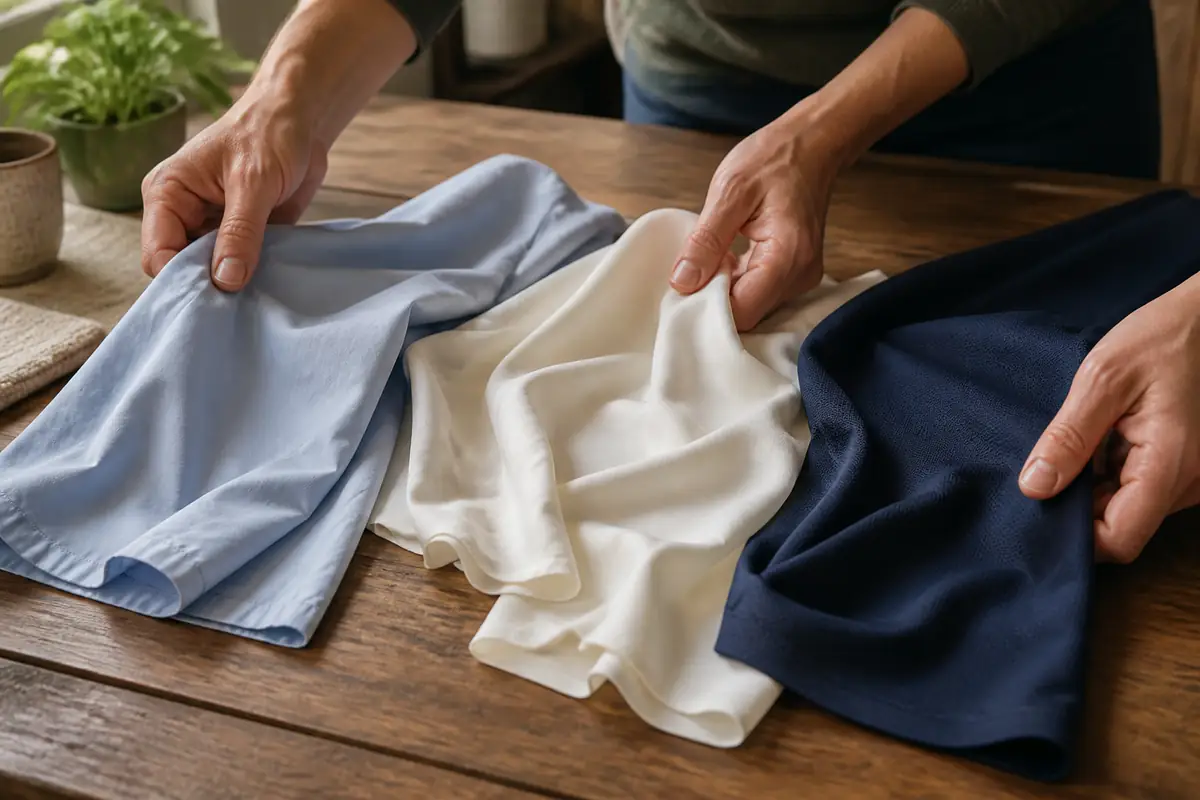
We did not laboratory-test fabrics or inspect a specific garment. Fibre performance varies with yarn, manufacture, dyes and finishes; recheck exact labels on purchase and publication day. The original featured image shows three generic unbranded fabrics with no label, logo, price or copied design. Links are editorial and non-affiliate.