How to buy jeans online in the UK: measurements, rise, fit and returns
The labelled waist is only one part of a jeans fit. A reliable online comparison uses a pair you already like, the exact product measurements, the rise, seat and thigh shape, the denim composition and the return route.
In this guide
Measure a good pair flat and compare the complete silhouette, not only the size number
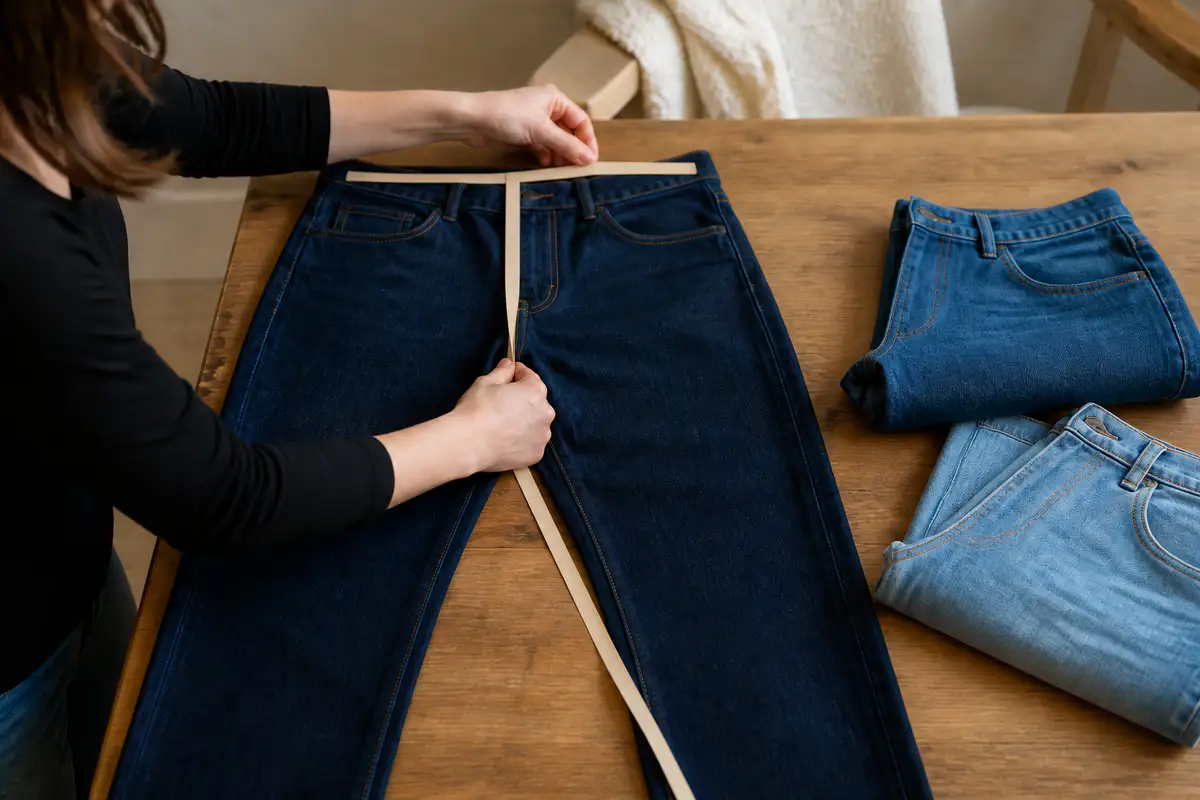
Record waistband, front and back rise, hip or seat, thigh, inside leg and hem opening from jeans that fit the way you want. Compare them with the exact retailer chart and product notes, allowing for rigid or stretch denim. Order unaltered where possible, keep tags attached and test the fit indoors before the change-of-mind deadline.
This is a measurement and decision guide, not a wear test. We reviewed current Levi’s and Uniqlo UK sizing guidance and general UK online consumer information. We did not order, wear, wash or measure a retailer’s jeans.
The measurements that predict jeans fit
| Measurement | How to take it on jeans laid flat | What it changes |
|---|---|---|
| Waistband | Fasten the jeans, align front and back waistband without stretching, measure straight across and double | Whether the waist closes and how much it gaps; it does not describe seat or thigh room |
| Front rise | Measure from the crotch seam to the top of the front waistband | Where the waistband sits and how the front feels when sitting |
| Back rise | Measure from the same crotch point to the top of the back waistband | Seat coverage and how readily the waistband pulls down |
| Hip or seat | Measure across the widest appropriate point, following the retailer’s diagram, then double | Room through seat and upper hip |
| Thigh | Measure across the leg just below the crotch, then double if the chart uses circumference | Mobility and whether a straight or relaxed cut actually feels relaxed |
| Inside leg | Measure the seam from crotch junction to finished hem | Finished length and whether alteration is needed |
| Hem opening | Measure straight across one leg opening and double for circumference | How the leg sits over footwear and whether the cut reads slim, straight, bootcut or wide |
Use the method shown by the retailer when supplied, because charts may define points differently. Levi’s official guide measures a good pair laid flat, while Uniqlo distinguishes body measurements from garment dimensions. Record both the method and result. Our UK clothing size-chart guide explains why two numbers obtained by different methods cannot be compared safely.
Start with jeans you already understand
Choose a reference pair that fits today and has the silhouette you want from the new order. Do not use a stretched-out favourite without noting how its waistband changed, and do not compare a rigid high-rise jean with a soft stretch low-rise pair as though measurements alone make them equivalent. Wash and dry the reference according to its normal routine before measuring if laundering noticeably changes it.
Lay the garment on a hard flat surface. Smooth wrinkles without pulling the fabric. Take each measurement twice, then photograph or sketch where the tape sat. A one-centimetre shift at the crotch can change the apparent rise or thigh. Store the numbers with the brand, style, labelled size, fibre composition and whether the pair was freshly washed or worn in.
Body measurements are still useful for choosing the starting chart size. Measure the natural waist, fullest seat and upper thigh over light clothing without pulling the tape tight. However, body numbers do not tell you the ease built into a particular cut. Garment-to-garment comparison is often the clearer second step.
Rise changes more than waistband height
Low, mid and high rise are relative descriptions, not universal centimetre bands. A high-rise style from one range can match the measured rise of another retailer’s mid-rise. The relationship between front and back rise also affects coverage, while the curved waistband and yoke influence gaping.
When sitting, a rise that is too short may pull at the crotch and drag the waistband down. A rise that is too long can fold or feel loose through the front. Check product photos only as supporting evidence: model height, selected size, pose and styling change the impression. Exact garment dimensions, where available, are stronger evidence.
Seat shape matters at the same time. If a waistband fits but the seat is tight, sizing up may create a larger waist without solving the curve. A different cut, contoured waistband or more generous back rise may work better. This is why the quality check in our clothing construction guide includes yoke, waistband and seam alignment rather than focusing on denim thickness.
Rigid versus stretch denim
Traditional rigid denim is usually cotton without elastane. It can feel firm at first, soften with wear and relax in high-stress areas, but the exact weave, weight and finishing determine behaviour. Stretch denim adds an elastic fibre or uses a stretch construction. It may feel easier immediately, yet recovery quality determines whether knees and seat return to shape.
Read every fibre percentage on the exact colour. Retailers sometimes vary composition between washes within a style family. A small elastane percentage can materially change feel, but it does not reveal fabric weight or recovery. Polyester or other fibres may be added for strength, softness or stretch systems. Use our fabric-composition explainer without assuming that natural is always durable or synthetic is always inferior.
| Fabric clue | Likely buying implication | Question to ask |
|---|---|---|
| 100% cotton rigid denim | Less immediate give; fit and rise must work before relying on break-in | Does the retailer report shrinkage or advise sizing based on wear? |
| Cotton with elastane | More movement, but recovery and heat-sensitive care matter | Does the fabric spring back after a gentle indoor bend and sit? |
| Lightweight soft denim | Comfortable drape but may outline pockets or wear differently | Is the intended silhouette fluid rather than structured? |
| Heavy or raw-style denim | Stiffer feel, possible colour transfer and specialist care | Are care and dye-transfer warnings compatible with your routine? |
Decode cut names with measurements
Slim, straight, relaxed, barrel, mom, bootcut and wide-leg describe an intention, not a shared specification. Compare thigh, knee and hem widths. A straight leg can be narrow or roomy; a barrel leg adds curve through the outer leg; a bootcut widens below the knee. Product photos should show front, side and back on a model whose height and worn size are stated, but the numbers decide whether that shape translates to you.
Check pocket placement, too. Small high back pockets and a deep yoke create a different visual balance from broad low pockets. On arrival, inspect the fly, belt loops, pocket corners, inseam and hem using our construction checklist. Uneven topstitching is not always structural failure, but loose stitches, broken bar tacks or a twisting leg deserve attention before tags are removed.
Length, hemming and footwear
Measure inside leg with the footwear and break you intend. Cropped jeans, wide legs and flares each need a different finished relationship to the shoe. Compare the inside leg, total outside length and rise: two jeans with the same inseam can finish differently because the rise changes where the crotch sits.
Do not request irreversible alteration on an unfamiliar cut unless every key dimension is proven. Uniqlo’s current online service, for example, shortens selected trousers but treats altered items as non-returnable for ordinary change of mind. Our Uniqlo UK profile explains the service and why first-time buyers should establish waist, seat and thigh fit first.
Online returns: protect the decision window
Before ordering, read the retailer’s current return period, postal or store route, fees, exclusions and condition rules. Online consumers often have a statutory cancellation route for eligible goods, but exceptions and procedural requirements apply; a retailer’s voluntary longer policy may offer additional flexibility. Faulty or misdescribed goods are different from a simple fit change.
When the parcel arrives, record the date and inspect indoors on a clean surface. Keep tags attached. Try the jeans with normal underwear and intended shoes, then stand, sit, bend and walk briefly without wearing them outside. Look for waist pressure or gaping, front pulling, seat drag lines, thigh restriction, pocket opening and hem position. Do not wash, alter or remove hygienic or return labels until you keep them.
Save the product page, selected size and colour, chart, order confirmation and return receipt using our purchase-documentation guide. The faulty-goods guide explains the separate route if stitching, zip or description is defective. Compare M&S service details in our Marks & Spencer fashion profile.
The measurements and material agree
Reference-jean dimensions, rise, thigh, inseam and fabric behaviour align, with a usable return route if the prediction is wrong.
The listing asks you to guess
A waist label is the only measurement, the rise is unclear, composition varies by colour or alteration would remove returns.
Jeans-order checklist
- Measure one good pair twice and record the exact measuring points.
- Take current body measurements without forcing the tape tight.
- Compare rise, seat and thigh, not just waistband and inside leg.
- Read the exact colour’s composition and care instructions.
- Check model height, worn size and cut as supporting evidence.
- Buy unaltered when fit is uncertain and preserve the return route.
- Test indoors with tags attached before washing or hemming.
Balanced verdict
Buying jeans online is manageable when the listing provides enough evidence and you compare against a known garment. The most predictive shortlist combines waistband, rise, seat, thigh, inseam, hem and fabric, then retains a practical return route. No single size label or “true to size” vote can replace that work.
A well-fitting pair can deliver excellent cost per wear, but only if the care routine and fabric recovery suit real use. Read our care-label guide before the first wash.
Check current official information:
Levi’s UK: how to measure jeansLevi’s UK size chartUniqlo UK: choosing a sizeGOV.UK consumer protection rights
Once you have a reference measurement record, our jeans shortlist worksheet compares listing evidence, uncertainty and total buying cost. It is the next decision step, not a second measurement tutorial.
Frequently asked questions
Should I size up in jeans?
Not by rule. Compare the exact waistband, rise, seat and thigh measurements plus fabric stretch. Sizing up can solve one tight point while creating a loose waist or excessive rise.
How do I measure the waist of jeans?
Fasten and lay them flat, align the waistband without stretching, measure straight across and double. Follow the retailer’s diagram if its method differs.
What does jeans rise mean?
Front rise is the distance from the crotch seam to the front waistband; back rise measures to the rear waistband. Together they affect waistband position, seat coverage and comfort.
Are stretch jeans better than rigid jeans?
They solve different needs. Stretch can improve immediate movement; rigid denim offers a firmer structure. Quality, recovery, cut and care matter more than declaring one universally better.
Can I return jeans after trying them on?
Eligible online jeans can normally be tried on indoors with reasonable care under the applicable return route, but terms, deadlines and exclusions vary. Keep tags attached and do not wash, alter or wear them outside.
How we researched this guide
The garment-measurement method is the main purpose of this guide. The linked Uniqlo UK size guidance was rechecked on 29 September 2026, including its distinction between body and product dimensions; the supporting Levi’s references remain available for its own brand methods. We did not order, measure or wear-test retail jeans. Listing comparison and after-delivery care are handled in separate guides.
Limitations
Retailer measuring methods, compositions, cuts, stock and return terms change. Denim also relaxes and launders differently. Confirm the exact product chart, care label and current return policy.