Waterproof overtrousers buying guide: seam construction, side zips, fit and packability
Waterproof overtrousers work only when they can be put on quickly, move over the trousers beneath and keep rain out at seams, waist and cuffs without creating an unmanageable sweat problem.
In this guide
Prioritise whole-garment protection and usable access
Choose the lightest pair that fits the real layers, exposure and footwear while preserving movement. Check test scope, sealed seams, zip length, cuff closure, seat and knee articulation, ventilation, pack size and care together.
Start with the waterproof-jacket explainer, compare breathable alternatives in the softshell guide, and use the outdoor-retailer comparison only after the clothing requirement is fixed.
| Design | Useful when | Check | Trade-off |
|---|---|---|---|
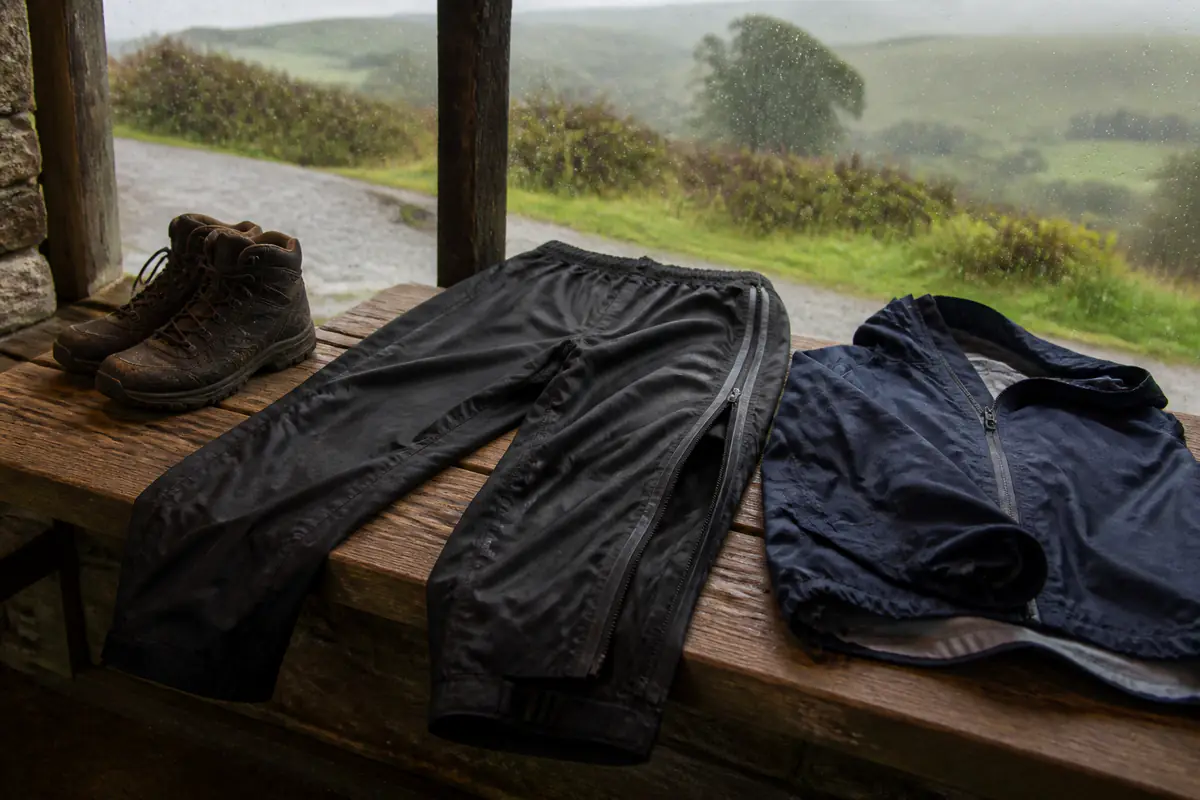
| Full side zips | Boot-on changes and ventilation | Flaps, sliders and closures | Weight and leak complexity |
| Short ankle zips | Occasional easy access | Opening over footwear | Limited ventilation |
| Pull-on | Low weight and simplicity | Boot clearance and waist | Harder roadside change |
| Reinforced seat/knee | Frequent kneeling or abrasion | Panel, seams and stiffness | Bulk and pack size |
Evidence to save before ordering
- Activity, duration and exposure.
- Fabric and whole-garment claim scope.
- Seam sealing and zip protection.
- Body and owned-trouser measurements.
- Boot opening and side-zip length.
- Movement, seat and knee articulation.
- Pack dimensions and measured weight.
- Check the waterproof overtrousers’ washing, drying and reproofing requirements before committing to regular use.
Define the rain problem
Decide whether the garment is for emergency showers, sustained hill rain, cycling, work, travel or spectator use. Duration, wind, exertion and abrasion change the balance between protection, ventilation and weight.
Record the trousers and footwear worn underneath. A pair that fits over thin walking trousers may bind over winter layers, while excessive volume can flap, snag and move the knee articulation away from the body.
Do not confuse the fabric with the finished garment
A hydrostatic-head or waterproof figure may describe a fabric test. Finished performance also depends on seams, zips, waist, cuffs, pocket openings, wear and maintenance.
Use the online quality checklist and seek the exact test method and claim scope. “Water-resistant” and “water-repellent” do not automatically mean suitable for prolonged rain.
Inspect seam construction
Look for seam taping or sealing across the seat, crotch, knee panels and zip attachments. More seams can improve shaping but also create more potential water paths.
Product photographs can show placement, not the integrity of every seal. On arrival inspect tape alignment and lifting without pulling, heating or flooding the garment.
Choose side-zip length by the change routine
Full-length zips allow boot-on changes and can vent, but add sliders, flaps, weight and failure points. Ankle or calf zips are simpler when footwear passes easily.
Rehearse the real change indoors with wet-weather footwear and balance. A zip that works on a table can be difficult beside a path when fabric catches or the opening is too narrow.
Check zip protection and operation
Confirm whether zips are covered, water-resistant or backed and how the top and ankle secure. A resistant zip is not necessarily waterproof under pressure.
Operate sliders gently through the full path and inspect snag points. Two-way or separating designs can aid access but should not be bought without understanding how they align and lock.
Measure over the intended base trousers
Take waist, hip, rise and inside-leg measurements while wearing the thickest realistic base trousers. Compare with the exact chart and any finished-garment dimensions.
Use the clothing size-chart guide. Nominal size alone cannot establish ease, and shortening can disturb ankle closures or articulated knees.
Test stride, seat and knee movement
Walk stairs, step high, squat gently and sit with the layers beneath. Check crotch pull, waistband security, knee position, hem lift and whether fabric restricts a cycling or climbing movement.
Do not choose extreme looseness as a cure for poor articulation. Excess fabric can rub, catch and pump water through openings while making the garment noisy.
Coordinate jacket and trouser coverage
The jacket hem should overlap the waistband during reach and bend. Check whether rain can run behind a low waist and whether braces, elastic or drawcord stay secure under a pack.
Try both garments together. Individually good pieces can leave a gap, bunch at the waist or place two bulky drawcords beneath the same belt.
Fit cuffs over the exact footwear
Confirm the opening clears boot size and shape and then closes without dragging. A hook-and-loop tab, snap or elastic must keep the hem from catching while avoiding pressure on the footwear.
Long hems can channel water away but create a trip risk. Short hems expose trouser fabric. Use actual stance and stride rather than relying only on model height.
Balance breathability and ventilation
Moisture inside may be sweat, condensation or leakage. Fabric transfer depends on temperature, humidity and exertion, while side zips can exchange air only where the design and weather permit.
A laboratory breathability number cannot promise dry comfort. Adjust layers and pace, and choose safe ventilation rather than opening a direct rain path in exposed conditions.
Judge reinforcement for the activity
Seat, knee and ankle reinforcement can help around rock, mud, work or repeated kneeling, but adds stiffness, drying time and pack volume. Match it to actual abrasion.
Do not assume thicker means longer-lived. Seam position, fit and friction matter, and unnecessary panels may make a lightweight emergency garment unpleasant enough to leave at home.
Compare weight and packability honestly
Use measured product weight and packed dimensions where available, including the bag if it will be carried. A very light pair has no value if access is slow or durability unsuitable.
Pack and unpack during the return window without compressing beyond instructions. Check whether the wet garment can be isolated from dry kit after use.
Plan care and reproofing
Read the exact wash, dry and water-repellent treatment instructions before purchase. Soil and inappropriate conditioner can impair performance, while some finishes require product-specific maintenance.
Decode symbols with the care-label guide. A wetting outer face is not by itself proof that a membrane leaks, but damage, delamination or failed seams need separate assessment.
Preserve returns and fault evidence
Try fit and access indoors, keep labels and avoid mud until the decision is made. Record the product code, order and the exact claim relied on.
For faults distinguish visible damage, seam failure and unsuitable fit. Use the returns guide and do not conduct destructive home waterproof tests.
Calculate value through carried use
Estimate how often the pair will be carried and worn, then compare protection, access, pack burden and care. Do not invent lifespan to justify a premium.
Apply cost per wear as a behaviour check. A slightly heavier pair used reliably can beat an ultralight pair that is too awkward to put on.
Run an arrival rehearsal
With clean boots and base trousers, time a calm boot-on change, fasten every closure, walk stairs and pack the garment again. Inspect overlap with the jacket and access under a rucksack belt.
This cannot prove storm protection, but it can reject the wrong opening, length, articulation or pack shape while the garment remains returnable.
Repeat the change while wearing ordinary outdoor gloves if that reflects the trip. Small zip pulls, hidden snaps and tight ankle openings can become much harder when hands are cold or balance is limited. Do not rehearse on a wet or unstable surface; the aim is to discover interface problems safely, not imitate the hazard.
Create a packing decision as well as a wearing decision. Note where the clean dry garment will sit, how a wet pair will be isolated and whether the supplied pouch can be operated without rolling grit into the fabric. If a pair is consistently left behind because the pack routine fails, a lighter claim has not created practical value.
Finally, compare the rejected pair with the waterproof trousers already owned, borrowed or repairable. Replacement is justified only when the new garment solves a documented access, fit, protection or packability failure. A discount, lower listed weight or newer membrane name is not itself a missing function.
Full side zips or simpler pull-on design?
Fast boot-on access matters
The closures are protected, manageable and worth the added weight and maintenance.
Low weight and fewer openings lead
The garment still passes easily over footwear and ventilation needs are modest.
Balanced verdict
Waterproof overtrousers are a system of fabric, seams, openings and fit. Choose by exposure and change routine, then verify articulation, jacket overlap, cuffs, ventilation, packing and care.
The linked waterproof and softshell guides clarify where each garment belongs.
Official checks:
GOV.UK product safety advice ↗
GOV.UK product labelling law ↗
GOV.UK textile labelling guidance ↗
CMA Green Claims Code ↗
Frequently asked questions
Are waterproof overtrousers fully waterproof?
Only the exact whole-garment evidence can support that claim; fabric, seams, zips, openings, fit, wear and care all matter.
Do I need full-length side zips?
They help boot-on changes and ventilation but add weight and openings. Rehearse the real change routine before deciding.
Should I size up?
Use measurements over the intended base trousers and the exact chart. Extra size can misplace articulation and create unsafe excess fabric.
Can I wear them instead of ordinary trousers?
Some designs allow it, but many are cut as shells. Follow the exact intended use, comfort and care information.
How do I test them without losing return rights?
Check fit, closures, movement and layering carefully indoors; do not soil, flood or damage the garment.
Methodology and limitations
We assessed waterproof overtrousers through exposure, whole-garment claims, seams, side zips, fit, articulation, jacket overlap, cuffs, ventilation, reinforcement, packability, care, returns and value. Official UK product and textile guidance was reviewed on 1 September 2026. We did not wear-test or laboratory-test a garment.
Limitations
Weather, exertion, body shape and layering vary, and test methods are not always comparable. Verify the exact current product and seek competent outdoor advice for hazardous conditions.