Portable electric heater ownership guide: placement, controls, meter checks and safe use
A portable heater is not a background appliance. Safe ownership depends on clear space, a suitable socket, active supervision, understood controls and a room plan that does not turn fabric, cables or exits into hazards.
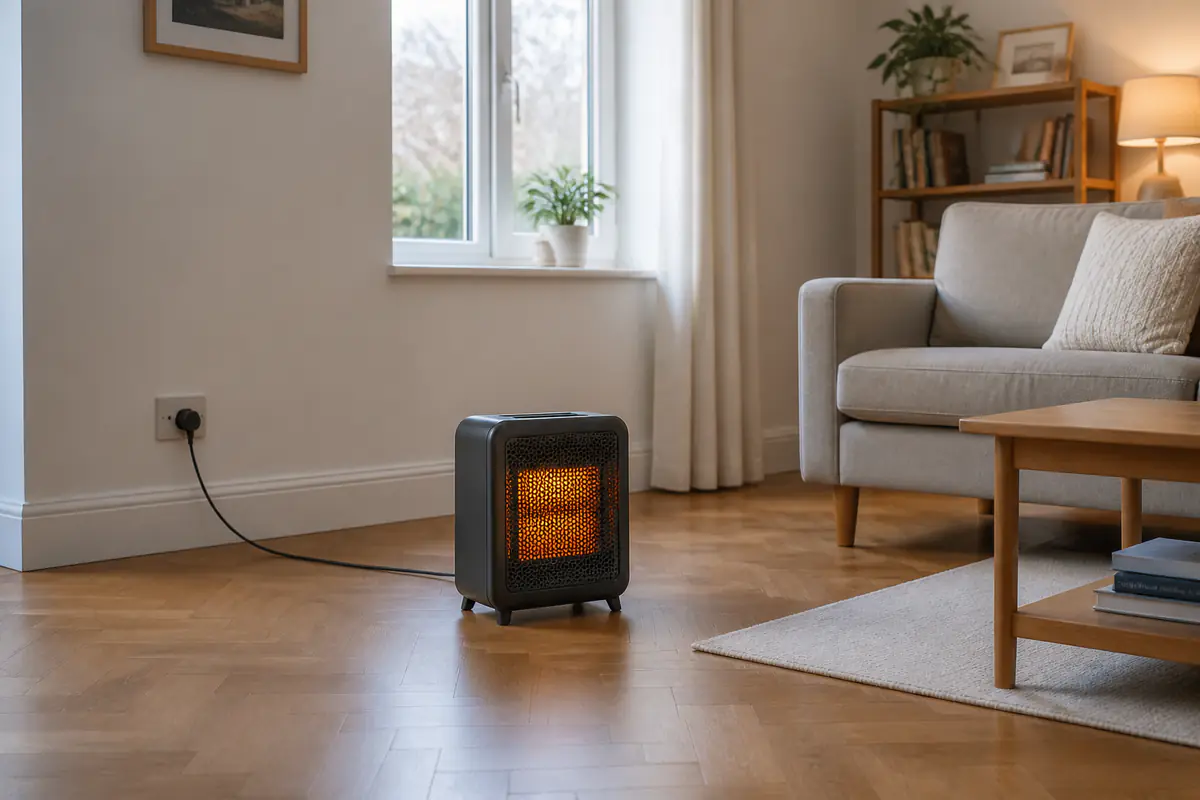
In this guide
Treat placement and supervision as core specifications
Use the exact manufacturer instructions, keep combustible items clear and stop when the room or user cannot support active supervision. Check the appliance, plug, socket, cable route, tip-over and overheat controls, room heat loss and measured use without bypassing any safety feature.
Choose the appliance type first with the portable-heater buying guide. Then check the genuine-shop guide and the faulty-goods guide if identity, recall or condition creates concern.
| Situation | Check first | Safer response | Do not do |
|---|---|---|---|
| Cold occupied room | Heat loss and clear placement | Short supervised heating plan | Dry clothes on heater |
| Damaged plug or cable | Stop and isolate safely | Competent inspection or remedy | Tape and continue |
| Extension lead required | Socket and manufacturer advice | Change location or seek advice | Assume any lead is suitable |
| Night-time warmth | Heating and bedding plan | Use appropriate fixed system/advice | Sleep with heater running |
Pre-use room check
- Exact model and instructions.
- Recall status and rating label.
- Plug, cable and case condition.
- Direct suitable wall socket.
- Clear stable placement.
- Curtains, bedding, clothes and furniture distance.
- Child, pet and mobility risks.
- Exit route and supervision plan.
Start with the exact instructions
Identify the model, rated power, permitted orientation, clearance, room restrictions and control behaviour. Generic advice cannot override product-specific warnings.
If instructions are missing, obtain the official version from the manufacturer before use. Do not infer safe operation from a visually similar heater or a marketplace description.
Check recalls before the next cold spell
Search the exact model and retain its rating-label photograph. A family name can cover several versions, so match model, batch and date information carefully.
Use the official recall service rather than a social post. If the product is affected or identity is uncertain, stop using it and follow the stated remedy route.
Inspect without dismantling
Before each period of use, look for cracked casing, loose guards, discolouration, damaged cable, bent plug pins, unusual dust build-up or evidence of overheating.
Do not open, bridge or repair electrical parts unless competent and authorised. A cosmetic-looking mark near a plug or vent can warrant stopping and seeking qualified advice.
Use a suitable wall socket
Follow the manufacturer’s connection instructions. High-power heating loads can expose weak contacts and unsuitable extensions; a plug fitting into an adaptor does not prove the arrangement is safe.
Stop for a hot plug, smell, buzzing, arcing, repeated tripping or visible damage. Switch off safely and seek a competent electrician or the seller’s remedy rather than changing the fuse spec or retrying.
Route the cable as part of placement
Keep the cable uncoiled where required, visible, undamaged and away from the hot outlet, walking path and door pinch points. Do not hide it under a rug or furniture.
A location that needs a cable across an exit is not a viable heater location. Reposition the activity or use an appropriate fixed heating solution.
Create real clearance from combustible material
Keep bedding, curtains, clothes, paper and furniture well away according to the instructions and fire-service guidance. Account for curtains moving and blankets falling, not just the tidy starting photograph.
Never dry clothes over or immediately beside the heater. Water, restricted airflow and fabric contact can create electrical, overheating and fire risks.
Use a stable position that cannot become an obstacle
Place the heater on the surface and orientation specified, away from traffic, uneven rugs and locations where a person or pet could knock it. Preserve the exit route.
People with limited mobility may face additional trip or contact risk. Consider a secured or fixed alternative and seek a home fire-safety assessment where appropriate.
Understand tip-over and overheat protection
Protection features can reduce some risks but are not permission for poor placement or unattended use. Confirm how the indicators and reset procedure work in the official instructions.
Never hold down a switch, defeat a cut-out or restart repeatedly after unexplained shutdown. The stop may indicate blocked airflow, unstable position or a fault needing investigation.
Set controls for the occupied zone
Thermostats often sense temperature near the heater, not evenly across the room. Use a separate room thermometer as context without modifying the appliance.
Aim for comfortable occupied use, not a maximum dial position. Cycling, room size, draughts and insulation determine actual consumption and comfort.
Measure cost from power and time
For a simple resistance heater, maximum input power and operating time provide an upper-bound calculation; thermostat cycling can lower actual use. Record kilowatts, hours and the current unit rate.
Do not claim that one resistance heater is inherently cheaper per unit of heat solely because its shape differs. Control, placement, cycling and the heated zone often explain practical cost differences.
Use plug-in meters only when suitable
A meter must be correctly rated and used according to its own instructions and the heater manufacturer’s advice. It adds another connection and is not essential for every calculation.
Do not insert an unknown smart plug, timer or meter simply to collect data. Compatibility, load rating and heat build-up matter more than app convenience.
Reduce room heat loss safely
Close appropriate doors, address obvious draughts and heat only occupied space where safe. Keep required ventilation and never block a heater inlet or outlet.
Curtains can reduce window loss but must remain safely away from the appliance. The curtain ownership guide helps separate fabric care from heater clearance.
Keep children, pets and vulnerable users in the plan
Supervision must account for touching, climbing, tails, toys and mobility aids. A guard or cut-out does not remove these interactions.
If continuous close supervision is unrealistic, choose another heating arrangement. Do not leave a portable heater with an unattended child, pet or person unable to respond to a fault.
Never use it as overnight background heat
Fire-service guidance says portable heaters should be turned off before bed. Build a separate night-time warmth plan using appropriate bedding and a suitable maintained heating system.
A timer that switches the heater off later still creates an unattended interval. Do not place the appliance near the bed, blankets or curtains.
Clean only when cold and disconnected
Follow the exact cleaning method. Switch off, unplug safely and allow full cooling before removing external dust with permitted tools. Keep liquids away from electrical openings.
Do not push objects into guards, use compressed air where prohibited or remove covers casually. Blocked airflow and hidden damage require competent attention.
Record faults and remedy safely
For unusual noise, smell, repeated cut-out or damage, stop use and save model, order, date, photographs and a plain description. Do not recreate the event for video.
Use the fault-evidence guide and the faulty-goods guide. Safety comes before proving duration or frequency.
Review whether portable heating is still the right system
After a week of measured use, compare occupied hours, comfort, room loss and any supervision burden. A portable appliance may suit short targeted use but become unsuitable as a long unattended routine.
Compare a competent repair, fixed heating controls, insulation measures and household support rather than buying a second portable heater. Do not invent payback periods without real tariffs and installation evidence.
Run a final ownership-cost check
Recheck recall status, current official instructions and any revised fire-service guidance before purchase. Confirm that all calculated examples use the current tariff supplied by the user rather than a dated national headline.
To estimate electricity cost, multiply power in kilowatts by hours of use and your unit rate per kWh. A worked example is an estimate; thermostat cycling, settings and actual use can change the bill.
Keep a short use-and-safety log
For the first week, record the room, start and stop time, selected control, beginning and ending temperature, any thermostat cycling and the reason for switching off. Add only observations made during normal supervised use; never create a fault, block airflow or extend a session for the sake of data.
Review the log for a practical result: comfort reached, cost method understood, placement still clear and supervision sustainable. If the heater runs for long periods without solving the cold zone, investigate room heat loss and the wider heating system. Buying a higher-wattage portable unit without resolving the same socket, clearance or occupancy constraints can increase burden without creating a safe solution.
Continue supervised use or stop?
The room and appliance pass every check
Placement, socket, cable, controls, supervision and instructions remain workable.
Damage, heat or uncertainty appears
Isolate safely and use the recall, seller or competent professional route.
Balanced verdict
Portable-heater ownership is a supervised room-safety routine, not just a wattage calculation. Verify identity, clearance, socket condition, control behaviour and stop conditions before measuring cost or comfort.
The linked buying, shop, fault and evidence guides support the surrounding decision.
Official checks:
London Fire Brigade portable-heater safety ↗
UK product recalls and alerts ↗
HSE introduction to electrical safety ↗
GOV.UK product safety advice ↗
Frequently asked questions
Can I plug a portable heater into an extension lead?
Follow the exact manufacturer instructions and competent electrical advice. High loads and extra connections can create risk; a plug fitting is not proof of suitability.
Can I leave a portable heater on overnight?
Fire-service guidance says to turn portable heaters off before bed. Use an appropriate alternative heating and bedding plan.
Are oil-filled radiators cheaper to run than fan heaters?
For resistance heaters, input power, cycling, time, tariff and room heat loss drive cost. Shape alone does not guarantee lower cost.
What should I do if the plug becomes hot?
Switch off safely, stop use and seek competent advice or a remedy. Do not retry through another adaptor or change protection.
Can I dry clothes beside a portable heater?
No — Keep clothes, bedding and other combustible materials well away and never use the heater for drying.
Methodology and limitations
We assessed portable electric-heater ownership through instructions, recall checks, condition, socket and cable use, clearance, stability, controls, measured consumption, room heat loss, supervision, cleaning and fault remedies. Official UK fire, electrical and product-safety guidance was reviewed on 2 September 2026. We did not electrically test a heater.
Limitations
Models, rooms, users, tariffs and installations vary. This is general ownership guidance, not an electrical inspection, energy assessment or substitute for manufacturer and fire-service instructions.