Urban Outfitters vs Free People UK: sizing, style, delivery and returns
Urban Outfitters offers a youth-focused multi-brand edit, while Free People concentrates on distinctive bohemian womenswear. Compare one exact clothing role and two complete transactions.
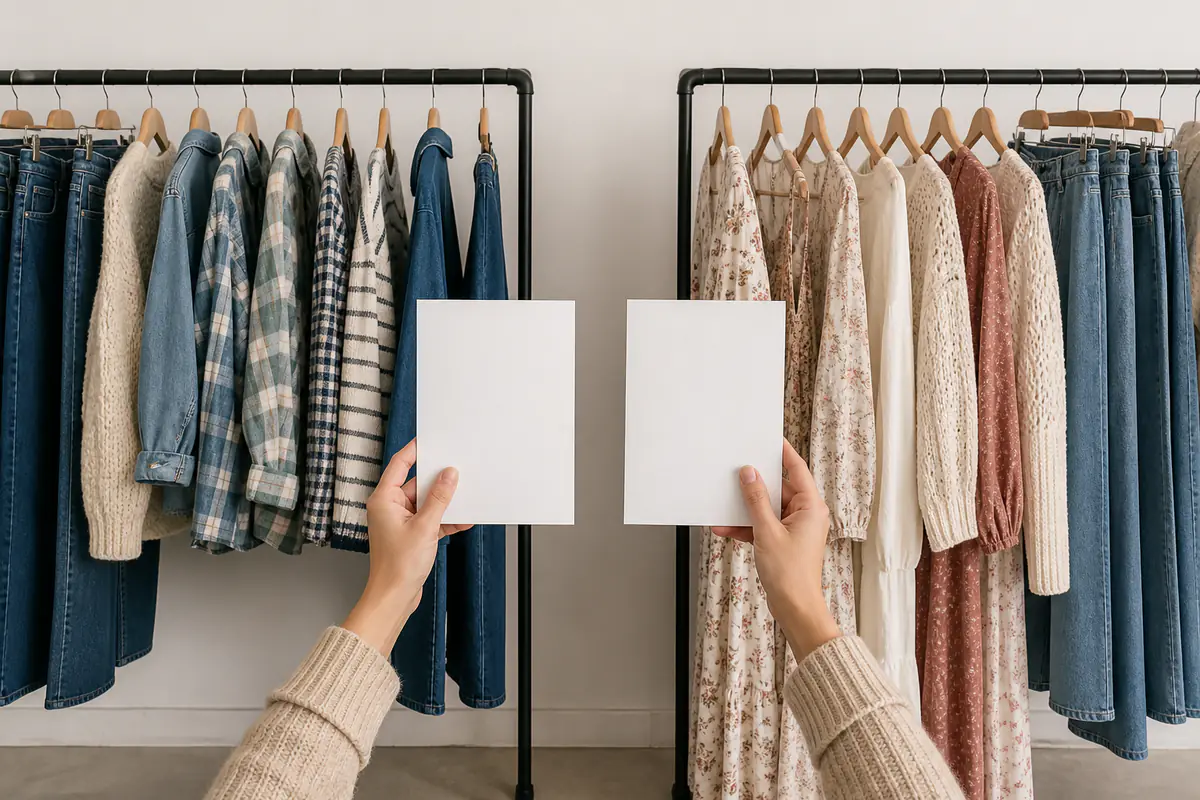
In this guide
Choose by product evidence and the wardrobe job, not by aesthetic identity
Urban Outfitters may offer broader brand variety; Free People may offer deeper expression within one womenswear direction. Neither difference proves fit, quality or value. Match silhouette, material, construction, final cost and return route on the same date.
Read the Urban Outfitters UK profile and Free People UK profile, then compare fit with clothing sizing charts.
| Question | Urban Outfitters | Free People | Deciding evidence |
|---|---|---|---|
| Range structure | Own labels, exclusives and third-party brands | Focused womenswear labels and categories | Exact brand and garment role |
| Fit | Varies strongly by brand and cut | Varies by silhouette and product | Chart, measurements and movement |
| Detail | Trend, basics and accessories | Drape, texture and embellishment emphasis | Construction and care |
| Returns | UK portal plus category/store conditions | UK portal plus eligible store returns | Live order route and proof |
Matched-retailer comparison file
- Define one wardrobe role.
- Choose candidates of equal construction.
- Save both product references.
- Compare relevant garment dimensions.
- Record full materials and care.
- Build two final UK baskets.
- Read both return routes before ordering.
- Inspect arrivals with one protocol.
Compare one garment job, not two storefronts
Choose a precise question such as relaxed straight jeans, a lined occasion dress, a textured everyday knit or a jacket for a defined temperature and layer. Broad website comparisons reward range and imagery rather than suitability.
Set essential fit dimensions, fibre limits, care, colour, delivery deadline and retained budget. A candidate that fails a non-negotiable should leave the comparison before promotion or brand preference is scored.
Use range structure as a search filter
Urban Outfitters combines own labels and third-party brands, while Free People presents a more concentrated bohemian womenswear identity. Those structures influence discovery but do not establish which exact garment is better made.
Record the actual product brand at Urban Outfitters and the precise Free People style. A multi-brand option may provide more alternatives; a focused range may provide more related cuts. Neither removes reference-level variation.
Match silhouettes before comparing sizes
A fitted Urban Outfitters third-party top and an oversized Free People tunic are not alternatives merely because both occupy the same category. Match coverage, shoulder position, body ease and finished length first.
Use the relevant chart, fit wording and a measured owned garment. Do not transfer one successful nominal size across retailers, departments or constructions.
Compare dresses at equal lining and movement
Record neckline, strap or shoulder structure, bodice length, waist placement, lining, fastening, slit and hem. Campaign movement can conceal transparency, shifting or an impractical fastening.
Test sitting, walking, reaching and stairs indoors with intended underwear and shoes. The better dress remains stable and comfortable without repeated adjustment or unplanned layers.
Match denim by geometry and fibre
Compare rise, waistband, hip, thigh, inseam, leg, hem and stretch, then apply the denim construction guide. Shared words such as wide, boyfriend or low-rise do not guarantee equal geometry.
Score fly, pockets, hardware, seams, wash and recovery separately. The winner is the pair that solves the defined fit and movement requirement, not the label with the stronger styling identity.
Compare decorative construction fairly
If the Free People candidate includes embroidery, lace or trim, compare it with an Urban Outfitters item of similar construction rather than an unlined basic. Record attachment, backing, edge finish, snag risk and care.
Decorative labour can justify a difference only when it is wearable, durable enough for the routine and visible in useful close evidence. Unknown construction should remain a risk, not receive an automatic premium.
Read complete materials and care
Save shell, lining, contrast, stretch and trim percentages for both products and interpret them with fabric composition explained. Compare construction and weight as well as headline fibre.
Reject a candidate whose cleaning, drying, pressing or storage conflicts with intended frequency. A lower price is weak value when care prevents realistic use; a higher price is not proof of longevity.
Measure product-page evidence, not image count
Score reference code, fit notes, useful dimensions, full composition, care and views that reveal front, back, side and construction. Campaign scenes and repeated angles do not answer an omitted measurement.
Ask a specific question where practical. If an essential unknown remains, price that uncertainty into return friction or choose the better-documented candidate rather than inventing equivalence.
Build two independent checkout totals
Apply only eligible offers, then add delivery and expected return cost for each final basket. Urban Outfitters and Free People publish different thresholds and services that can change without the garments changing.
Compare the cost of the kept item after any promotion reallocation. Do not add filler merely to equalise delivery because that turns a two-product comparison into two different basket decisions.
Compare delivery on the same date
Record the selected service, estimate, dispatch structure and postcode context for both baskets. Either retailer can split an order, while stock source and availability can alter the route.
Use realistic contingency for an event and save confirmations. A shorter published range is not useful if the product is not eligible or the order is processed in multiple parcels.
Return convenience needs category detail
Both retailers currently describe prepaid UK return routes and eligible store options, but conditions, exclusions and product departments matter. Compare window, starting event, portal, store eligibility, item condition and refund timing.
Keep retailer, order and parcel evidence separate. Do not assume a shared corporate family or similar portal means items can be mixed, and do not remove tags before the fit decision.
Inspect arrivals under one protocol
In the same neutral light check product identity, colour, measurements, opacity, lining, seams, hems, fastenings, trim, labels and movement. Use the intended layers and preserve return condition.
Record genuine faults promptly. Return the weaker preference candidate without extended wear rather than keeping it as an undefined backup that distorts the comparison.
Use an evidence-weighted score
Weight fit confidence, material suitability and construction first; then care, delivery, return friction and retained cost. Style preference can break a close result but should not rescue a failed essential.
A valid comparison can end with neither candidate. When both omit decisive evidence or create disproportionate trial work, wait or search a better-specified product.
Judge ownership rather than opening-day appeal
Estimate outfit compatibility, likely wears, cleaning and repair, then use cost per wear. Check the Fashion archive for garment-specific fit and care guidance.
Save the winning reference and measurements, but recheck before repeating. New colours and seasons can change material, pattern and finish even when the product family looks familiar.
Which retailer should you choose?
Its exact multi-brand option has stronger evidence
The brand, cut, material and final UK transaction solve the role with less uncertainty or a more practical return route.
Its distinctive product justifies the detail and care
The silhouette, construction and materials are better matched, and delivery and return conditions support a controlled trial.
Balanced verdict
Urban Outfitters versus Free People should be decided by one matched garment role and two dated transaction records. Range structure and aesthetic identity help discovery, but measurements, materials, delivered construction and return evidence decide suitability.
Use both retailer profiles for context, then recheck the official UK listings, checkout and return pages before purchase.
Official checks:
Urban Outfitters official UK womenswear ↗
Free People official UK clothing ↗
Urban Outfitters official UK returns ↗
Free People official UK returns ↗
Frequently asked questions
Which retailer has more brands?
Urban Outfitters uses a multi-brand edit, while Free People is more concentrated around its own womenswear families and related labels.
Which retailer has better sizing?
Neither wins universally — Match the exact silhouette, chart and relevant garment measurements rather than transferring a nominal size.
Which is better for dresses?
Compare equal lining, fastening, movement, opacity, material and care. The best option depends on the defined dress role.
Are their UK return routes the same?
No — Both currently describe prepaid UK routes, but portal, store and category conditions must be checked separately.
Which offers better value?
Compare retained cost, fit confidence, material, construction, care and realistic wear rather than average price or aesthetic position.
Methodology and limitations
We compared official Urban Outfitters and Free People UK range, product, delivery and returns information across range structure, sizing, dresses, denim, materials, decorative construction, baskets and return friction. We did not order products or claim hands-on testing.
Limitations
Stock, product detail, prices, promotions, delivery and return conditions change. This is a framework, not a permanent winner. Recheck both official UK sites on publication and purchase day.