Power banks buying guide: usable capacity, output, airline rules and recharge time
A large milliamp-hour number is not the energy delivered to a device. Compare watt-hours, conversion losses, port allocation, recharge input and traceable safety evidence.
In this guide
Buy the smallest traceable bank that covers the real outage
Convert the labelled capacity to watt-hours, allow for losses, and match each device’s input protocol to the bank’s per-port and shared output. For travel, verify the airline’s current battery rules before every journey, keep the rating legible and carry the power bank in the permitted cabin location.
Power banks combine lithium cells, conversion electronics, ports, cables and firmware. Headline capacity describes internal charge under stated conditions, while the device receives a different voltage after conversion. A useful comparison therefore starts with energy and use cases, not an imagined number of full phone charges.
Translate the specification into decisions
| Specification | Useful meaning | Missing question |
|---|---|---|
| mAh | Cell charge at a stated voltage | What voltage and usable output energy? |
| Wh | Energy measure used in travel rules | Is the rating clearly marked? |
| USB-C output | Potential charging port | Which PD/PPS profiles and maximum per port? |
| Total output | Shared power across active ports | How is it divided for each combination? |
| Input | How quickly the bank itself can recharge | Which charger and cable are required? |
| Pass-through | Input and output in one setup | Is it explicitly supported and under what limits? |
Use watt-hours to compare energy
Watt-hours equal amp-hours multiplied by nominal voltage. A bank labelled 10,000 mAh at 3.7 V is about 37 Wh internally, before conversion and operating losses. Marketing may use the cell voltage while USB output is higher, so comparing the raw mAh with a phone battery does not predict delivered charges.
Look for a manufacturer’s rated output capacity or energy at a stated voltage and load. If none is provided, use a conservative range rather than a precise promise. Temperature, cable, device state and high-power conversion all affect delivery. Our battery-claim guide explains why controlled conditions matter.
Build an outage brief
- Daily top-up: define the percentage and device, not “one charge”.
- Long journey: include phone, headphones and navigation use.
- Laptop support: record required USB PD voltage and sustained power.
- Emergency reserve: decide how long the bank may sit between checks.
- Shared household use: list the two devices likely to connect together.
- Air travel: use watt-hour rating and current airline permission as hard gates.
Add a modest margin for conversion and ageing, but do not double capacity without a use case. A bank too heavy to carry will not solve a travel problem. Weigh it with the required cables and pouch, then compare energy per carried gram only among products with credible specifications.
Match output protocol to the device
USB-C is a connector, not a single charging rate. Check Power Delivery profiles, PPS ranges where relevant, legacy protocols and each port’s maximum. A phone may accept a modest rate while a laptop requires a specific voltage and minimum power to charge during use.
Higher advertised output does not force excess power into a compliant device, but the complete bank, cable and device must negotiate correctly. Map the documented protocols and cable ratings for the complete chain. Avoid adapters or trigger cables that create unsupported combinations.
Read simultaneous output tables
A two-port bank may reduce both outputs when a second cable connects. It may reserve fast charging for one port, disable PPS, or restart negotiation. The manual should state exact combinations. “65 W total” can mean one 65 W port alone, not laptop plus phone at that rate.
Test the common pair during the return window. Confirm stable connections and ordinary device indicators without chasing an inline meter of uncertain accuracy. If inserting a second cable repeatedly interrupts the first device, decide whether that behaviour is acceptable.
Recharge time is half of readiness
Large energy storage with slow input may take most of a day to refill. Check maximum USB-C input, supported voltage/current and whether charger and cable are included. Estimate from watt-hours and input power with allowance for taper and losses, then treat the result as a range.
A small overnight charger may be sufficient for routine use; a fast input matters when turnaround is short. Simultaneous recharge and discharge can increase heat and battery stress and should be used only when explicitly supported. Do not leave a power bank charging unattended or under bedding.
Check cables as part of the system
The included cable may support only the bank’s input or a limited output. Record connector direction, length, power rating and electronic marking for high-current use. A thick or braided exterior does not prove capacity. Damaged strain relief, bent shells and unstable plugs are replacement triggers.
Carry only the cables needed and label them privately by capability. A low-power cable can make a working bank appear defective; a data-only assumption can create security or transfer surprises. Use the maker’s approved accessories where required.
Apply traceability and safety gates
Buy from a seller that identifies the manufacturer, model, responsible business, ratings and instructions. Reject spelling errors in essential markings, conflicting capacities, exposed cells, swollen cases, loose ports or unexplained heat. Check official recall sources and keep proof of purchase.
Do not open or repair a lithium power bank. Stop using it after swelling, cracking, liquid exposure, scorching, unusual smell, hissing or repeated overheating, isolate it safely away from combustible material and follow local professional disposal advice. The seller guide and quality checklist reduce avoidable listing risk.
Check current airline and airport rules
Power banks are treated as spare batteries in aviation guidance. UK CAA passenger material places power banks and spare batteries in permitted cabin locations rather than checked baggage. Capacity limits, airline approval, terminal protection, quantity and in-flight use can vary, and operators or countries can impose stricter rules.
Before every trip, read the airline’s current page and departure/transfer airport rules. Keep the Wh rating and model legible, protect ports from short circuit and pack the bank where crew instructions can be followed. Do not assume a previous flight proves permission today.
Store and cycle for readiness
Follow the maker’s storage charge, temperature and maintenance interval. A bank left full in a hot car or empty for months may age poorly. Set a reminder to inspect and top up the emergency bank, then record whether self-discharge remains normal.
Do not use a swollen bank to “run it down”. Keep it away from children and metal objects. Disposal routes differ; batteries do not belong in ordinary household waste. Use an appropriate local battery or electrical recycling point that accepts power banks.
Verify the real charging chain
A quoted maximum output is only useful when the selected port, cable and device negotiate a compatible profile. Read the per-port table rather than assuming every socket delivers the headline figure. Some units reduce output when two devices are connected, reserve their fastest mode for one connector or cannot accept fast input while supplying another device.
List the exact devices and their charging inputs, then match them to the bank and cables. A laptop that accepts USB-C charging may still require a higher power profile than a small bank provides. A phone cable designed mainly for data or low current can also become the limiting component. Treat compatibility as a documented chain, not a logo or connector-shape guess.
Store and retire the battery responsibly
Keep the bank dry, away from direct heat, crushing and loose metal objects that could contact ports. Do not leave it charging unattended on soft furnishings or inside a hot vehicle. Inspect the case and cable before travel; swelling, unusual heat, smell, leakage, impact damage or unstable charging are reasons to stop use rather than run another test cycle.
Follow the manufacturer’s storage and disposal instructions and use an appropriate battery or electrical recycling route. Do not put a lithium battery in household rubbish. Before a flight, confirm the current airline policy and keep capacity markings legible because staff may need to verify them. Travel permission is a separate question from everyday product suitability.
Which capacity route is appropriate?
Phone top-ups and daily carry dominate
Usable energy covers the defined gap, weight encourages carriage and modest output meets the devices.
Laptop or multi-device use is documented
The Wh rating, PD profiles, port allocation, cables and travel permission all fit the real scenario.
Balanced verdict
The best power bank is not the largest; it is the smallest traceable unit whose usable watt-hours and port profiles cover the outage you actually face. Include recharge time, cable capability, carry weight and current travel rules before paying.
Compare lifetime value with total cost of ownership, check device support life, and browse Tech & Audio guidance or the shop directory.
Check current official sources:
CAA passenger baggage battery guide ↗UK product recalls and alerts ↗Electrical Safety First disposal advice ↗
Frequently asked questions
How many phone charges does 10,000 mAh provide?
No exact universal number. Compare watt-hours and rated output energy, then allow for conversion, cable and device losses.
Can a power bank charge a laptop?
Only when its USB PD profiles, sustained output and cable meet the laptop’s documented requirement.
Can power banks go in checked luggage?
CAA guidance treats them as spare batteries for permitted cabin carriage; always verify the current airline rules.
Is pass-through charging safe?
Use it only when the exact model explicitly supports it and follow temperature and placement instructions.
When should a power bank be replaced?
Stop after swelling, damage, liquid exposure, unstable ports, unusual smell, noise or repeated overheating, and use an appropriate disposal route.
Methodology and limitations
We assessed power banks through energy, protocols, allocation, recharge, cables, traceability, travel, storage and disposal. Current CAA and UK product-safety sources were checked on 29 August 2026. No bank was electrically loaded or opened.
Limitations
Airline rules and product specifications change. Delivered energy depends on the complete chain. Confirm the exact model, devices and every journey on the relevant day.
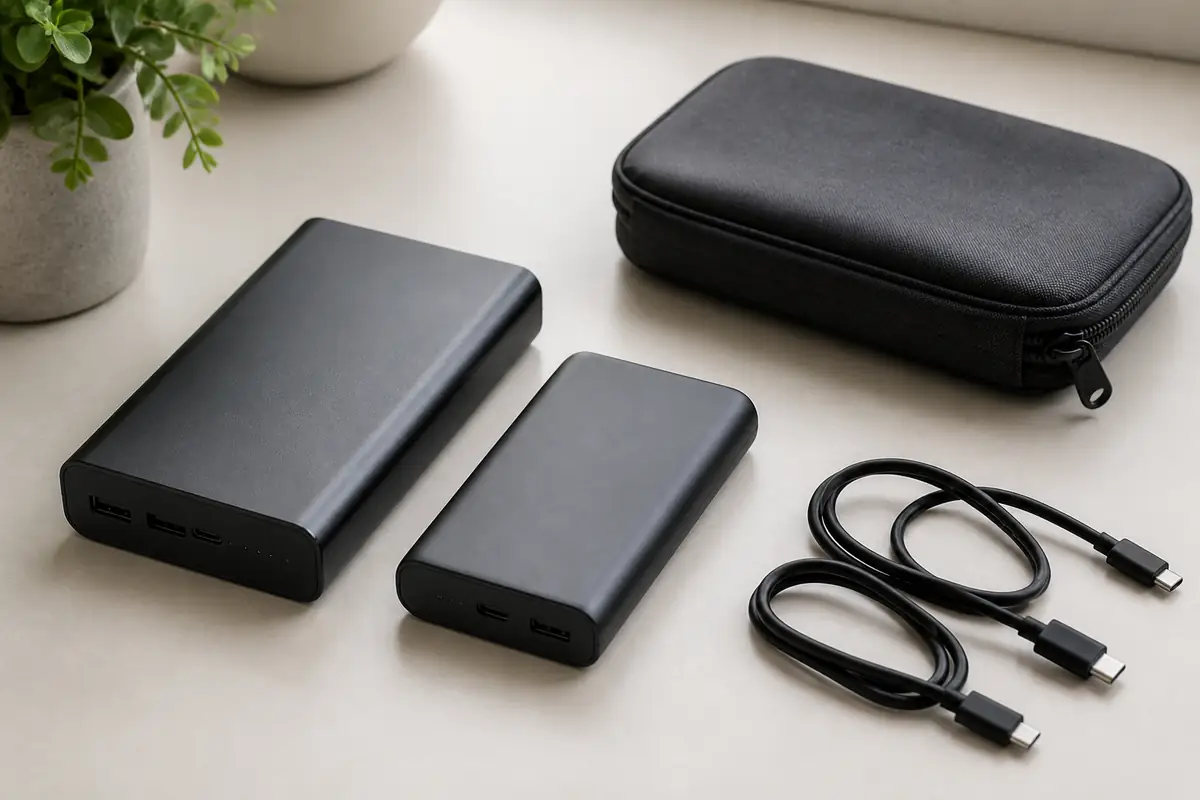
The image is an editorial illustration, not a photograph from a product test. Links are editorial and non-affiliate.